Nick Hodge,
Publisher
Sept. 10, 2026
Junior mining is a brutal business.
Most projects fail.
Most drill holes disappoint.
Most juniors run out of money before they ever get close to proving anything meaningful.
Rick Rule has been saying that for decades.
But he has also spent nearly 50 years backing one particular model he believes gives speculators a statistically better way to play exploration.
That model is called prospect generation.
I recently sat down with Rick Rule and Jeff Phillips — two of the most successful financiers and speculators in the junior resource space — to talk about exactly how that model works.
You can watch the full interview here.
The idea is simple.
Instead of putting all your money behind one junior with one project and one drill program, a prospect generator uses its technical team to generate multiple targets, then brings in larger partners to fund the expensive exploration.
Rick started with the math.
He said that when he was in university, he learned that roughly one in 3,000 mineralized anomalies becomes a mine.
That makes the typical one-project junior exploration story a tough proposition.
Prospect generators try to improve that setup by giving shareholders:
- More shots on goal
- Less dilution at the share level
- Partner-funded exploration
- Third-party technical validation
- Exposure to multiple possible discoveries
Rick also emphasized the due diligence advantage.
When a major mining company earns into a project, it has done its own technical work. It has put its own geologists, geophysicists, engineers, and capital behind the idea.
And instead of sending shareholders the bill, that partner is writing the check.
Jeff Phillips looks at the model through a capital markets lens.
He likes prospect generators because they can reduce the need for constant equity financings. But he also warned that not every company calling itself a prospect generator deserves investor capital.
He wants to see management with meaningful insider ownership.
He wants patient shareholders.
He wants technical teams with relevant experience in the exact rocks and jurisdictions they are exploring.
And he wants real partners with real balance sheets.
That led us into three companies all of us have invested in through private placements: Kincora Copper (TSX-V: KCC)(OTC: BZDLF), Headwater Gold (CSE: HWG)(OTC: HWAUF), and Latin Metals (TSX-V: LMS)(OTC: LMSQF).
Kincora Copper: Australia’s Hybrid Prospect Generator
Kincora Copper is focused in New South Wales, Australia, across the Macquarie Arc and Cobar Basin.
It is not a pure prospect generator. It is a hybrid.
The company has partner-funded exploration, but it also has the cash and technical team to advance certain projects itself.
Kincora’s Northern Junee-Narromine Belt projects are partnered with AngloGold Ashanti, which can spend up to A$100 million under earn-in and joint venture agreements.
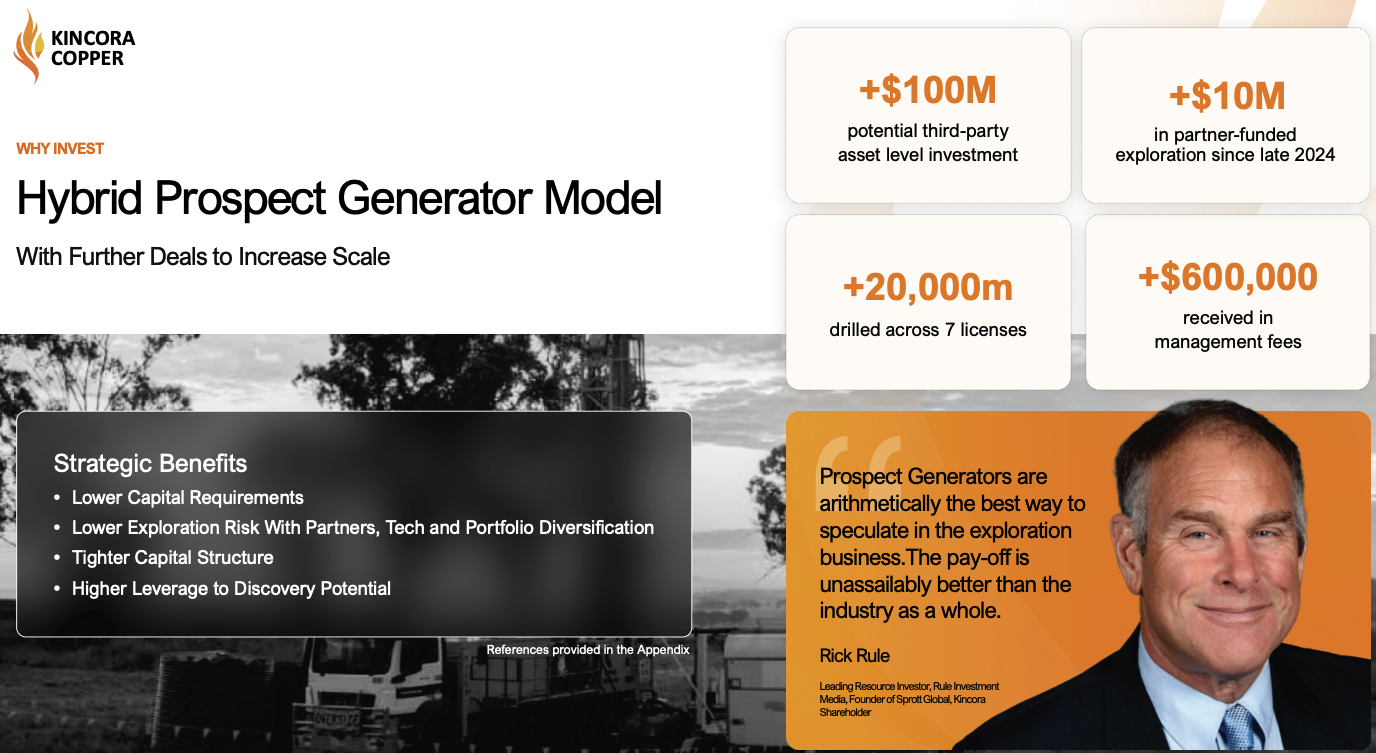
Kincora also has exposure to the Cobar Basin, where it is drilling the Condobolin project, and it has incorporated next-generation exploration tools, including Geomorphic AI, across several projects.
Jeff explained that when he first got involved, Kincora had transitioned toward the prospect generator model, cleaned up its share structure, and still had roughly 25% insider ownership.
Since then, the company has raised money at higher prices, sold a non-core Mongolian asset, increased its cash position, and continued advancing partner-funded and self-funded exploration.
Headwater Gold: High-Grade Gold in the American West
Headwater Gold is focused on high-grade gold and silver in Nevada, Idaho, and Oregon.
Its partners include Newmont, OceanaGold, and Centerra.
Newmont alone can spend up to US$115 million across multiple Headwater projects. OceanaGold can spend up to US$65 million. Centerra can spend up to US$25 million at Crane Creek.
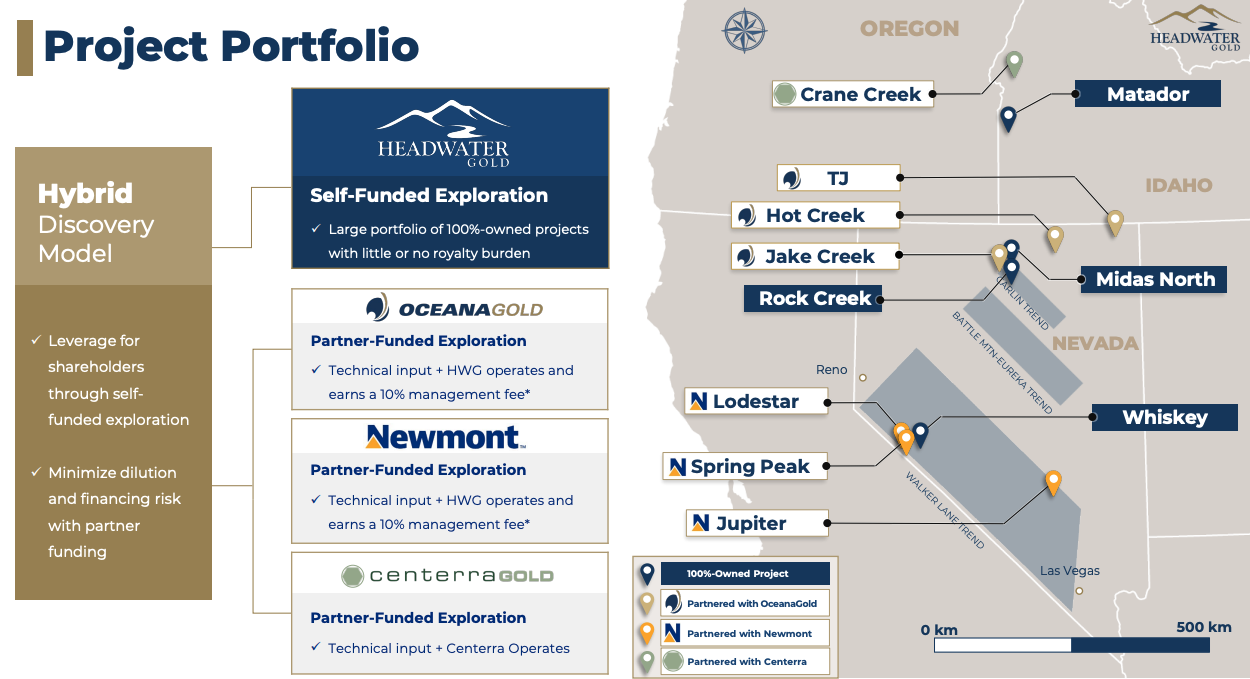
Headwater also has approximately 30% management and insider ownership.
Jeff highlighted Headwater as one of the cleaner examples of prospect-generator execution: strong insider ownership, multiple major-funded projects, and management aligned for a real discovery rather than a quick trade.
Rick said he was attracted to Headwater because the American West is capable of producing five-million-ounce-plus gold deposits, remains underexplored in certain areas, and is once again drawing serious attention from major producers that need to rebuild exploration pipelines.
Latin Metals: Multiple Shots on Goal in South America
Latin Metals is focused on copper, gold, and silver projects in Peru and Argentina.
Its current partners include Moxico Resources, Daura Gold, and Minsur.
Moxico is earning into the Zaha copper-gold project in Argentina, where Latin has reported a discovery hole from surface of 387 meters grading 0.57% copper and 0.27 g/t gold. A 15,000-meter drill program is expected this year.
Daura Gold is funding work at Cerro Bayo and La Flora, silver-gold projects in Argentina’s Deseado Massif. Initial drilling returned encouraging gold and silver mineralization, and more drilling is planned.
Minsur, one of Peru’s leading mining companies, recently optioned Latin’s Lacsha copper project in Peru. That agreement contemplates 60,000 meters of drilling over six years.
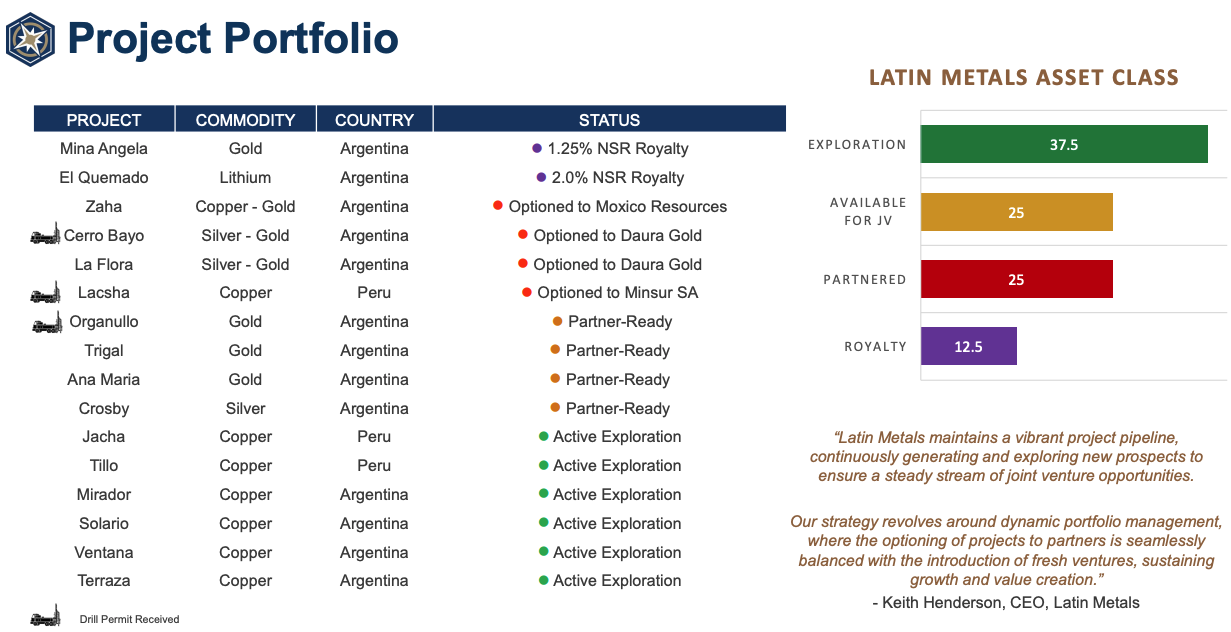
Latin Metals also has roughly 40% management and board ownership.
Jeff said he likes that Latin gives investors exposure to different jurisdictions, different commodities, and different partners. He also noted that CEO Keith Henderson has said the company aims to have most of its projects joint ventured.
That is exactly what a prospect generator is supposed to do: generate ideas, attract partners, limit dilution, retain upside.
Rick’s preferred structure is simple: he likes royalties, carried interests, or sales that compensate the generator for the time, risk, and intellectual capital that went into creating the opportunity.
He is less interested in seeing a small company forced to finance mine development on its own.
Why the Model Matters
The junior mining sector is full of lifestyle companies. It is full of expensive drill programs, constant financings, and disappointed shareholders.
Prospect generation does not eliminate risk.
The drill bit still decides.
But it can make the risk more intelligent.
Rick’s arithmetic filter is to compare the amount of partner-funded exploration being spent on behalf of shareholders against what the company spends on G&A and project generation.
Jeff’s filter is even simpler: People and structure.
- Do they know the rocks?
- Have they done it before?
- Do they own enough stock?
- Are the partners real?
- Are the projects big enough to matter?
That is the lesson from this conversation.
In junior mining, you do not want to fund every unanswered question yourself.
You want to own teams that generate questions good enough that major mining companies pay to answer them.
That is the prospect-generator model.
And it is why Rick Rule and Jeff Phillips keep writing checks.
Watch the full interview here.
Call it like you see it,

Nick Hodge
Publisher, Resource Stock Digest