Click here to read important disclaimer & disclosures Click here to see more about GreenLight Metals Inc.
Copper-Gold in the American Heartland
TSX-V: GRL | OTCQB: GRLMF
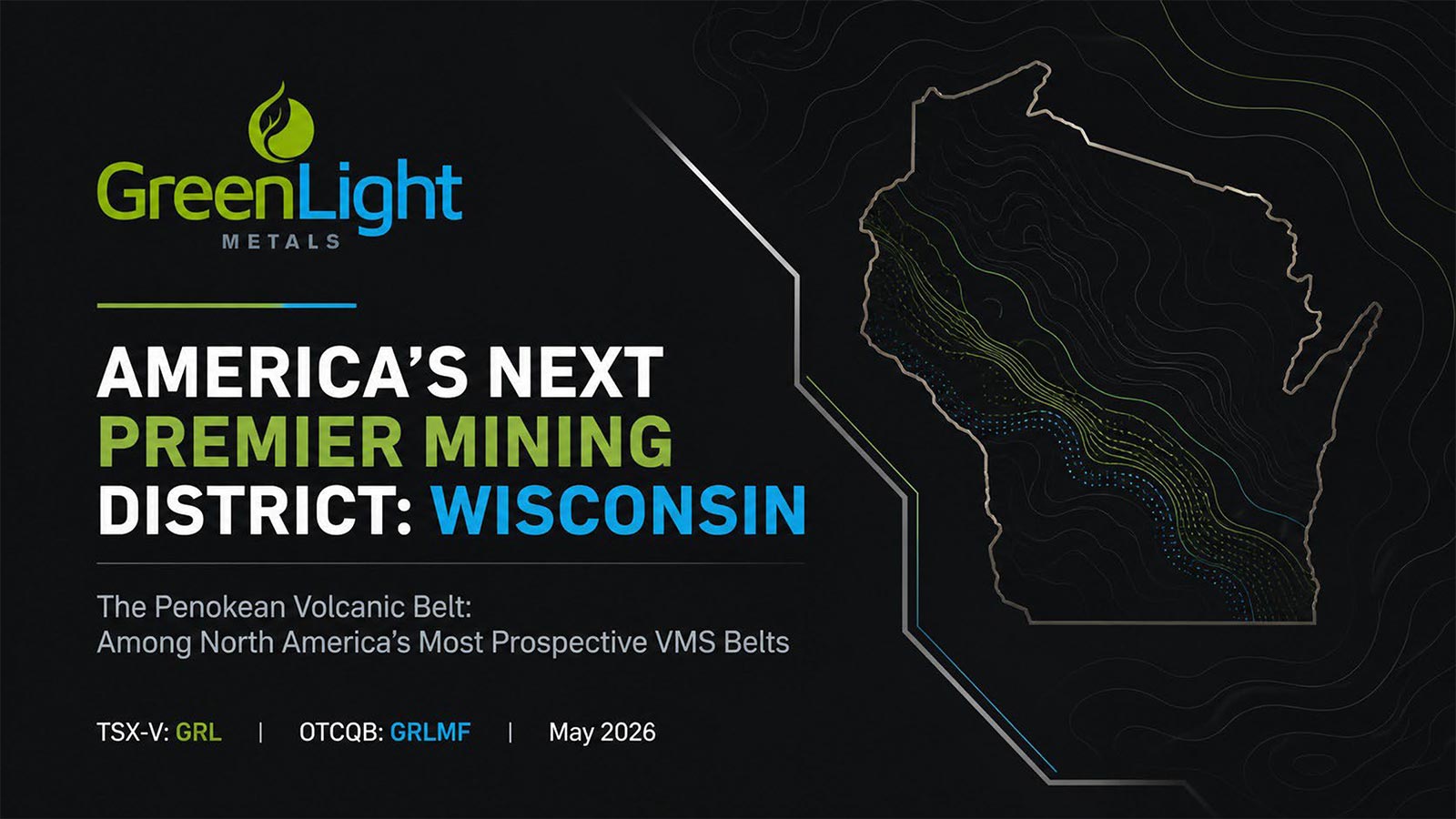
Reawakening a Forgotten
North American VMS Belt
District-Scale Copper-Gold in Wisconsin’s Penokean Volcanic Belt
— Shares Currently Below C$0.50 —
ULTRA-RICH COPPER-GOLD VMS SYSTEM
EXPANDING AT BEND PROJECT
Drilling Confirms Scale, Continuity & Key Metals Mix
— Phase-2 Drilling Underway Now —
Click Here to Read Sponsor Disclosure
First-Mover Critical Metals Drill-Play
in Tier-1 US Jurisdiction
GreenLight Metals Inc. (TSX-V: GRL)(OTCQB: GRLMF) is building what few small-cap explorers ever attempt: a true first-mover, district-scale critical minerals platform in the continental United States.
GreenLight Metals (“GRL”), with a sub-C$50 million market cap, controls two of the most prospective polymetallic exploration assets in Wisconsin’s Penokean Volcanic Belt: Bend and Reef.
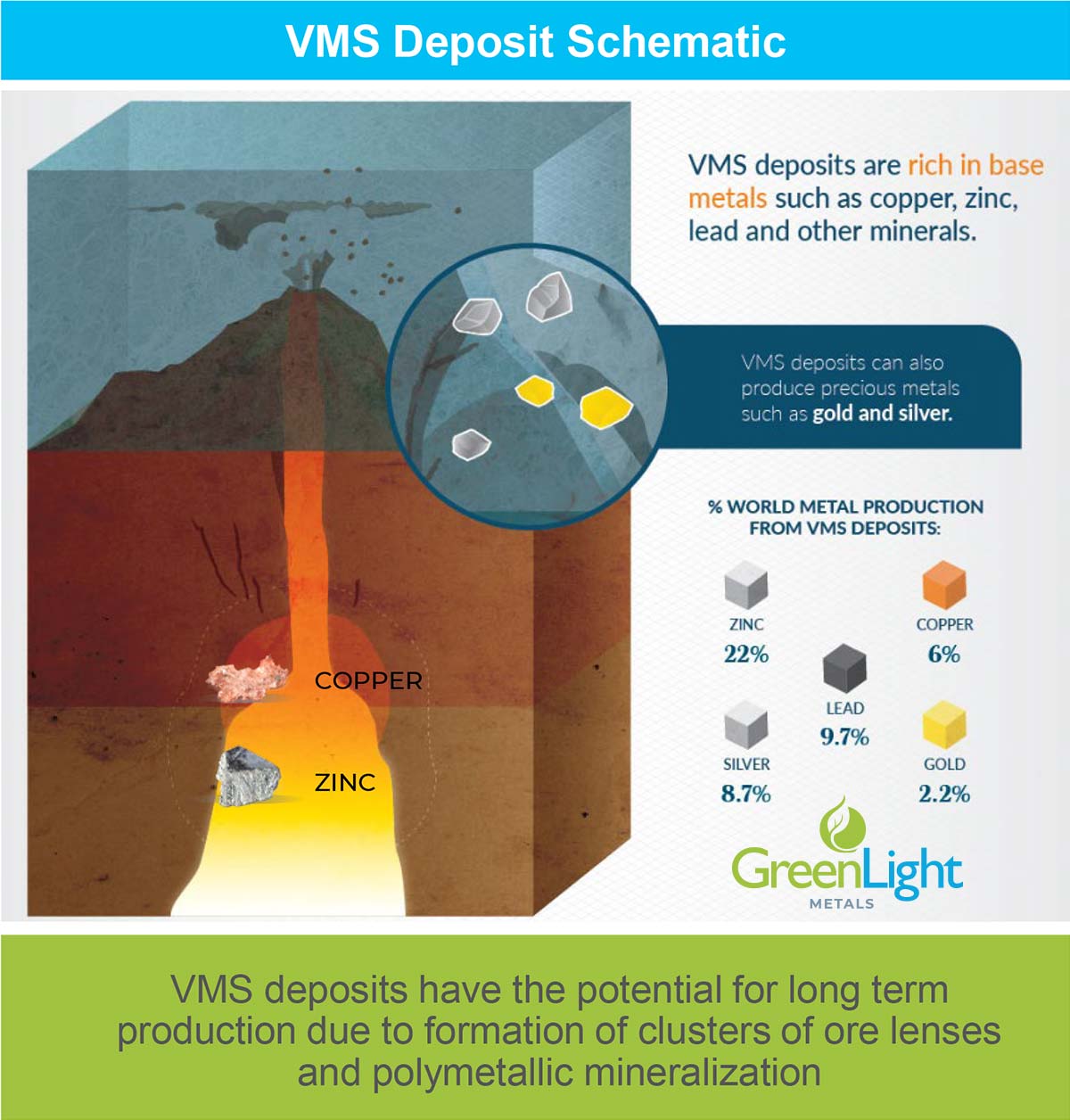
The Penokean is a prolific but long-overlooked VMS (Volcanogenic Massive Sulfide) system sharing key geological traits with Canada’s famed Abitibi and Flin Flon belts before major discoveries unlocked their full potential.
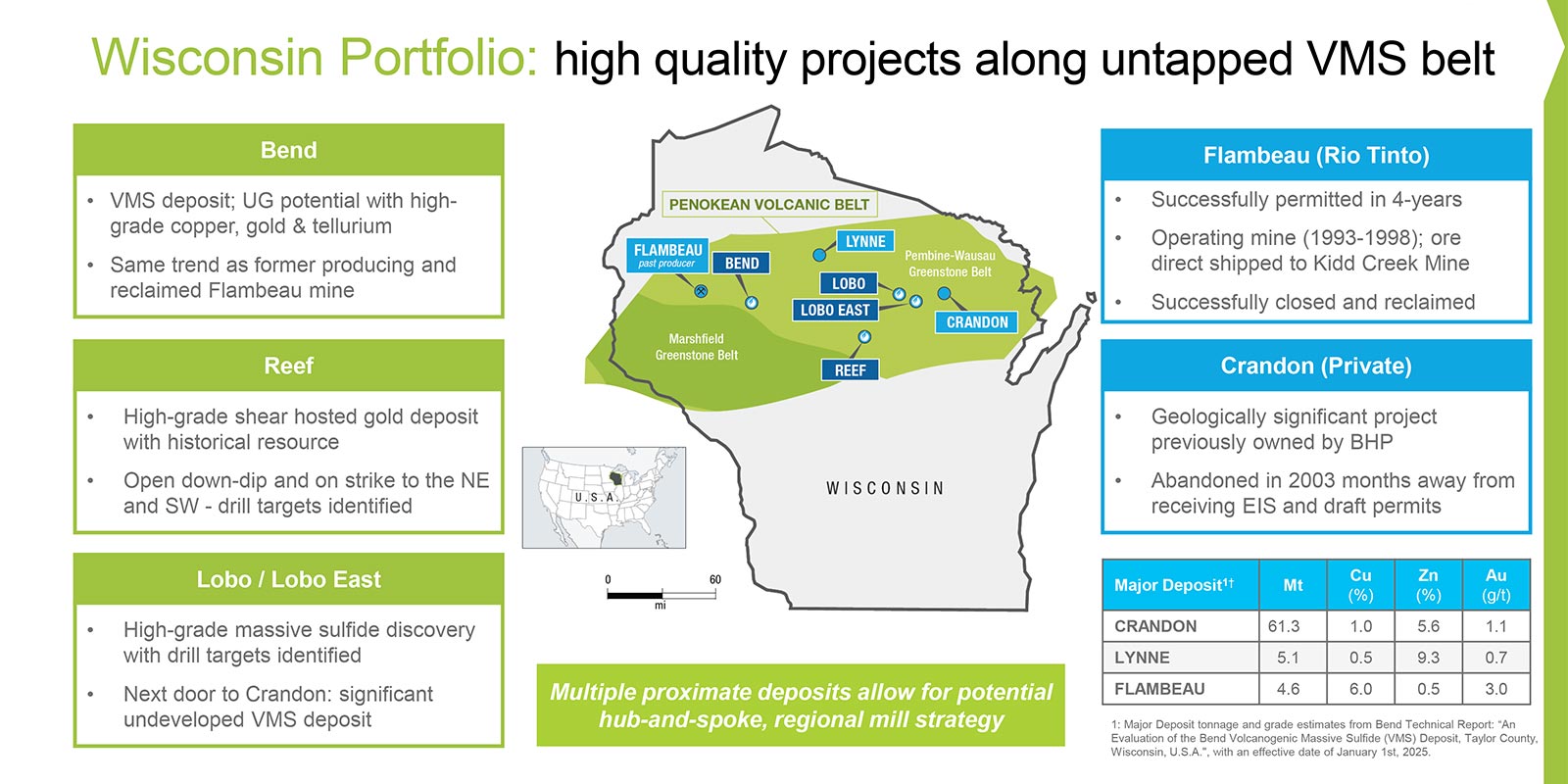
Historically, the Penokean belt has demonstrated its ability to host high-grade copper-dominant VMS mineralization, including past-producing deposits — a rich discovery path never fully realized due to regulatory constraints rather than geological limitations.
What distinguishes this moment from those more established Canadian belts is timing — a decisive advantage for GreenLight Metals as 2026 gets underway.
With US policy now prioritizing domestic critical minerals supply, GRL is executing a first-mover strategy to become a central player in America’s critical metals resurgence — and in the process, re-establish Wisconsin as a national leader in critical minerals production.
For two-plus decades, Wisconsin remained closed off to modern non-ferrous mining under a state-level moratorium, effectively blocking exploration, sidelining major discoveries, and freezing capital investment.
That all changed for good in 2017 when the moratorium was lifted, the permitting framework modernized, and the door reopened to responsible exploration and development.
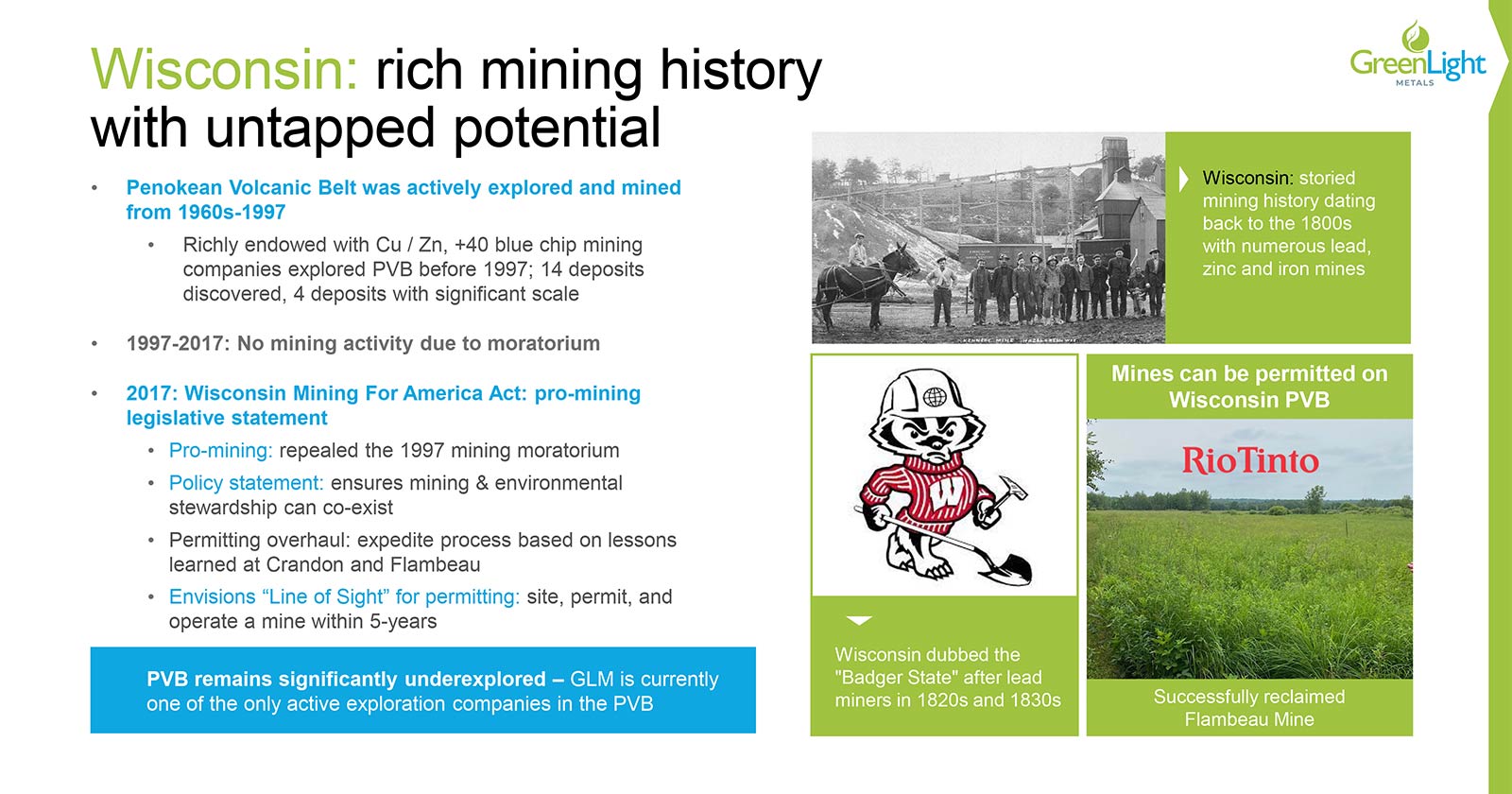
GreenLight Metals — recognizing Wisconsin’s reopening as a once-in-a-generation reset in a world-class yet long-forgotten mining district — set its wheels in motion, consolidating high-quality exploration assets, securing strategic land positions, and assembling a team with deep technical expertise across exploration, permitting, and capital markets.
When GRL listed publicly in April 2025, it did so with a robust portfolio of Wisconsin-based exploration assets in the Penokean Volcanic Belt ready for advancement.
At the center of that portfolio sits the Bend project — a copper-gold VMS system with more than US$8 million already invested by prior operators, over 22,000 meters of historic drilling, and early indications of strategic metals such as tellurium (a critical mineral used in advanced solar technologies) — now positioned for systematic expansion.
GreenLight’s advancement of Bend in Q1 2026 has moved swiftly from Phase-1 drilling success to targeted Phase-2 step-out drilling.
Following the receipt of all required regulatory approvals from the Wisconsin Department of Natural Resources and the US Forest Service for drilling on a 40-acre private mineral estate in February 2026, GreenLight has mobilized two diamond drill rigs to Bend and has commenced Phase-2.
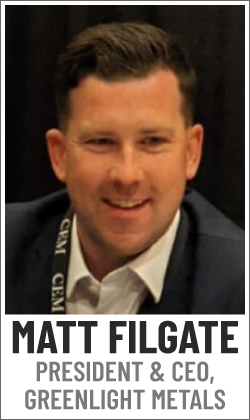
As GreenLight Metals president & CEO Matt Filgate — whom you’ll meet shortly in our exclusive interview just ahead — stated via press release:
“Hole B26-007 continues to show continuity in both grade and thickness below hole B25-004, returning 30.7 meters of 2.49% CuEq2 including 14.9 meters of 3.65% CuEq. Every hole drilled in Phase 2 to date has intersected significant VMS mineralization, and the massive to semi-massive sulfide lenses logged in B26-008, B26-009, and B26-010 tell us the system continues to build along strike to the east. With two rigs turning and pending assays on three holes, GreenLight is positioned to continue advancing the Bend Project through the Phase 2 program as the copper market continues to strengthen.”
Anchoring that momentum, GreenLight recently completed a C$11.5 million financing, strengthening the balance sheet and supporting this next critical phase of drilling.
Beyond Bend, GRL has assembled an impressive pipeline of accretive regional assets — including Reef and Lobo & Lobo East in Wisconsin — while Kalium Canyon adds Nevada Walker Lane gold exposure through a proposed staged earn-in and joint venture with Barrick.
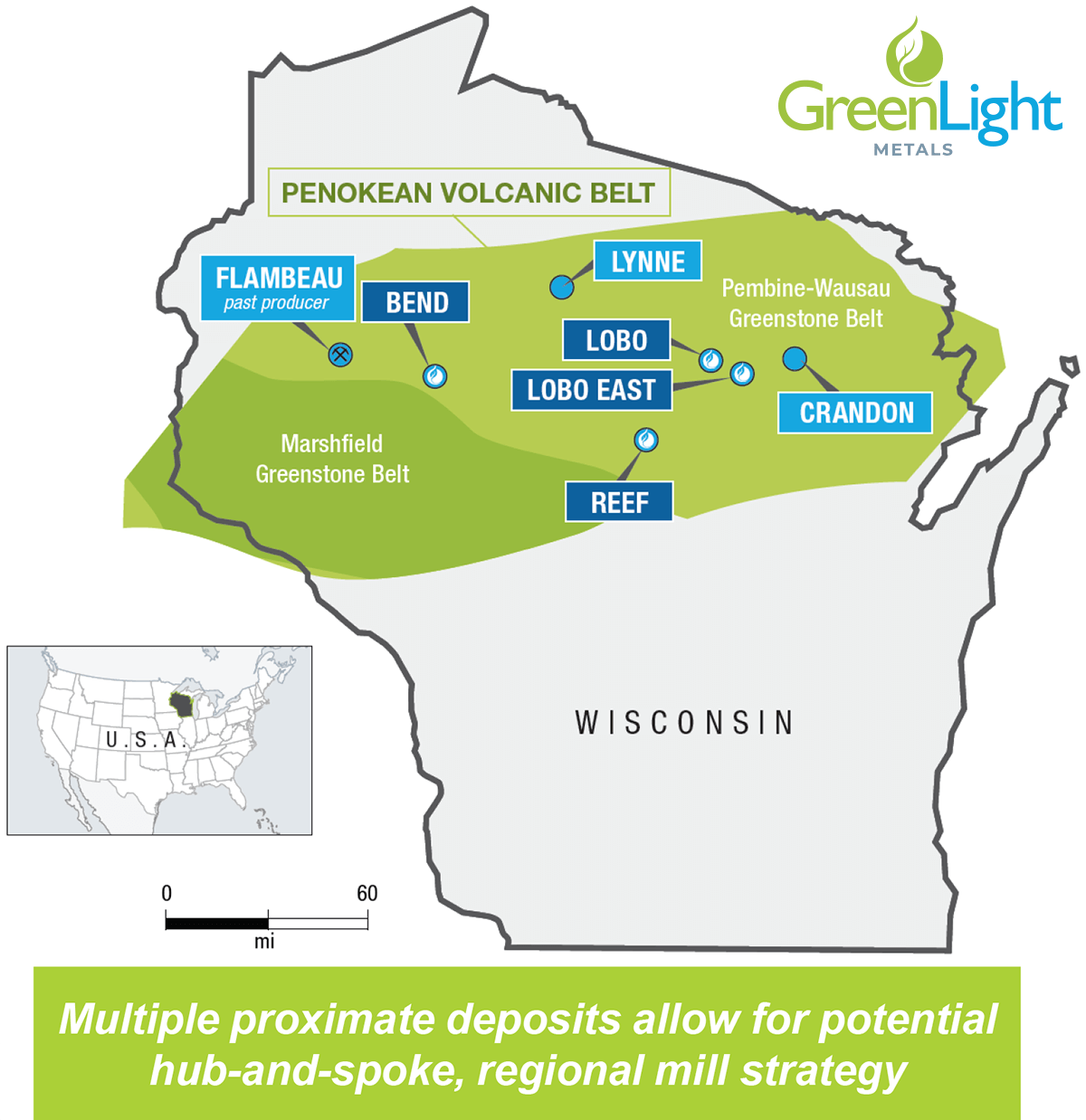
Together, these elements underscore the strategic convergence of timing, jurisdiction, and execution now taking shape at GreenLight Metals.
With metals markets increasingly favoring high-grade, US-based discoveries, let’s take a closer look at the flagship Bend project — the copper-gold VMS system anchoring GRL’s district-scale strategy in Wisconsin’s newly reopened Penokean Volcanic Belt.
Flagship Bend Project: VMS System with Multi-Rig, Phase-2 Drill Program Underway
The flagship Bend project anchors GreenLight Metals’ portfolio as an exploration-stage copper-gold VMS system now advancing through an expanded, multi-rig Phase-2 drill campaign.
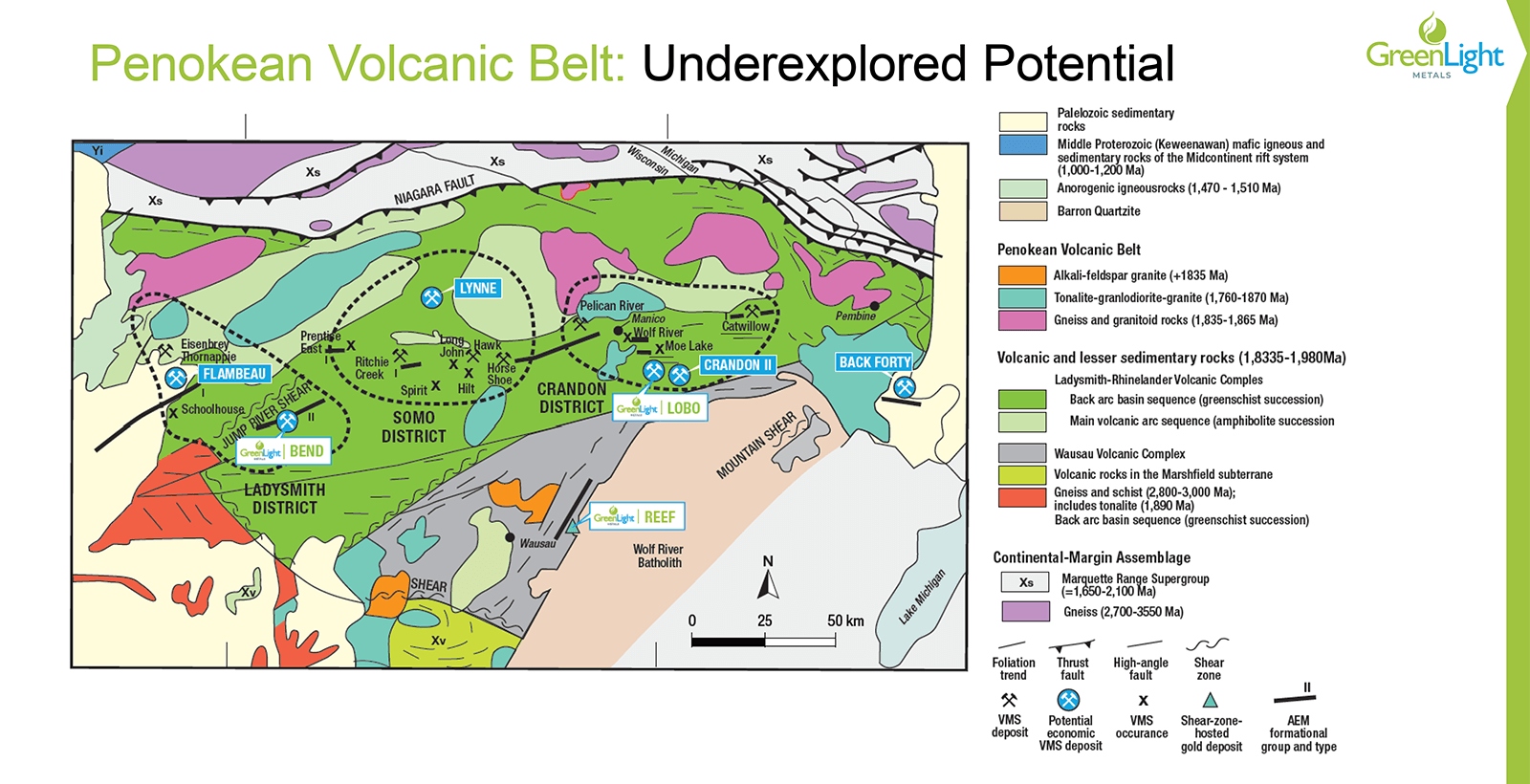
Bend Copper-Gold Project Highlights
- 100%-owned copper-gold-silver VMS (Volcanogenic Massive Sulfide) system characterized by steeply dipping stacked massive and semi-massive sulfide lenses; successful Phase-1 drill program completed in 2025 by GreenLight Metals.
- Strategically situated within northern Wisconsin’s Penokean Volcanic Belt (~35 miles from the past-producing Flambeau Mine).
- More than US$8 million invested by prior operators; ~22,000 meters of historic drilling across ~50 holes.
- Supported by a historical estimate of approximately 4.0 million tonnes (the “1992 JRJV historical estimate”).1
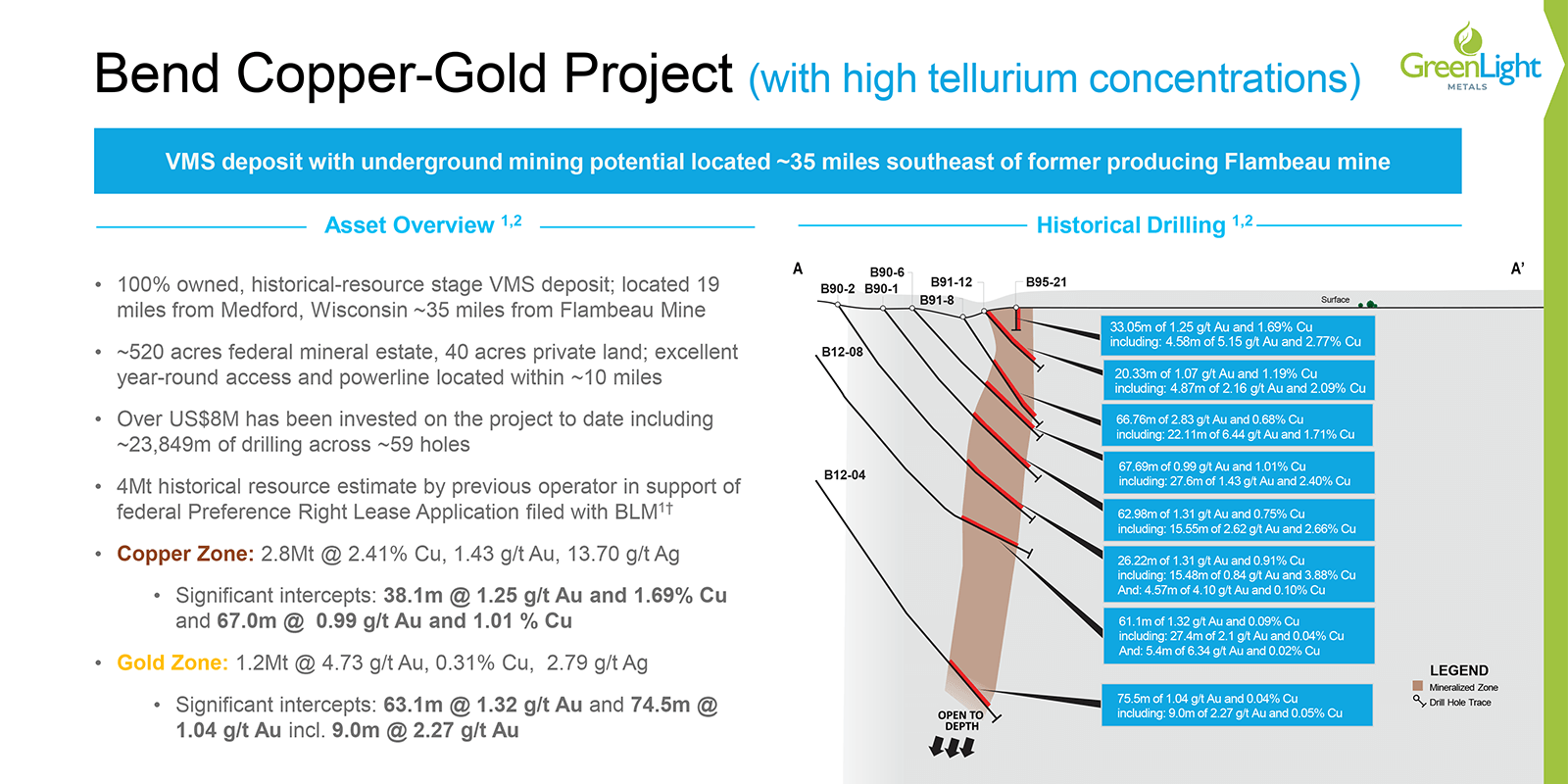
- Mineralization traced over ~330 meters of strike and ~600 meters of vertical extent.
- Large portions of the system historically untested along strike and down-plunge.
- Year-round access with nearby roads, power infrastructure, regional services, and rail adjacency.
Importantly, the historic resource estimate noted above provides valuable geological context as the GRL team advances Phase-2 step-out drilling.
As management notes, Bend compares favorably in grade and geological character to other more advanced North American VMS systems; however, geological similarities to other VMS systems are not necessarily indicative of similar economic outcomes at Bend, and readers are cautioned not to draw conclusions about Bend’s potential from such comparisons.
Solving the Historic Bottleneck
Historically, Bend was constrained not by geology but by access, with fragmented land ownership leaving large portions of the system untested.
GreenLight addressed that constraint directly by consolidating key mineral rights and securing permits, enabling step-out drilling beyond the limits of historic programs for the first time in decades.
Phase-1 Drilling: Technical Validation Ahead of Phase-2
Phase-1 drilling (completed in 2025) targeted several previously untested mineralized extensions at Bend, delivering clear technical validation heading into Phase-2:
- All 6 drill holes from Phase-1 intersected copper-rich VMS mineralization.
- Massive and semi-massive sulfide zones confirmed with mineralization increasing in both grade and thickness as drilling advanced down-plunge.
- Hole B25-004 intersected 34.25 meters averaging 3.74% copper equivalent (CuEq),2 including 22.24 meters of 3.02 grams per tonne (g/t) gold and 2.03% copper (5.27% CuEq); high-grade zone of 7.41 g/t gold over 6.10 meters; Visible Gold (VG) observed at ~290 meters depth; significant tellurium values encountered.
- Note on drill intervals: Unless otherwise stated, drill intercepts reported for the Bend Project are drilled/core lengths and may not represent true thickness. Estimated true thickness varies by hole and interval and, where available, is disclosed in the related Company news releases. Estimated true thickness is generally 75–85% of drilled thickness.
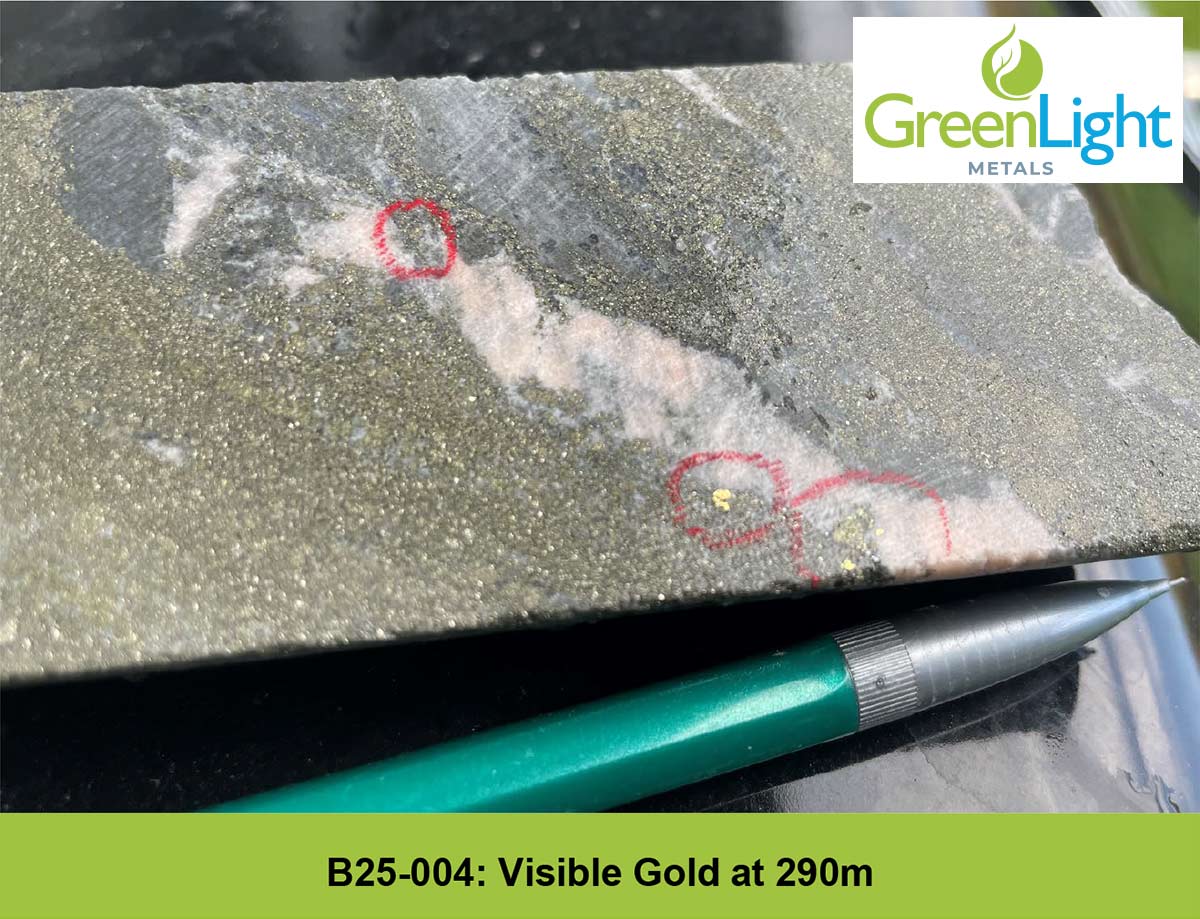
- Consistent mineralization characterized as a plunging VMS system — a hallmark of VMS deposits that typically expand through successive, deeper drill stages.
Following the completion of Phase-1, GreenLight Metals president & CEO Matt Filgate stated:
“The completion of our Phase-1 program marks a significant milestone for the Bend project with all six holes successfully intersecting mineralization and confirming our geological model. The results from B25-006 are particularly encouraging — the intercept shows both increased thickness and robust grades approximately 65 meters down-dip from B25-005, continuing the pattern of strengthening mineralization we’ve observed throughout this program. The consistency of these results, combined with the presence of high-grade copper and gold across multiple holes, reinforces our confidence in the deposit’s expansion potential.”
Building on that confidence, the results confirm continuity of mineralization, orientation, and expansion potential — all core requisites for advancing the project toward a future Mineral Resource Estimate in a disciplined, technically sound manner.
Phase-2 Drill Program Underway with Initial 2026 Results
Building off the success of Phase-1 — and with key permits in hand — GreenLight has commenced a fully funded, multi-rig Phase-2 drill program at Bend totaling up to approximately 7,000 meters across up to 15 permitted drill pads.
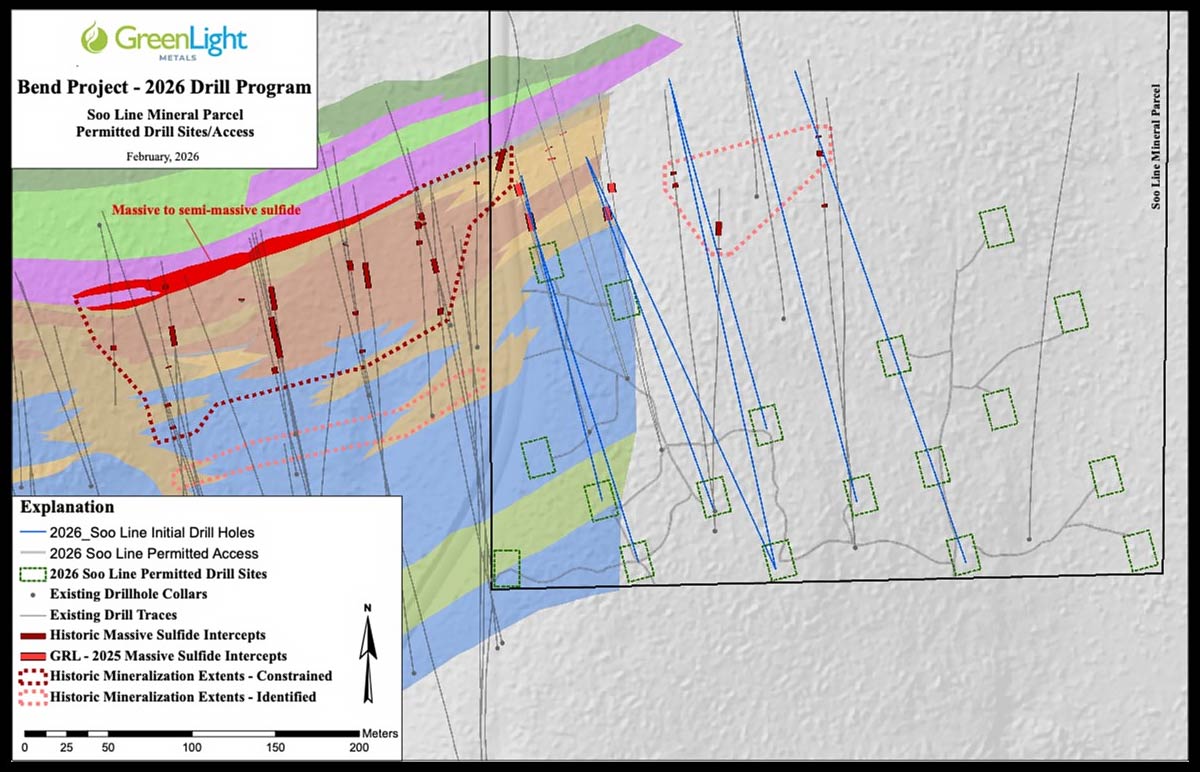
Initial Phase-2 results include B26-007, which returned 30.7 meters of 1.05% copper, 1.34 g/t gold, 11.49 g/t silver and 139 g/t tellurium (2.49% CuEq) from 330.59 meters, including 14.9 meters of 1.95% copper, 1.58 g/t gold, 20.57 g/t silver and 227 g/t tellurium (3.65% CuEq) from 338.85 meters. The program is testing down-plunge and down-dip extensions of the high-grade copper-gold-tellurium system with the aim of delineating additional high-grade zones as the company advances toward a modern NI 43-101–compliant Mineral Resource Estimate (MRE).3
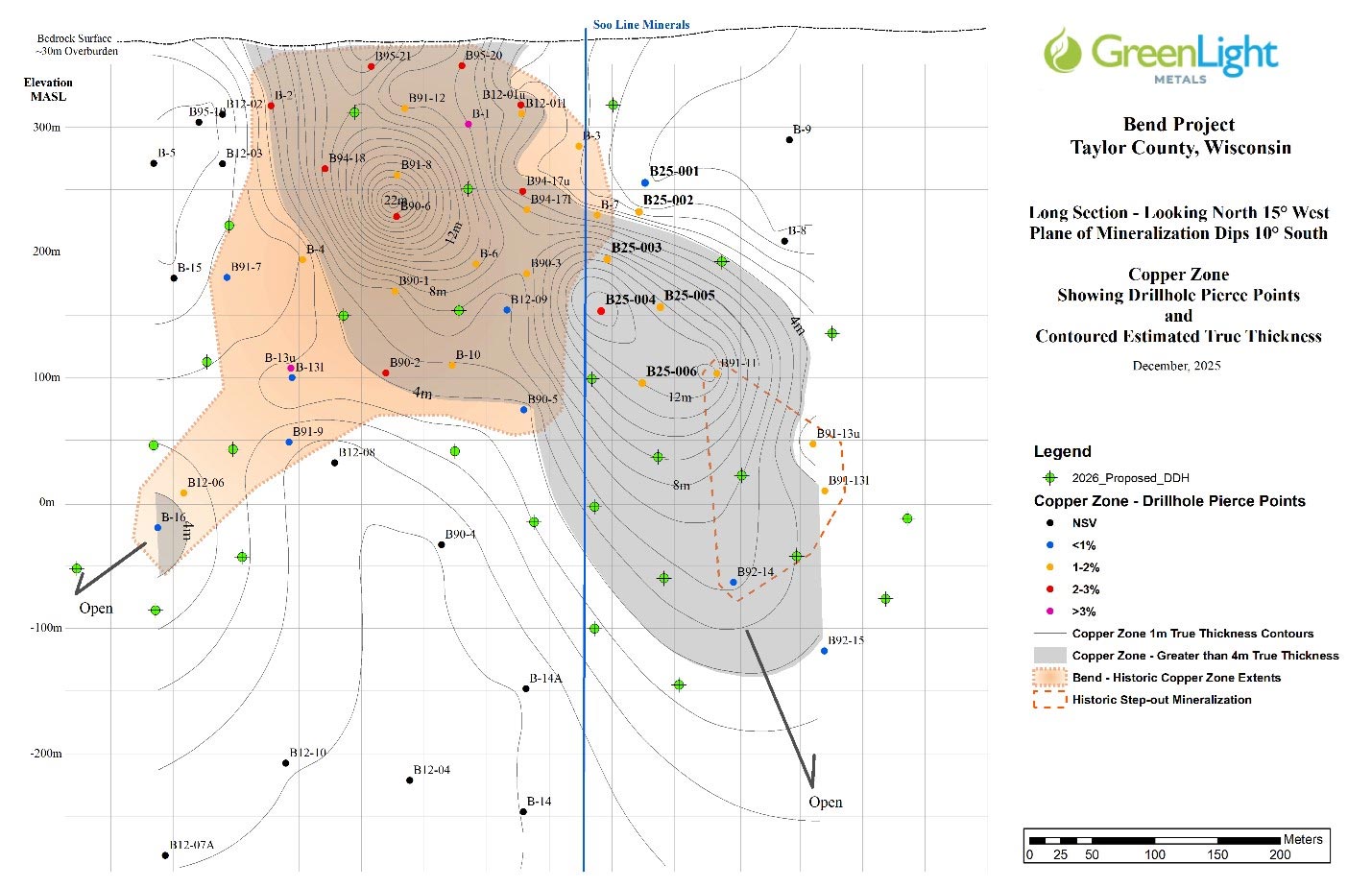
As of the Company’s April 27, 2026 update, the planned initial 4,000-meter portion of the permitted 7,000-meter Phase-2 drill program was progressing, with two rigs turning and assays pending for holes B26-008 through B26-010.
Modern Exploration Advantage
Phase-2 will incorporate Borehole Electromagnetic (BHEM) surveys, enabling real-time 3D plate modeling designed to optimize targeting precision.
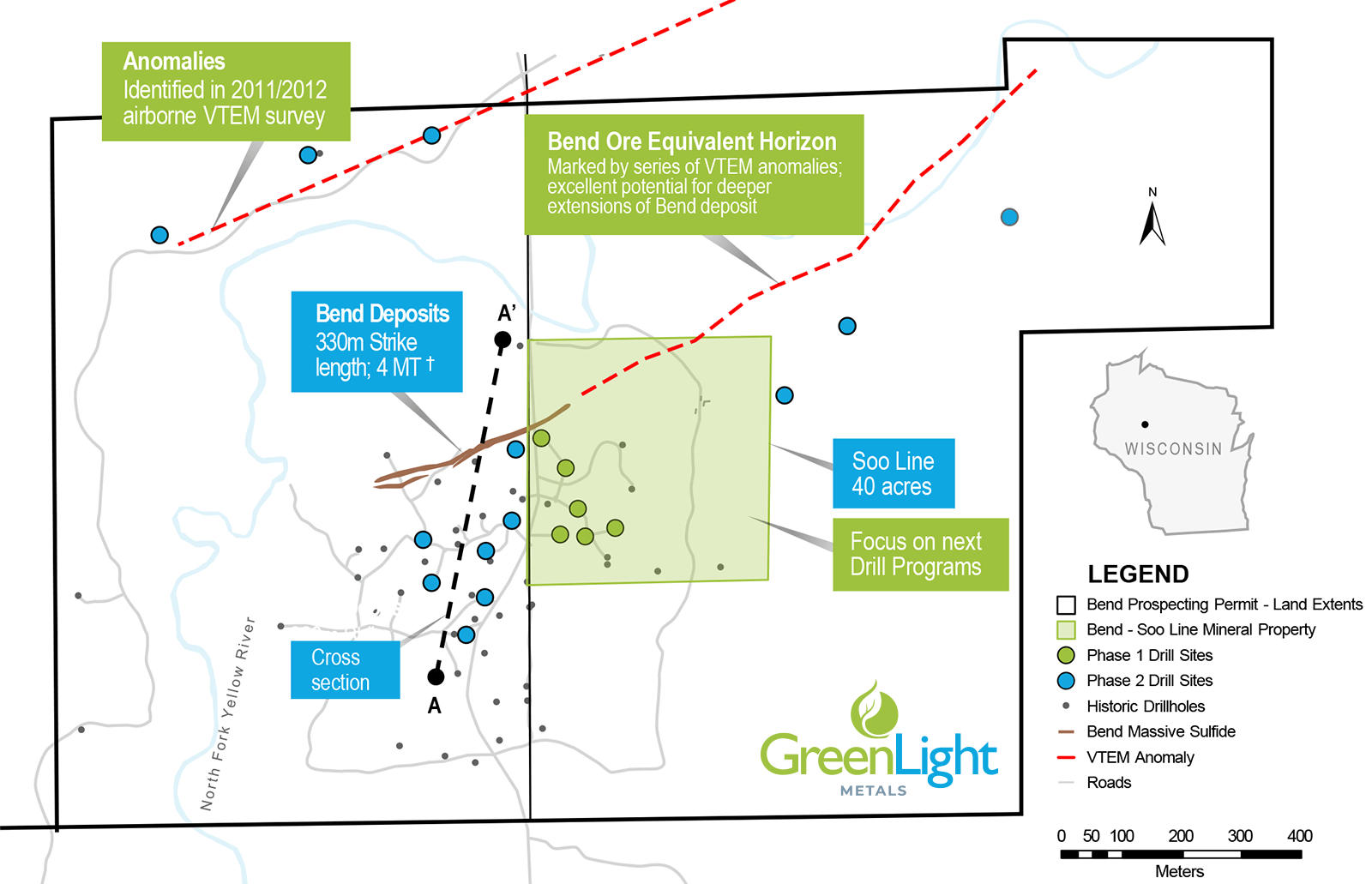
That integration of active step-out drilling and simultaneous downhole geophysics represents a powerful technical advantage for the GRL team in Phase-2:
- Faster vectoring toward mineralized zones
- Improved targeting efficiency
- Increased probability of follow-up success
As noted earlier, GreenLight has reengaged Taconite Drilling LLC to execute the Phase-2 program following the firm’s successful completion of Phase-1.
With Phase-2 underway and producing initial results, Bend is increasingly demonstrating the characteristics of a large, scalable VMS system aligned with GRL’s broader vision of executing a US-based copper-gold-critical-metals hub-and-spoke platform.
As the program advances, speculators can expect a steady stream of news flow, including drilling updates and assay releases.
Next, let’s dive into GreenLight’s complementary projects — Reef, Lobo, and Lobo East — further strengthening the company’s district-scale resource potential and exploration optionality across Wisconsin’s Penokean Volcanic Belt.
Expansive Discovery Upside:
Reef, Lobo/Lobo East & Kalium Canyon
With the flagship Bend project anchoring GreenLight Metals’ district-scale strategy — and with Phase-2 drilling now underway and producing initial results — the company has assembled a broader US-focused portfolio spanning copper, gold, silver, zinc, and tellurium.
These accretive assets — Reef, Lobo, Lobo East, and Kalium Canyon — add meaningful upside, strategic flexibility, and longer-term optionality across two highly prospective US mineral districts.
Reef: High-Grade Gold-Copper System with Established Footprint
The 100%-owned Reef project represents a compelling exploration-stage gold-copper exploration opportunity within GreenLight’s copper-dominant Wisconsin portfolio.
Located on private land, Reef hosts a shear-zone related system supported by extensive historic drilling and multiple high-grade intercepts, including long intervals of continuous gold mineralization.
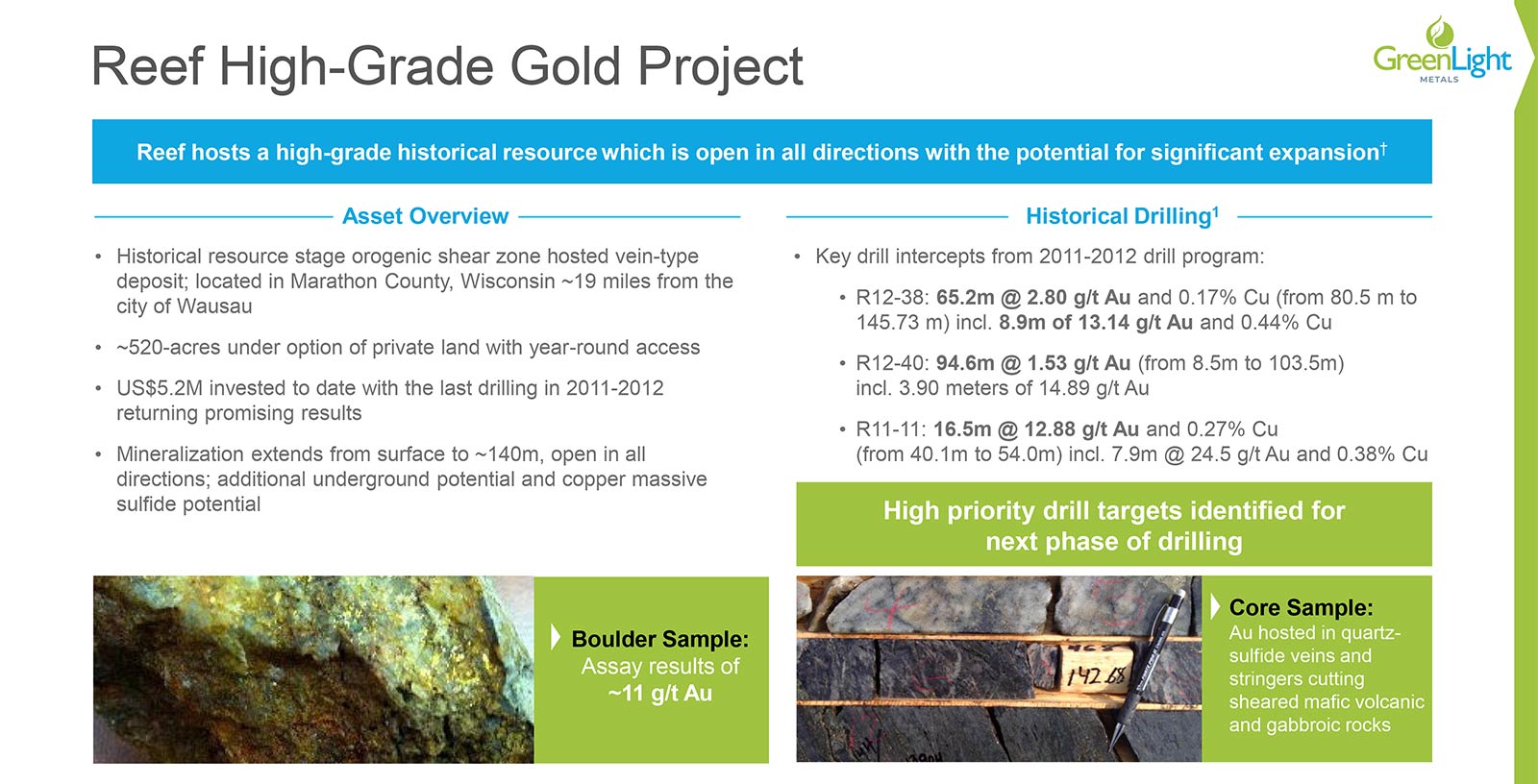
Past work outlined broad zones of gold mineralization with copper credits extending from surface to approximately 150 meters depth, remaining open along strike and at depth.4
Importantly, Reef has already benefited from millions of dollars in prior investment, providing GreenLight with a substantial technical and geological foundation.
Reef Gold-Copper Project: At a Glance
- Shear-zone hosted gold-copper system on private land
- Extensive past drilling with multiple high-grade gold intercepts and copper credits
- Broad zones of mineralization from surface to ~150 meters depth
- Open along strike and at depth
- Significant prior investment supporting a strong technical base
Current work is focused on validating and digitizing historic datasets, re-logging core, and refining geological interpretations — a disciplined approach positioning Reef for efficient follow-up drilling (~2,000 meters planned) as permitting progresses.
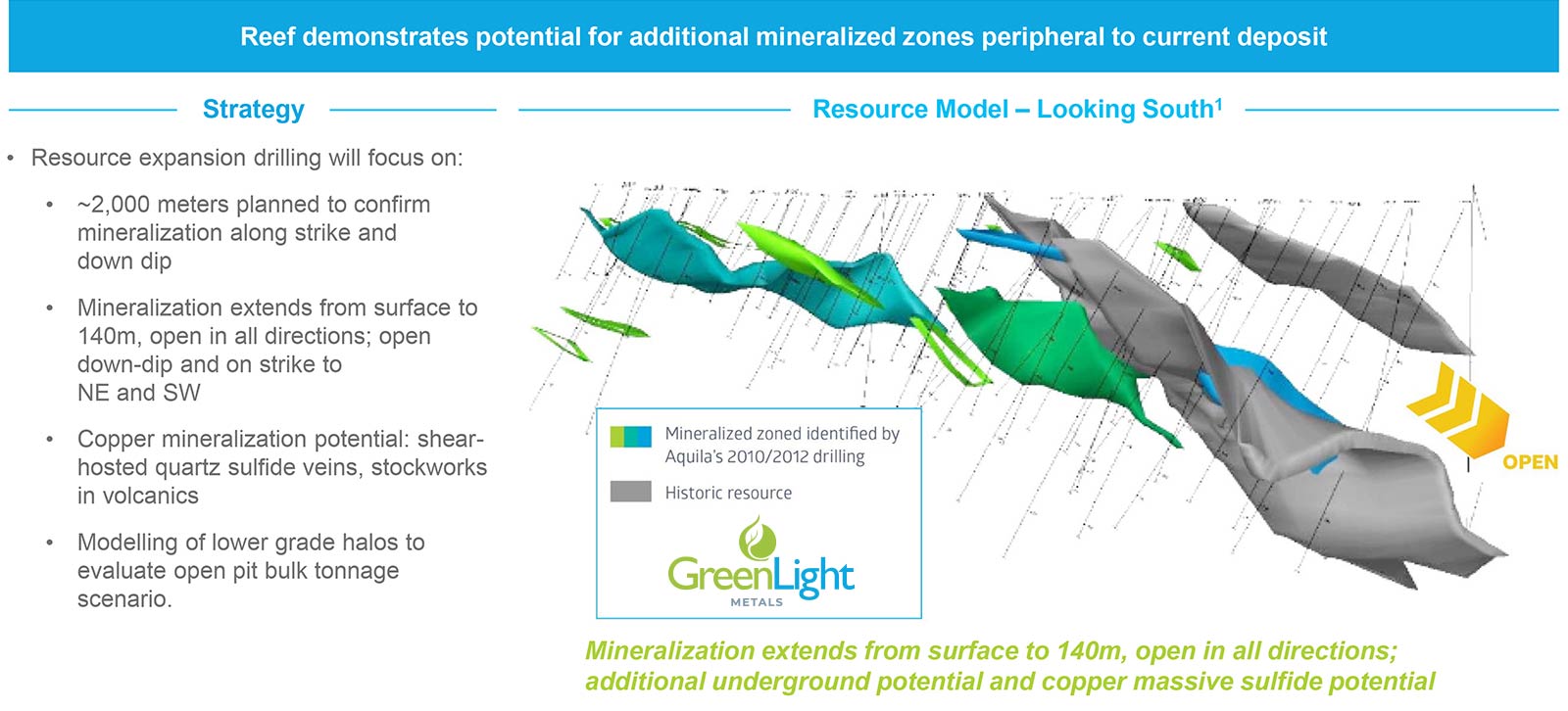
In today’s rising precious and base metals price environment, Reef adds meaningful gold-copper exposure, complementing Bend’s copper-dominant profile.
Lobo & Lobo East: High-Grade VMS Discovery Potential
The Lobo and adjacent Lobo East projects introduce a new layer of VMS-focused discovery upside to the GreenLight portfolio.
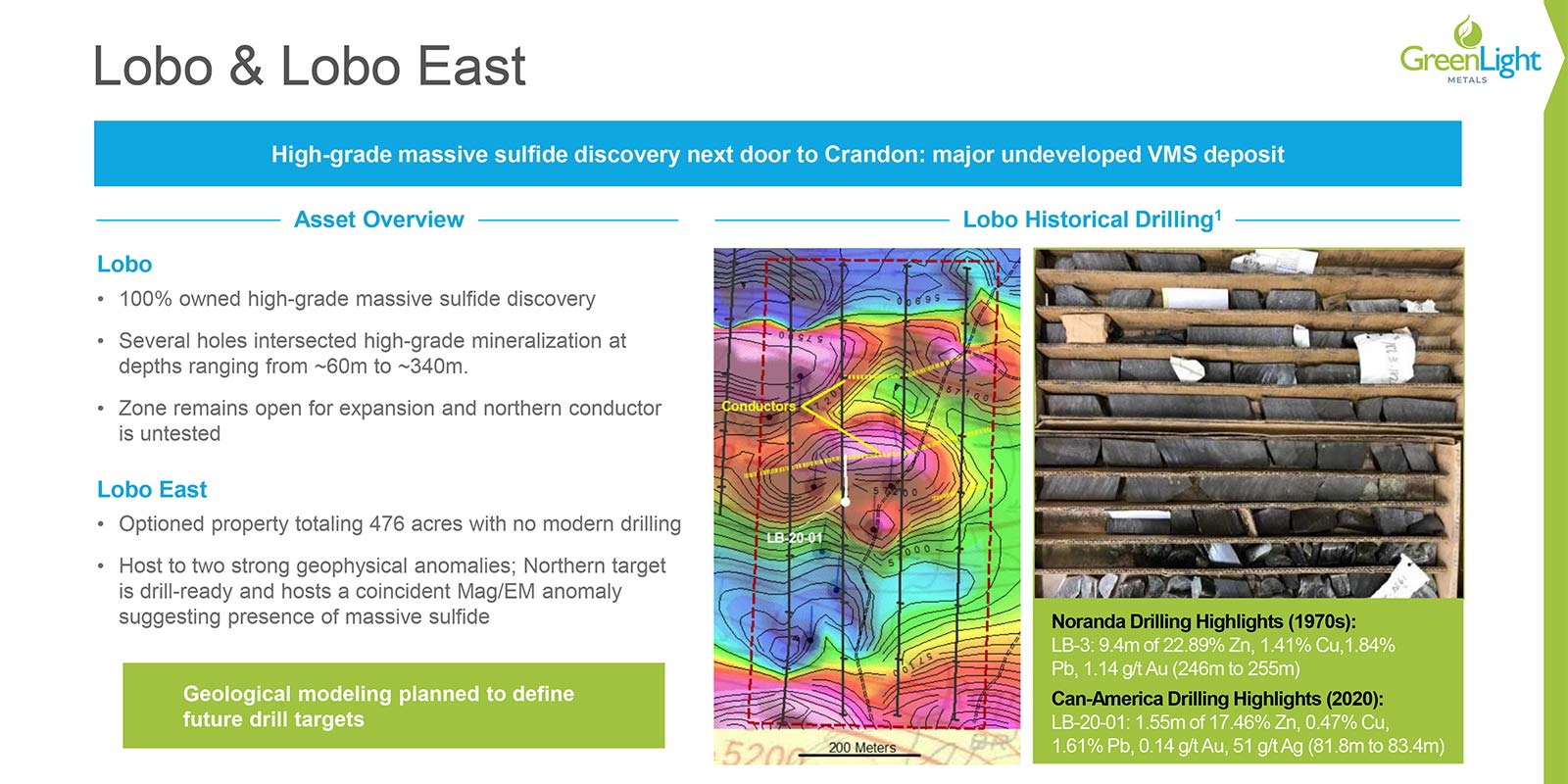
Lobo is a historic, high-grade VMS discovery located near the world-class Crandon deposit, one of the largest undeveloped VMS systems in North America.5
Past drilling at Lobo intersected exceptionally high grades, including zinc-dominant massive sulfide mineralization with meaningful copper, gold, and lead credits.6
Mineralization remains open along strike and down dip with only limited historical drilling completed.
Lobo East remains largely undrilled despite hosting strong geophysical anomalies consistent with VMS-style mineralization.
The strategically positioned project is currently advancing through baseline environmental studies and permitting.
Why Lobo & Lobo East Stand Out
- Proximity to the world-class Crandon VMS deposit
- Past drilling with exceptionally high-grade massive sulfides
- Zinc-dominant mineralization with copper, gold, and lead credits
- Mineralization open along strike and down dip
- Lobo East largely untested with strong VMS-style geophysical anomalies
Together, Lobo and Lobo East provide GreenLight with district-scale VMS discovery optionality — the kind of upside that has historically driven meaningful re-ratings upon drill-bit success.
Kalium Canyon: Walker Lane Gold Optionality with Barrick Earn-In
Kalium Canyon contains several low-sulfidation epithermal targets within the productive Walker Lane trend of Nevada. The 100%-owned property comprises 135 federal unpatented lode mining claims organized around two target areas: the historic Argentite prospect and the Kalium structural zone to the west.
On May 7, 2026, GreenLight announced that, through its wholly owned subsidiary Green Light Wisconsin LLC, it had signed a binding term sheet with a wholly owned subsidiary of Barrick Mining Corporation for a proposed staged earn-in and joint venture at Kalium Canyon. Under the term sheet, Barrick may earn an initial 60% project-level equity interest by completing US$7.5 million in qualifying exploration expenditures and making aggregate cash payments of US$1.0 million to GreenLight over a six-year Stage 1 earn-in period.
Following Stage 1, Barrick may elect to earn an additional 10% interest by funding an additional US$12.0 million over Stage 2 and, after Stage 2, may elect to earn up to an 80% aggregate interest by completing a pre-feasibility study at its sole cost under Stage 3. Although the term sheet is binding, the parties have not yet entered into a long-form agreement; completion and implementation remain subject to final documentation, applicable third-party notices, consents, waivers and other customary conditions.
Disciplined Portfolio Advancement
GreenLight continues to prioritize capital deployment and technical effort at Bend while systematically advancing Reef, Lobo, and Lobo East through targeted, lower-cost de-risking programs — including permitting, data validation, and target refinement — while the proposed Barrick earn-in provides a potential funded path for exploration at Kalium Canyon.
That disciplined, low-cost exploration model preserves multiple future pathways, including internal advancement, strategic partnerships, or joint ventures — while maintaining upside exposure across the broader Penokean Belt and Nevada’s Walker Lane.
In a market increasingly rewarding jurisdictional safety, geological scale, and strategic optionality, GRL’s multi-project, multi-metal approach delivers leverage well beyond a single-asset story.
With the broader portfolio taking shape — and with Kalium Canyon now subject to a proposed staged earn-in and joint venture with Barrick — the focus now turns to the timing behind GreenLight’s emerging hub-and-spoke strategy in one of the safest mining jurisdictions globally.
Perfect Timing: Metals, Energy Transition & US Policy
The broader metals environment is increasingly favoring the type of assets GreenLight Metals is advancing in Wisconsin’s Penokean Volcanic Belt and Nevada’s Walker Lane.
Across copper, gold, silver, zinc, and tellurium — the metals most relevant to GreenLight’s portfolio — markets are signaling sustained demand, tightening supply, and growing strategic importance tied to electrification, infrastructure investment, and domestic supply security.
Copper, gold, and silver, in particular, sit at the intersection of electrification, infrastructure buildout, and monetary uncertainty as governments and industry alike prioritize secure domestic sources of supply.
Zinc remains essential to global infrastructure through its critical role in steel galvanization. Meanwhile, tellurium demand, driven by its strategic importance in advanced solar technologies, has been in a sustained uptrend since 2022.
In that context, scale, jurisdiction, and development readiness matter more than ever.
Current Metals Prices Underscore That Shift
- Copper: Currently above US$5.75 per pound
- Gold: Currently above US$5,200 per ounce
- Silver: Currently above US$85 per ounce
- Zinc: Currently above US$3,300 per tonne
- Tellurium: Currently above US$100 per kilogram
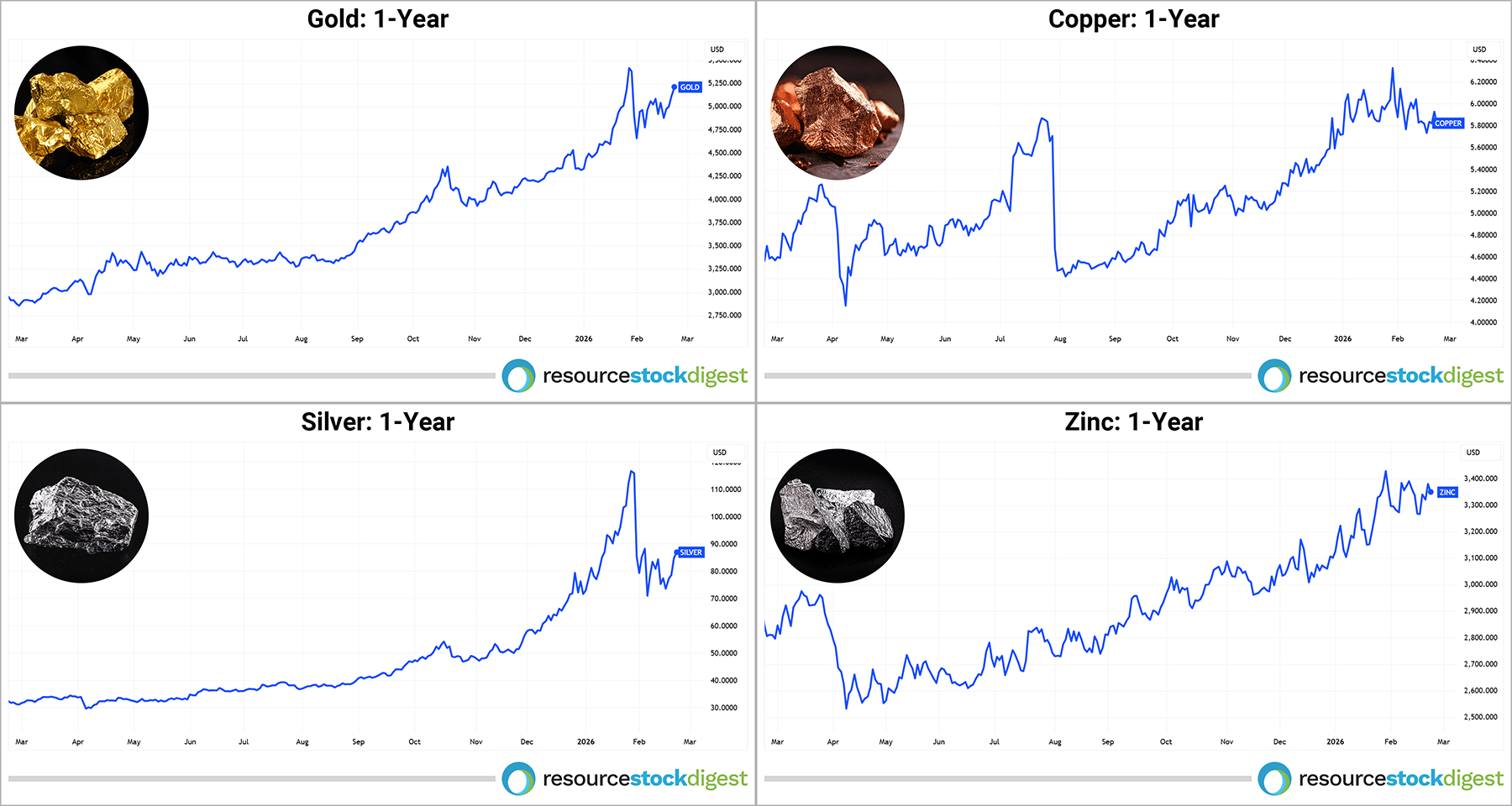
Against that backdrop, large-scale polymetallic projects in secure North American jurisdictions are becoming increasingly rare — and increasingly valuable — in today’s bullish metals environment.
VMS systems are especially relevant in this setting as they naturally host multiple payable metals within a single geological system, often delivering copper-dominant economics with meaningful gold, silver, and zinc credits.
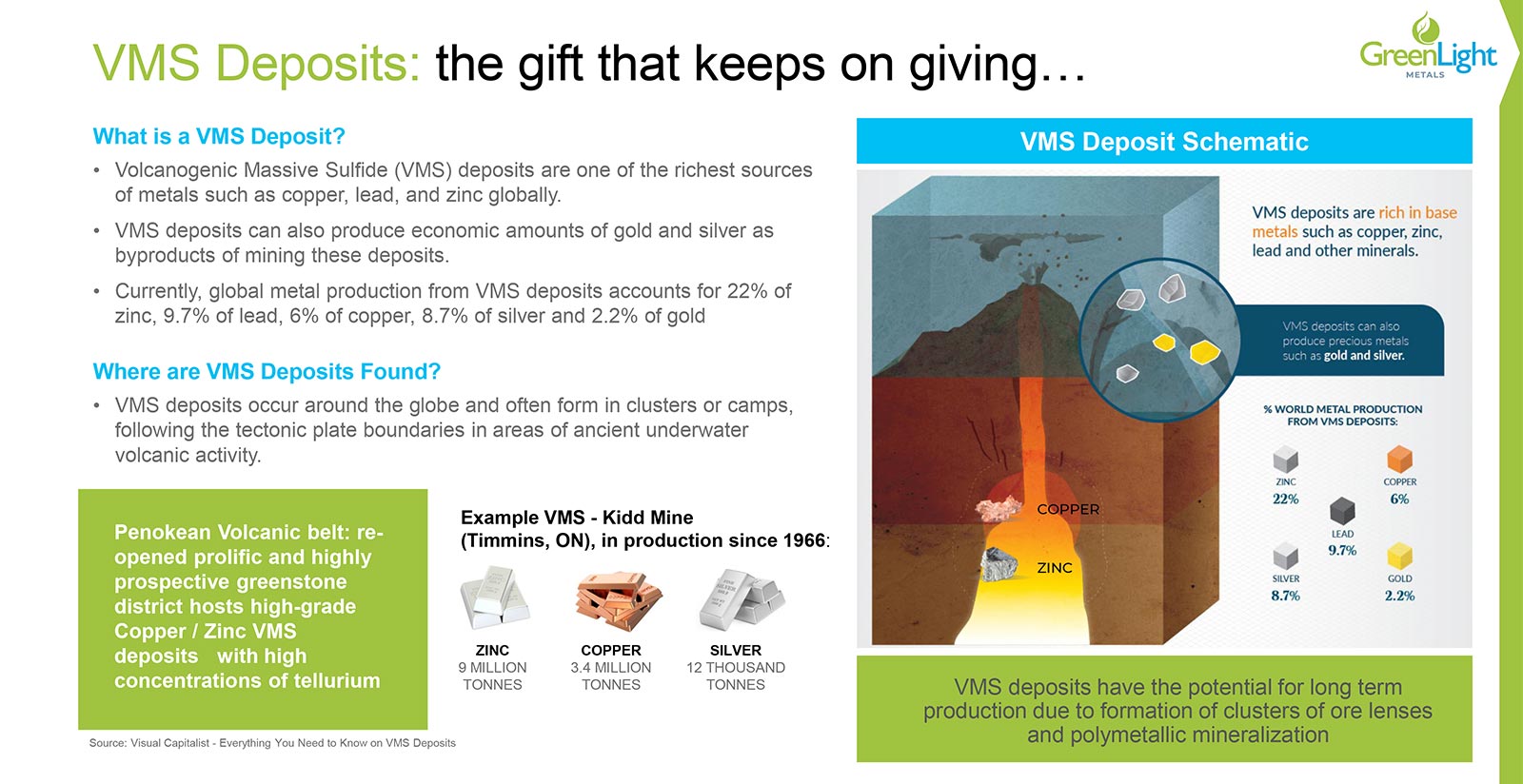
That polymetallic profile provides built-in resilience across commodity cycles, reinforcing GreenLight’s focus on the VMS-hosted Bend project along with additional VMS discovery upside at Lobo and Lobo East.
Complementing that exposure, the Reef project adds significant gold-copper optionality within the same belt, while Kalium Canyon broadens the portfolio with low-sulfidation epithermal gold exposure in Nevada’s Walker Lane.
Also noteworthy, GreenLight’s assets are located in a jurisdiction that has decisively reopened to responsible mining, supported by Wisconsin’s modernized regulatory framework — creating a favorable operating environment for small-cap explorers.
As global geopolitics continue to disrupt traditional supply chains, projects located entirely within the United States — and capable of contributing to domestic critical metals security — are commanding renewed attention.
In this setting, GRL is executing a disciplined hub-and-spoke strategy supported by accretive assets that are well aligned for the next growth phase.
As Matt Filgate explains, the company’s strategy reflects tightening copper supply alongside rising demand with additional leverage from gold, silver, tellurium, and zinc exposure across this deeply mineralized, underexplored US belt.
To that end, GreenLight is advancing multi-project exploration and resource growth with a clear roadmap toward a scalable, US-based VMS platform.
That execution-first approach is driven by a leadership team with decades of combined experience building and advancing large-scale mineral systems.
Next, we explore that perspective in our exclusive conversation with GreenLight Metals president & CEO Matt Filgate.
Exclusive Interview with GreenLight Metals
President & CEO Matt Filgate
Our own Gerardo Del Real of Resource Stock Digest caught up with GreenLight Metals president & CEO Matt Filgate to discuss the company’s rapid ascent to first-mover status in a newly reopened US critical minerals district.
Matt brings a unique blend of capital markets experience and hands-on project advancement at an ideal moment for a US-focused critical metals story.
Since taking the company public in April 2025, he has overseen rapid technical validation at Bend, strengthened the balance sheet, and positioned GreenLight for its next phase of growth.
Just as importantly, Matt has assembled a tightly focused team with deep experience spanning exploration, development, permitting, and corporate governance.
So let’s jump in as CEO Matt Filgate details why 2026 is shaping up to be a pivotal year for GreenLight Metals with drilling, resource growth, and portfolio advancement all moving forward in America’s heartland.
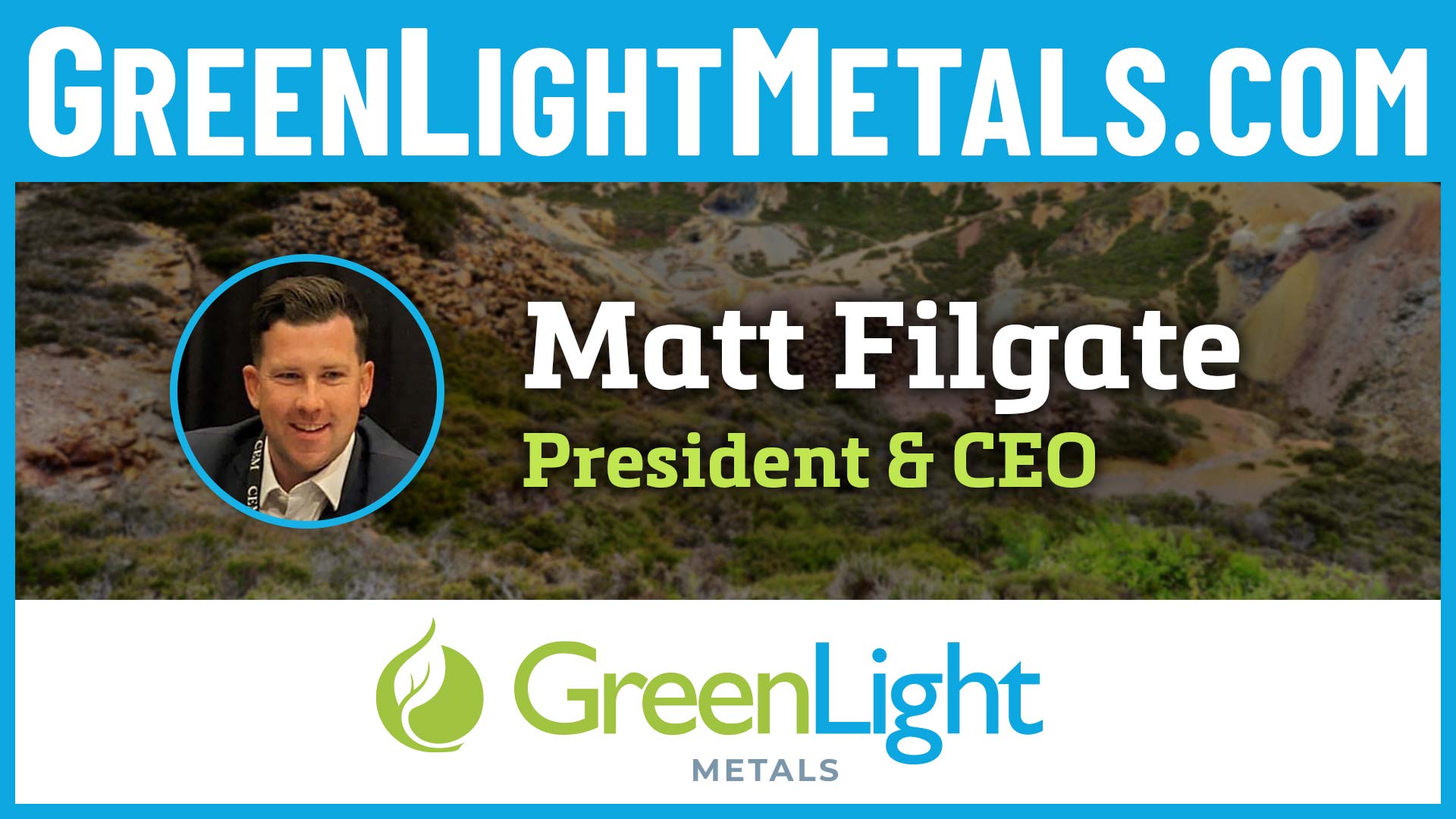

Gerardo Del Real: This is Gerardo Del Real with Resource Stock Digest. Joining me today is the president & CEO of GreenLight Metals (TSX-V: GRL)(OTCQB: GRLMF) — Mr. Matt Filgate.
Matt, it’s a heck of a time to be hitting high-grade copper in America, which is exactly what you’re doing. Congrats on a very successful initial round of assays. How are you today?

Matt Filgate: I’m great, Gerardo. Thanks for having me. And you’re right — it is a good time to be hitting high-grade copper in the US, and we’re very excited about these results coming out of Bend.
Gerardo Del Real: Well, listen, let’s talk about Bend. It’s not just copper — you also have some gold and silver, as well as some tellurium.
When you announce intercepts like 12.85 meters of 3.74% copper equivalent — consisting of 1.81% copper, 1.75 g/t gold, and 22.7 g/t silver from 257 meters — that’s a heck of a highlight.
And you’ve made it pretty clear that all of the holes you’ve drilled thus far have looked pretty darn good. Can you speak to how you’re feeling about this initial set of results and what you’re seeing in the rocks?
Matt Filgate: Yes, the first set of results came back better than expected. Holes one and two intersected mineralization higher in the system, which is why you don’t see significant thickness there; you still see some good copper grades but not great thickness.
The Bend project, moving away from the known historic resource, appears to be plunging down at about 30 to 40 degrees. Hole three tagged into that plunge very nicely with those results you just mentioned.
Hole four hit about 70 meters down-dip beneath hole three where we intersected 38 meters of mineralization, 22 meters of which was thick, 75% massive sulfide. That’s extremely encouraging. That’s the down-dip extension away from the known deposit.
The drill program was designed to demonstrate upside at Bend and show that it’s bigger than the historical (non-NI 43-101-compliant) 4 million tonne resource estimate.

For six drill holes totaling 2,000 meters, the Phase-1 program cost us just under C$1 million. We essentially added 150 meters of strike of thick, massive sulfide to the deposit. So it can grow very quickly… and we’re excited about that.
Gerardo Del Real: Matt, can you speak to the critical metals aspect of the story? I know it’s early but, as we touched on last time we spoke, there’s potential for that to become a meaningful part of the story even if the economic contribution proves minimal.
Matt Filgate: Yes, and I’m assuming you’re referring to tellurium (Te). Many VMS deposits contain a tellurium component, yet high-grade tellurium occurrences are relatively rare.
What we’re seeing at Bend are multiple samples exceeding 500 g/t Te. Within the main massive sulfide interval, we’re averaging above 350 g/t Te. For your listeners, tellurium is a key metal used in cadmium telluride (CdTe) solar panels so there’s strong demand on the critical energy side as a strategic metal.
Rio Tinto recently commissioned a tellurium-specific processing plant at its Kennecott Mine in response to increasing tellurium demand from the solar sector. So the tellurium component we’re seeing at Bend introduces potential funding opportunities at both the federal and state level as, at current prices, 500 g/t Te equates to roughly 0.05% CuEq.
While it does not have a massive economic impact on its own, it does add to the economics and, more importantly, opens up potential government-level funding mechanisms.
Gerardo Del Real: That’s exciting and the timing couldn’t be better.
Matt Filgate: Yes, and the primary goal here is to define an economic deposit at Bend — something that can become the next high-grade copper-dominant mine in the United States. That’s our focus, and we have lots of exciting exploration and news flow ahead as we advance Bend.7
Gerardo Del Real: Well, it’s a heck of a start on a project that hasn’t seen drilling since 1994. Welcome back, Bend.
Matt Filgate: Yes, welcome back, Bend. We’re excited for the future. Thank you, Gerardo. I appreciate it.
Gerardo Del Real: Thank you for your time, Matt. Let’s chat again soon.
Matt Filgate: Absolutely.
The GreenLight Metals Opportunity
GreenLight Metals Inc. (TSX-V: GRL)(OTCQB: GRLMF) enters 2026 with accelerating momentum across its project portfolio as metals markets turn increasingly supportive of high-grade, US-based projects — particularly in newly reopened, underexplored districts like Wisconsin’s Penokean Volcanic Belt.
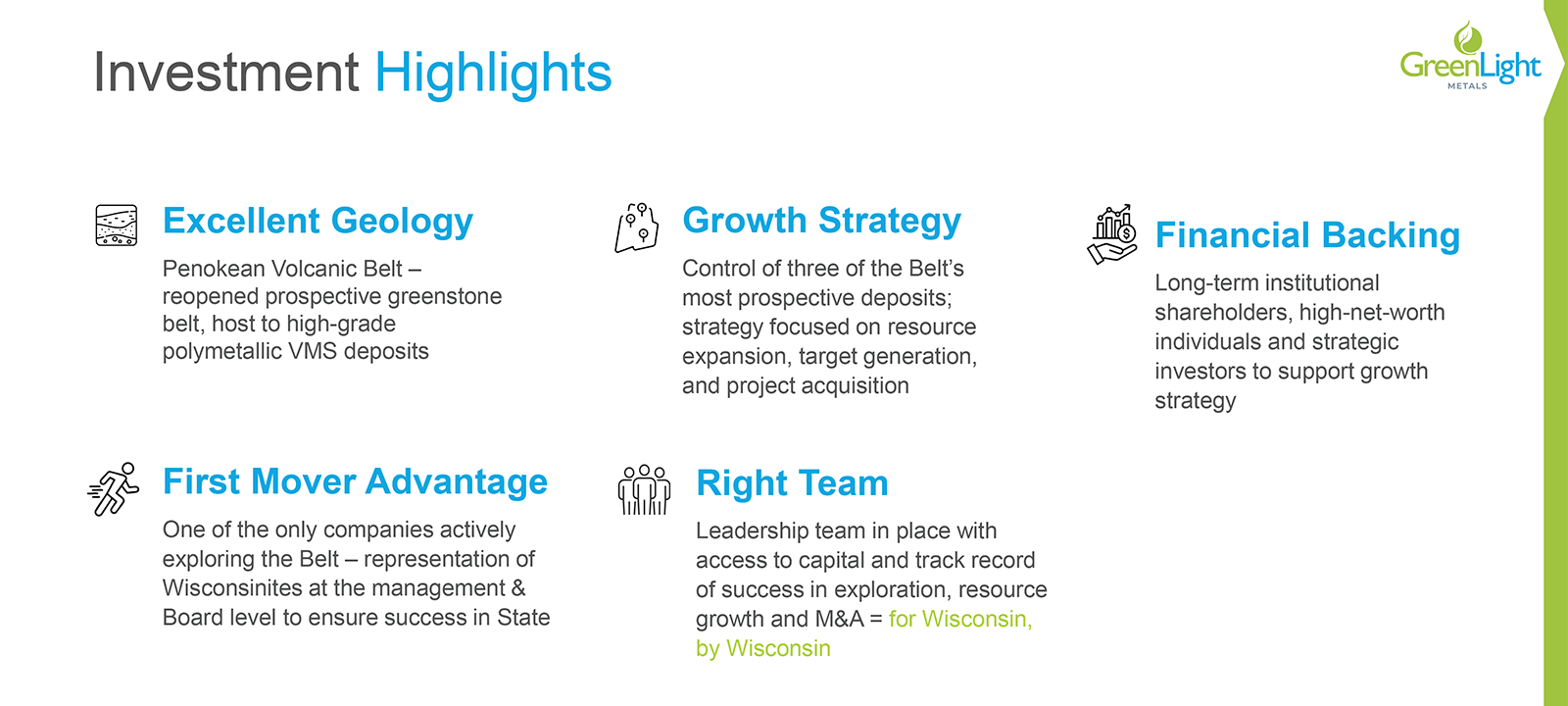
At the flagship Bend project, multi-rig Phase-2 drilling is underway with a focus on systematically advancing the copper-gold VMS system.
You heard directly from CEO Matt Filgate, who says,
“The primary goal here is to define an economic deposit at Bend — something that can become the next high-grade copper-dominant mine in the United States. That’s our focus, and we have lots of exciting exploration and news flow ahead as we advance Bend.”
That strategy is supported by a strengthened balance sheet following a recently completed C$11.5 million financing.
Beyond Bend, GreenLight’s broader portfolio in the Penokean adds depth and optionality with Reef providing gold-copper leverage and Lobo and Lobo East offering high-grade VMS discovery potential.
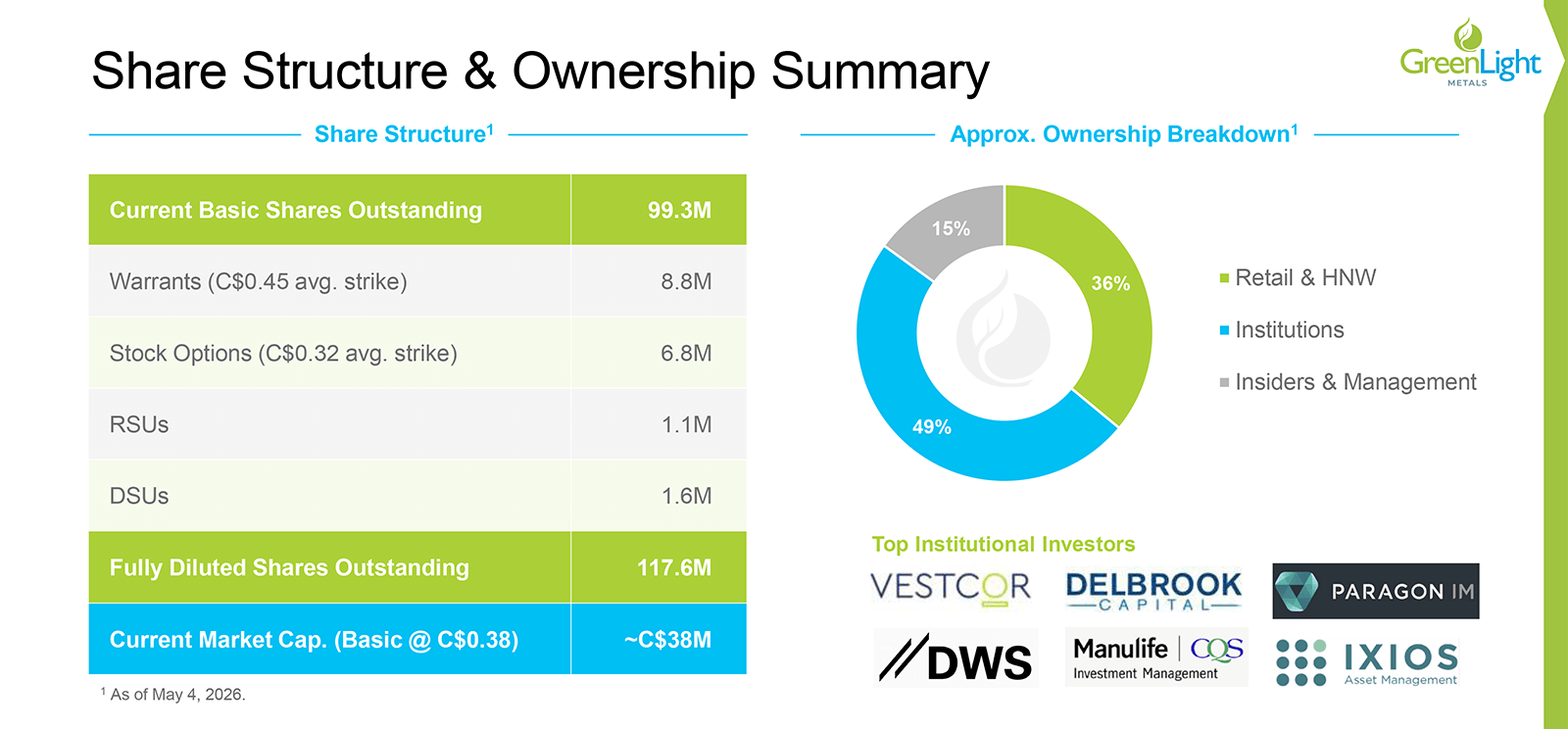
With ~100 million shares outstanding on a non-fully-diluted basis as of May 4, 2026 and a market capitalization below C$50 million, GRL maintains a tight share structure, providing meaningful leverage to exploration success as the project portfolio advances through successive exploration and drilling phases.
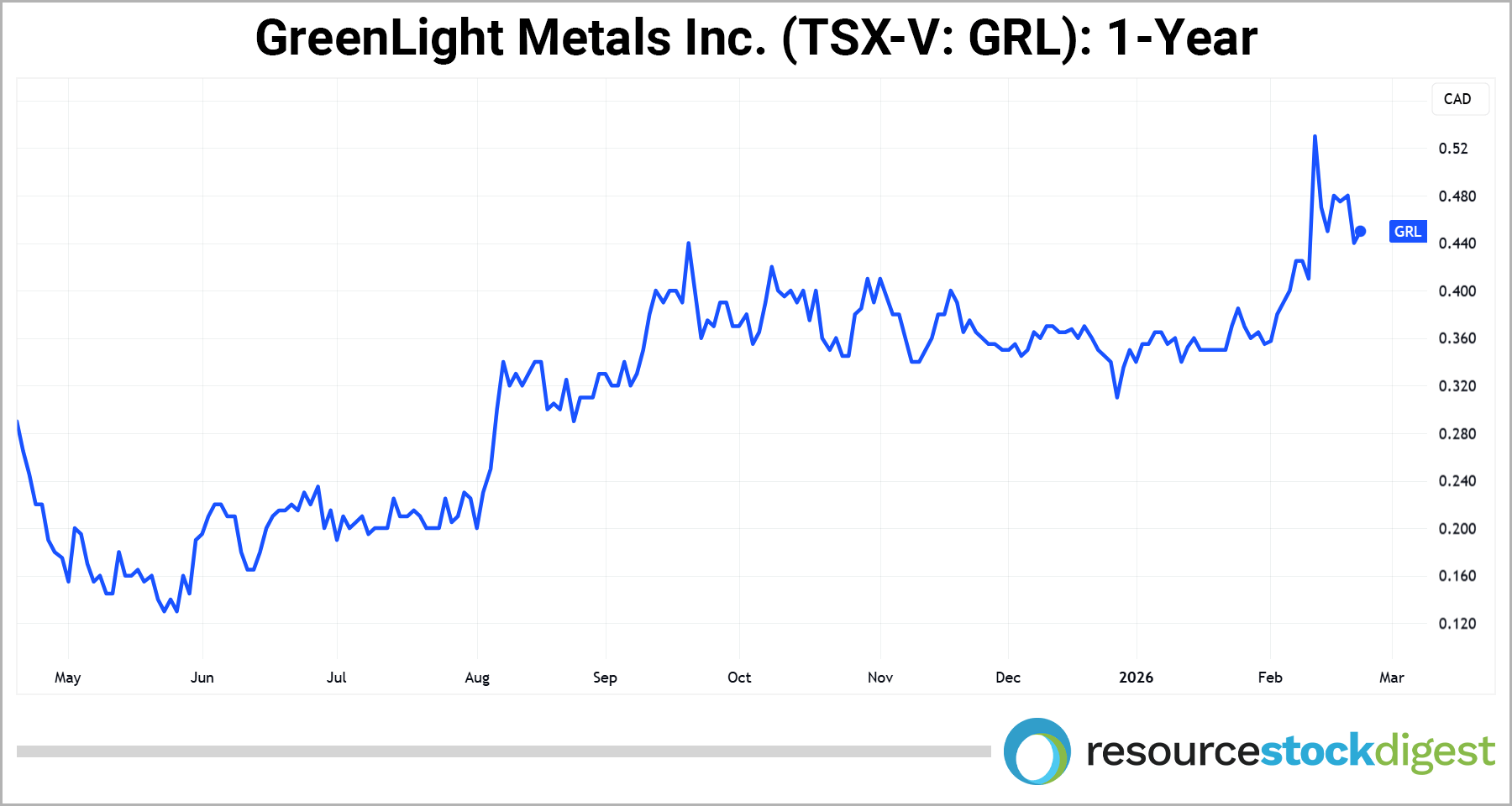
With Wisconsin’s Penokean Volcanic Belt reopened and Phase-2 drilling now underway at the flagship Bend project, GRL stands out as a first mover with multiple catalysts ahead — and investors are encouraged to review the Company’s public filings on SEDAR+ and consult their own qualified investment advisor before making any investment decision.
A great place to continue your due diligence is the company’s corporate website where you can learn more about the projects, meet the team, and sign up for direct updates.
View the current Investor Presentation here.
GreenLight Metals Inc. trades on the TSX-V under the symbol GRL and on the OTCQB under the symbol GRLMF.
— Resource Stock Digest Research
Click here to see more from GreenLight Metals Inc.FOOTNOTES
- Source (primary): E.K. Lehmann and Associates, Inc., 1992, “Report of the geology and ore reserves of the Bend copper-gold deposit, Taylor County, Wisconsin” (Bureau of Land Management Preference Right Lease Application, prepared for the Jump River Joint Venture (“JRJV”)); reproduced in Section 6.2.1 and Table 4 of the Bend Project NI 43-101 Technical Report with an effective date of January 1, 2025 (the “2025 Bend Technical Report”). The 1992 JRJV historical estimate is reported as: Cu Zone — 2.8 Mt at 2.41% Cu, 1.43 g/t Au and 13.70 g/t Ag; Au Zone — 1.2 Mt at 0.31% Cu, 4.73 g/t Au and 2.79 g/t Ag; Total — 4.0 Mt at 1.74% Cu, 2.44 g/t Au and 11.56 g/t Ag. Methods and parameters known from the source report: based on 33 diamond drillholes plus 1 wedge (approximately 13,713 metres drilled between 1986 and 1992); polygonal and cross-sectional methods were both used and the results averaged; at the time, the estimate was categorized as a “geologic resource” under U.S. Geological Survey Circular 831 (1980); no cut-off grade was stated in the source report and no metal prices, metallurgical recoveries or other economic parameters were stated. Reliability and relevance: the 1992 JRJV historical estimate is pre-CIM, was prepared by a previous owner using legacy classification terminology that does not correspond to the current CIM Definition Standards or to NI 43-101 resource categories (Measured, Indicated or Inferred), and has not been independently verified by GreenLight Metals or its Qualified Person; it is referenced in this report for geological context only. More recent estimates: Section 14 of the 2025 Bend Technical Report confirms that no current Mineral Resource is defined on the Bend property and that no more recent estimate of mineral resources or mineral reserves has been completed. Significant data compilation, re-drilling, re-sampling and data verification will be required by a Qualified Person before the historical estimate can be classified as a current Mineral Resource. A Qualified Person has not done sufficient work to classify the historical estimate as a current Mineral Resource. The Company is not treating the historical estimate as a current Mineral Resource or Mineral Reserve, and the historical estimate should not be relied upon.
- Copper equivalent (“CuEq”) is reported to express the aggregate in-situ value of copper, gold and silver as a percentage copper grade. CuEq incorporates assumed metallurgical recoveries and is not a proxy for, nor evidence of, economic value. Tellurium (Te) is reported separately and is not included in CuEq. CuEq (%) = ((Cu grade (%) / 100 × 0.9 (recovery) × 2204.6 × US$4.50) + (Au grade (g/t) × 0.9 (recovery) / 31.1035 × US$3,600) + (Ag grade (g/t) × 0.9 (recovery) / 31.1035 × US$40)) / (2204.6 × 0.01 × US$4.50). Assumptions: metal prices of US$4.50/lb Cu, US$3,600/oz Au and US$40/oz Ag; recoveries of 90% for Cu, Au and Ag based on the Company’s preliminary assessment of analogous VMS deposits. No allowances have been made for smelting/refining charges, penalties or deleterious elements, or payability factors. No metallurgical test work has been completed at Bend; actual recoveries and payabilities are unknown and may differ materially. Readers are cautioned that visible gold occurrences are not necessarily indicative of the gold grade of any mineralized interval; assay results determine actual grade. Tellurium values referenced (including the “significant tellurium values encountered” statement) are individual assay results from selected samples and are not necessarily representative of the mineralization on the property as a whole.
- There is no assurance that exploration results from Phase-2 or any subsequent program will be sufficient to support a Mineral Resource Estimate, that any such Mineral Resource Estimate will be completed, or that the timing or content of any future Mineral Resource Estimate will be as the Company currently contemplates.
- Historic drilling at Reef was most recently conducted by Aquila Resources in 2011–2012; representative historic intercepts include hole R12-38: 65.2 metres grading 2.80 g/t Au and 0.17% Cu from 80.5 m to 145.73 m, including 8.9 metres at 13.14 g/t Au and 0.44% Cu; and hole R11-11: 14.8 metres grading 14.41 g/t Au and 0.30% Cu from 40.6 m to 55.4 m, including 9.3 metres at 21.3 g/t Au and 0.33% Cu (source: GreenLight Metals news release dated May 28, 2025; results reproduced in the Reef Project NI 43-101 Technical Report effective January 1, 2025). The historic results referenced have been reviewed by the Qualified Person but the Company has not independently verified the historic sampling, assay or QA/QC procedures and historic results are not necessarily indicative of mineralization that may be encountered on the property by GreenLight.
- The Crandon deposit is held by a third party, is not located on any property held by GreenLight Metals, and mineralization at the Crandon deposit is not necessarily indicative of mineralization on the Lobo or Lobo East projects.
- Historic drilling at Lobo was conducted by Noranda in the 1970s and by Can-America in 2020; the representative historic intercept referenced is Noranda hole LB-3: 9.4 metres grading 22.89% Zn, 1.41% Cu, 1.84% Pb and 1.14 g/t Au (246–255 m); confirmation drilling by Can-America (hole LB-20-01) returned 1.55 metres of 17.46% Zn, 0.47% Cu, 1.61% Pb, 0.14 g/t Au and 51 g/t Ag (81.8–83.4 m). Drillhole LB-3 is archived at the Wisconsin Geological and Natural History Survey Core Repository (Mt. Horeb, WI); quarter core samples of the entire mineralized interval were re-assayed by Can-America in 2019. The Company has not independently verified the original Noranda sampling, assay or QA/QC procedures and historic results are not necessarily indicative of future results.
- References to “define an economic deposit” and “the next high-grade copper-dominant mine in the United States” are forward-looking. Mine development is contingent on (i) completion of an NI 43-101-compliant Mineral Resource Estimate, (ii) Mineral Reserve estimation, (iii) feasibility studies, (iv) financing, (v) permitting and construction, and (vi) a positive production decision. The Bend Project does not currently host a Mineral Resource or Mineral Reserve under NI 43-101, and there is no certainty that any of the foregoing will occur.
QUALIFIED PERSON
The technical information contained in this report has been prepared in accordance with Canadian regulatory requirements as set out in NI 43-101 and reviewed and approved by Thomas Quigley, MSc, CPG-11962, Exploration Director of GreenLight Metals Inc., a Qualified Person as defined by NI 43-101.
CAUTIONARY NOTE REGARDING HISTORICAL ESTIMATES
The 1992 JRJV historical estimate of approximately 4.0 million tonnes referenced in this report (originally documented in E.K. Lehmann and Associates, Inc., 1992, “Report of the geology and ore reserves of the Bend copper-gold deposit, Taylor County, Wisconsin”, prepared for the Jump River Joint Venture, and reproduced in Section 6.2.1 of the Bend Project NI 43-101 Technical Report effective January 1, 2025) is not compliant with the current CIM Definition Standards or NI 43-101, and the categorization used in the source (USGS Circular 831 (1980) “geologic resource”) does not correspond to current CIM categories. Section 14 of the 2025 Bend Technical Report confirms that no current Mineral Resource is defined on the Bend property and that no more recent estimate exists. A Qualified Person has not done sufficient work to classify the historical estimate as a current Mineral Resource. The Company is not treating the historical estimate as a current Mineral Resource or Mineral Reserve, and the historical estimate should not be relied upon. To upgrade or verify the historical estimate as a current Mineral Resource, the Company would need to complete confirmation drilling, data validation, QA/QC verification, and an independent Qualified Person review under NI 43-101.
CAUTIONARY NOTE REGARDING FORWARD-LOOKING INFORMATION
This report contains forward-looking information within the meaning of applicable Canadian securities legislation, including but not limited to statements regarding: planned exploration programs, drilling and assay timing; the potential for additional or extended mineralization at the Bend, Reef, Lobo, Lobo East and Kalium Canyon projects; the expected negotiation, execution, timing and terms of a long-form ownership earn-in agreement and any long-form joint venture documentation with Barrick; the binding nature and anticipated implementation of the Kalium Canyon term sheet; Barrick’s ability or decision to complete cash payments, qualifying exploration expenditures, drilling, work programs, studies and other obligations contemplated by the term sheet; Barrick’s ability or decision to terminate or discontinue the arrangement, or to earn a 60%, 70% or 80% equity interest in Kalium Canyon; the potential to define a NI 43-101-compliant Mineral Resource Estimate at any of the Company’s projects; references to Bend becoming “the next high-grade copper-dominant mine in the United States”, “economic deposit”, or similar prospective characterizations; and any references to conceptual tonnage, grade or scale potential. Forward-looking information is based on the Company’s current expectations and assumptions and involves known and unknown risks and uncertainties, including but not limited to: exploration risk and the inherent uncertainty of mineral exploration; commodity price volatility (including copper, gold, silver, zinc and tellurium); permitting, regulatory and First Nations consultation risk; access to financing; the risk that historical estimates and historical drill results are not necessarily indicative of future results; and the risks that the long-form agreement will not be entered into, that required third-party notices, consents or waivers will not be obtained, that Barrick will not earn any interest in Kalium Canyon, that a joint venture will not be formed or operated as contemplated, or that expected payments, expenditures, studies or other benefits will not be realized. There is no certainty that any Mineral Resource or Mineral Reserve will be defined on any of the Company’s projects, that any mine will be developed, or that any conceptual tonnage range will be realized. Readers are cautioned not to place undue reliance on forward-looking information. The Company disclaims any obligation to update forward-looking information except as required by applicable law.
CAUTIONARY NOTE REGARDING ADJACENT PROPERTIES
References in this report to the past-producing Flambeau Mine, the Crandon deposit, and the Abitibi and Flin Flon belts are provided for general geological and historical context only. Those properties and belts are held by parties other than GreenLight Metals and are not part of the Bend, Reef, Lobo or Lobo East projects. Mineralization on those properties or belts is not necessarily indicative of mineralization on, and readers are cautioned not to draw conclusions about the prospectivity of, GreenLight’s projects.
IMPORTANT DISCLAIMER & DISCLOSURES
Resource Stock Digest, as a publisher, is not a broker, investment advisor, or financial advisor in any jurisdiction.
Please do not rely on the information presented by Resource Stock Digest as personal investment advice.
If you need personal investment advice, kindly reach out to a qualified and registered broker, investment advisor, or financial advisor.
The communications from Resource Stock Digest should not form the basis of your investment decisions. Examples we provide regarding share price increases related to specific companies are based on randomly selected time periods and should not be taken as an indicator or predictor of future stock prices for those companies.
GreenLight Metals Inc. has sponsored this report.
The information in this newsletter does not constitute an offer to sell or a solicitation of an offer to buy any securities of a corporation or entity, including U.S. Traded Securities or U.S. Quoted Securities, in the United States or to U.S. Persons. Securities may not be offered or sold in the United States except in compliance with the registration requirements of the Securities Act and applicable U.S. state securities laws or pursuant to an exemption therefrom.
Any public offering of securities in the United States may only be made by means of a prospectus containing detailed information about the corporation or entity and its management as well as financial statements. No securities regulatory authority in the United States has either approved or disapproved of the contents of any newsletter. Neither Resource Stock Digest nor any employee of Resource Stock Digest is registered with the United States Securities and Exchange Commission (the “SEC”): as a “broker-dealer” under the Exchange Act, as an “investment adviser” under the Investment Advisers Act of 1940, or in any other capacity. Resource Stock Digest, its owners, directors, and employees are also not registered with any state securities commission or authority as a broker-dealer or investment advisor or in any other capacity.
HIGHLY BIASED:
In our role, we aim to highlight specific companies for your further investigation; however, these are not stock recommendations, nor do they constitute an offer or sale of the referenced securities. Resource Stock Digest has received cash compensation from GreenLight Metals Inc. and is thus extremely biased. It is crucial that you conduct your own research prior to investing. This includes reading the companies' SEDAR and SEC filings, press releases, and risk disclosures. The information contained in our profiles is based on data provided by the companies, extracted from SEDAR and SEC filings, company websites, and other publicly available sources.
Resource Stock Digest, and its owners, directors, employees, and members of their households may own shares of GreenLight Metals Inc. Therefore, Resource Stock Digest is extremely biased. Measures are in place such that no shares will be sold during the active awareness campaign.
HIGH RISK:
The securities issued by the companies we feature should be seen as high risk; if you choose to invest, despite these warnings, you may lose your entire investment. You must be aware of the risks and be willing to accept them in order to invest in financial instruments, including stocks, options, and futures.
NOT PROFESSIONAL ADVICE:
By reading this, you agree to all of the following: You understand this to be an expression of opinions and NOT professional advice. You are solely responsible for the use of any content and hold Resource Stock Digest, and all partners, members, and affiliates harmless in any event or claim. While Resource Stock Digest strives to provide accurate and reliable information sourced from believed-to-be trustworthy sources, we cannot guarantee the accuracy or reliability of the information. The information provided reflects conditions as they are at the moment of writing and not at any future date. Resource Stock Digest is not obligated to update, correct, or revise the information post-publication.
FORWARD-LOOKING STATEMENTS:
Certain information presented may contain or be considered forward-looking statements. Such statements involve known and unknown risks, uncertainties, and other factors that may cause actual results or events to differ materially from those anticipated in these statements. There can be no assurance that any such statements will prove to be accurate, and readers should not place undue reliance on such information. Resource Stock Digest does not undertake any obligations to update the information presented or to ensure that such information remains current and accurate.