Click here to read important disclaimer & disclosures Click here to see more about Gladiator Metals
District-Scale High-Grade
Copper in the Yukon

TSX-V: GLAD | OTCQX: GDTRF | FSE: ZX7
How Gladiator Metals Is Reviving One of Canada’s Most Productive Copper Belts
Project: Whitehorse Copper Project, Yukon, Canada
— STILL TRADING BELOW $2.00 —
Click Here to Read Sponsor Disclosure
Copper Is at Record Highs — and the Supply Problem
Is Getting Worse
Copper is no longer just an industrial metal. It is now a strategic material, essential to:
- Power grids
- Electric vehicles
- Renewable energy
- Data centers and AI infrastructure
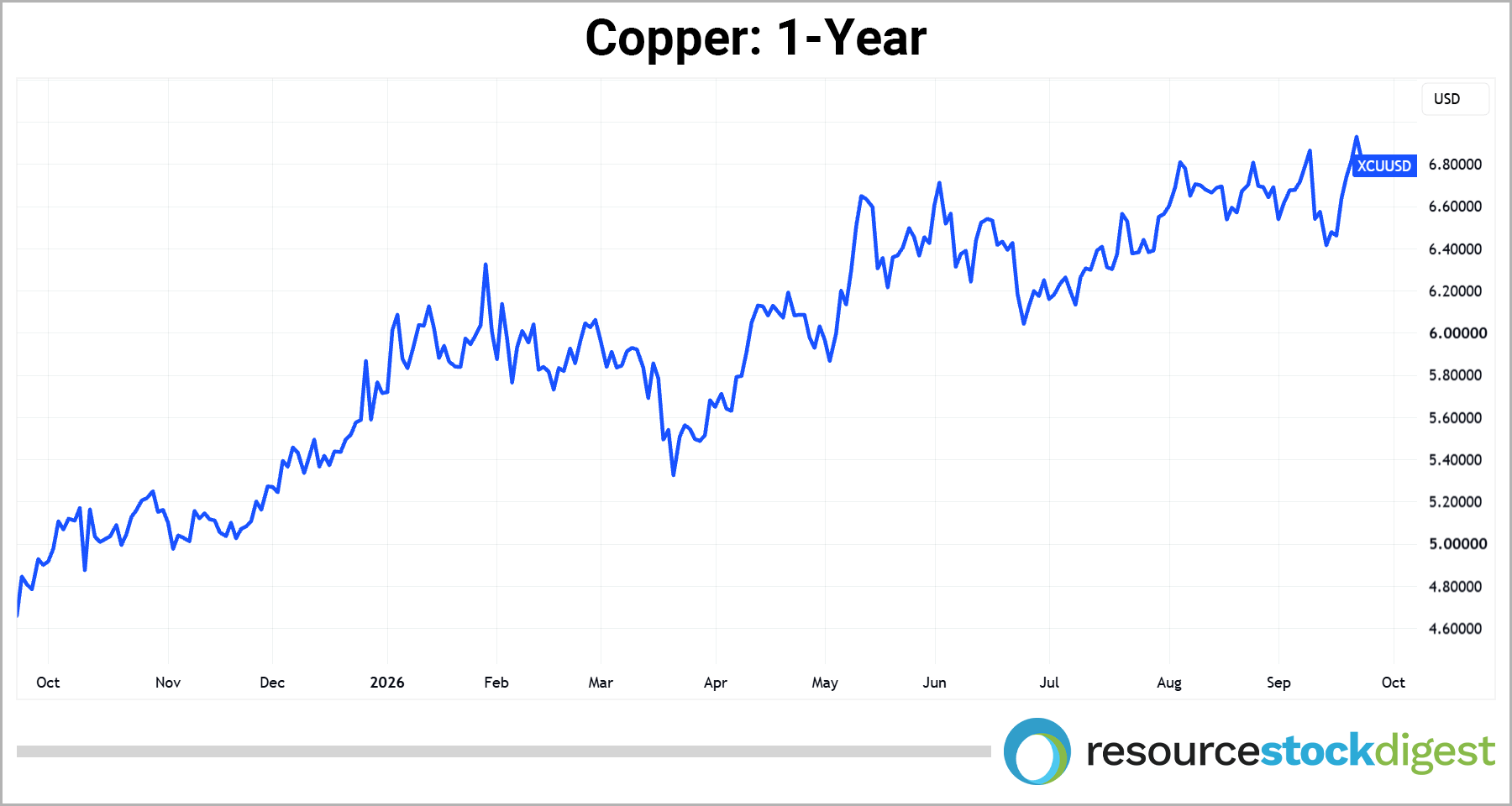
Every major energy transition scenario points to the same conclusion: we will need far more copper than current mines can supply.
And yet, the global mining industry has not been finding enough new large, high-grade copper deposits to replace aging production.
That’s why projects that combine:
- High grades
- Large scale
- Stable jurisdictions
- Near-surface mineralization
Are increasingly rare — and increasingly valuable.
Which brings us to a largely forgotten copper district in Canada’s Yukon.
What makes this moment different is not just copper demand — it’s where that demand must be sourced from.
Governments, utilities, and manufacturers are now prioritizing secure, domestic, and politically stable copper supply to support grid expansion, electrification, and the explosive power requirements of AI data centers.
As a result, large, high-grade copper projects in Tier-1 jurisdictions with existing infrastructure are no longer optional — they are becoming strategic necessities.
The Whitehorse Copper Belt: A Historic Producer
Left Dormant for Decades
Gladiator Metals (TSX-V: GLAD)(OTCQX: GDTRF) is focused on advancing the flagship Whitehorse Copper Project located just outside the town of Whitehorse in Yukon Territory, Canada — an established Tier-1 mining jurisdiction.
The project produced approximately 267.5 million pounds of copper between 1967 and 1982. The high-grade ore — 10.5 million tons of it at 1.5% copper, plus gold and silver credits — came from both open pit and underground workings.
In total, the Whitehorse Copper Belt has more than 100 years of mining history with past production of:
- 267.5 million pounds of copper
- 225,000 ounces of gold
- 2.8 million ounces of silver
Between the late 1960s and early 1980s, Hudbay Mining operated multiple copper mines across this belt, producing at grades that would be considered exceptional by today’s standards.
Then copper prices collapsed. Exploration stopped. Mines closed.
And for more than 40 years, this prolific copper system received almost no modern exploration.
No district-scale geophysics. No deep drilling. No modern modeling.
Until now.
Gladiator Metals: Consolidating and Modernizing
an Entire Copper District
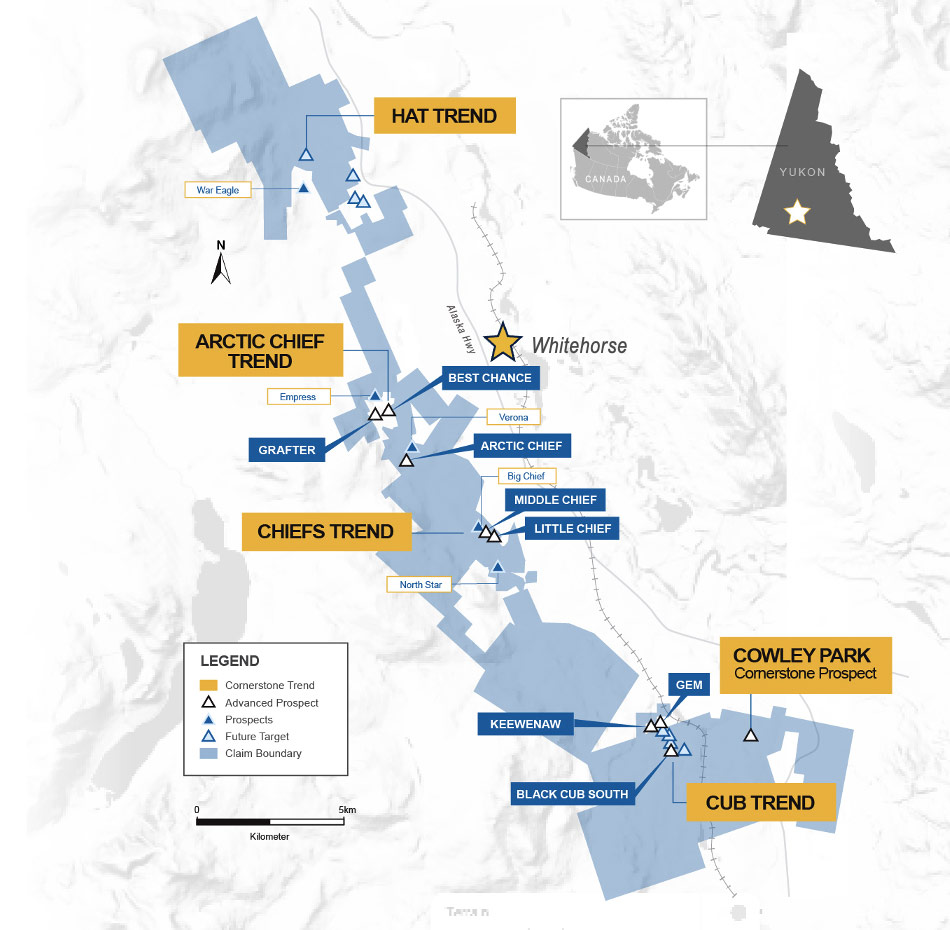
Gladiator Metals controls a 133 sq km land package hosting more than 30 known copper occurrences across roughly 35 kilometers of continuous strike length along the Whitehorse Copper Belt.
Within this corridor, the company has identified multiple mineralized trends, including:
- Cowley Park (cornerstone prospect)
- Chiefs Trend (Middle Chief & Little Chief)
- Arctic Chief Trend (including Best Chance and Grafter)
- Cub Trend (including Cub East, Gem, Keewenaw, Black Cub South)
Instead of betting on a single isolated deposit, Gladiator is pursuing a district-scale resource strategy, similar to how many of the world’s largest copper camps were originally developed.
The goal is not simply to find a deposit — but to demonstrate repeatable mineralization across the belt, building toward a multi-deposit copper district.
Cowley Park: The Emerging Cornerstone Resource
At the southern end of the belt sits Cowley Park, now the most advanced and intensively drilled area of the project.
Ongoing drilling is defining:
- Shallow, near-surface copper-molybdenum skarn mineralization
- Strong continuity of high-grade mineralization
- Expansion to the northeast and up-dip toward surface
- Significant molybdenum as a potentially valuable future by-product
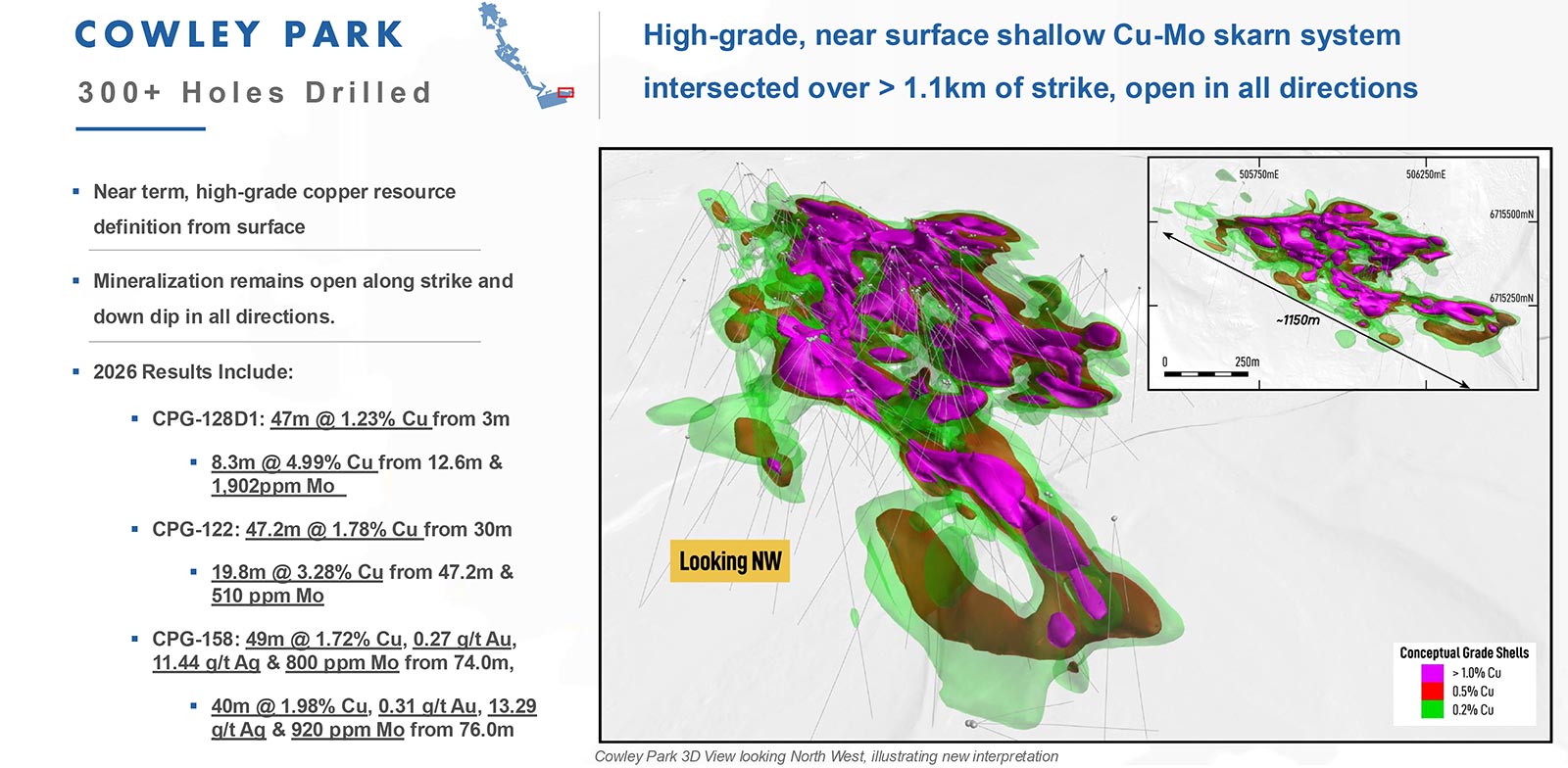
Grades are consistently strong with meaningful molybdenum, gold, and silver credits.
Recent drilling continues to confirm:
- Broad mineralized widths
- Excellent continuity
- High-grade mineralization extending toward surface
- Expansion of the mineralized footprint
In other words, Cowley Park is behaving exactly the way you want a future open-pit or bulk underground copper system to behave.
High Grades, Broad Widths, and Still Growing
Recent intercepts at Cowley Park include:
- 40.0 meters @ 1.98% copper, 0.31 g/t gold, 13.29 g/t silver and 920 ppm molybdenum
- 18.1 meters @ 1.97% copper, 0.19 g/t gold, 7.34 g/t silver and 1,172 ppm molybdenum
- 23.4 meters @ 1.16% copper, 0.11 g/t gold, 8.81 g/t silver and 1,226 ppm molybdenum
- 8.3 meters @ 4.99% copper, 0.23 g/t gold, 26.66 g/t silver and 1,902 ppm molybdenum
These are not narrow vein intercepts. These are thick, continuous zones of mineralization — exactly what resource geologists look for when modeling large-scale copper systems.
Just as important: recent drilling continues to expand mineralization to the northeast and up-dip toward surface, while confirming strong continuity across the Northern Limb.
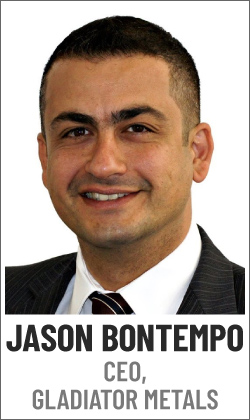
CEO Jason Bontempo, who you’ll hear from below, said the latest results demonstrate the “exceptional near-surface grade, thickness and metal endowment” at Cowley with every hole drilled on the Northern Limb intersecting significant copper-gold-silver-molybdenum skarn.
And Gladiator is responding accordingly. Drilling at Cowley has been expanded from an initial 8,000 meters to more than 14,000 meters with additional drilling targeting the Southern Limb.
Cowley Park has not yet found its boundaries.
A Surprise Discovery at Depth: Signs of a Porphyry System
While most early drilling focused on shallow skarn mineralization, Gladiator recently tested deeper targets below 200 meters.
What they found changed the geological model.
Instead of skarn alone, drilling intersected:
- Bornite and chalcopyrite
- Hosted within altered granodiorite
- Over a 180-meter wide interval
This is significant, because it suggests the possibility of an underlying porphyry copper system feeding the skarn mineralization above.
Porphyry systems are responsible for many of the world’s largest copper deposits.
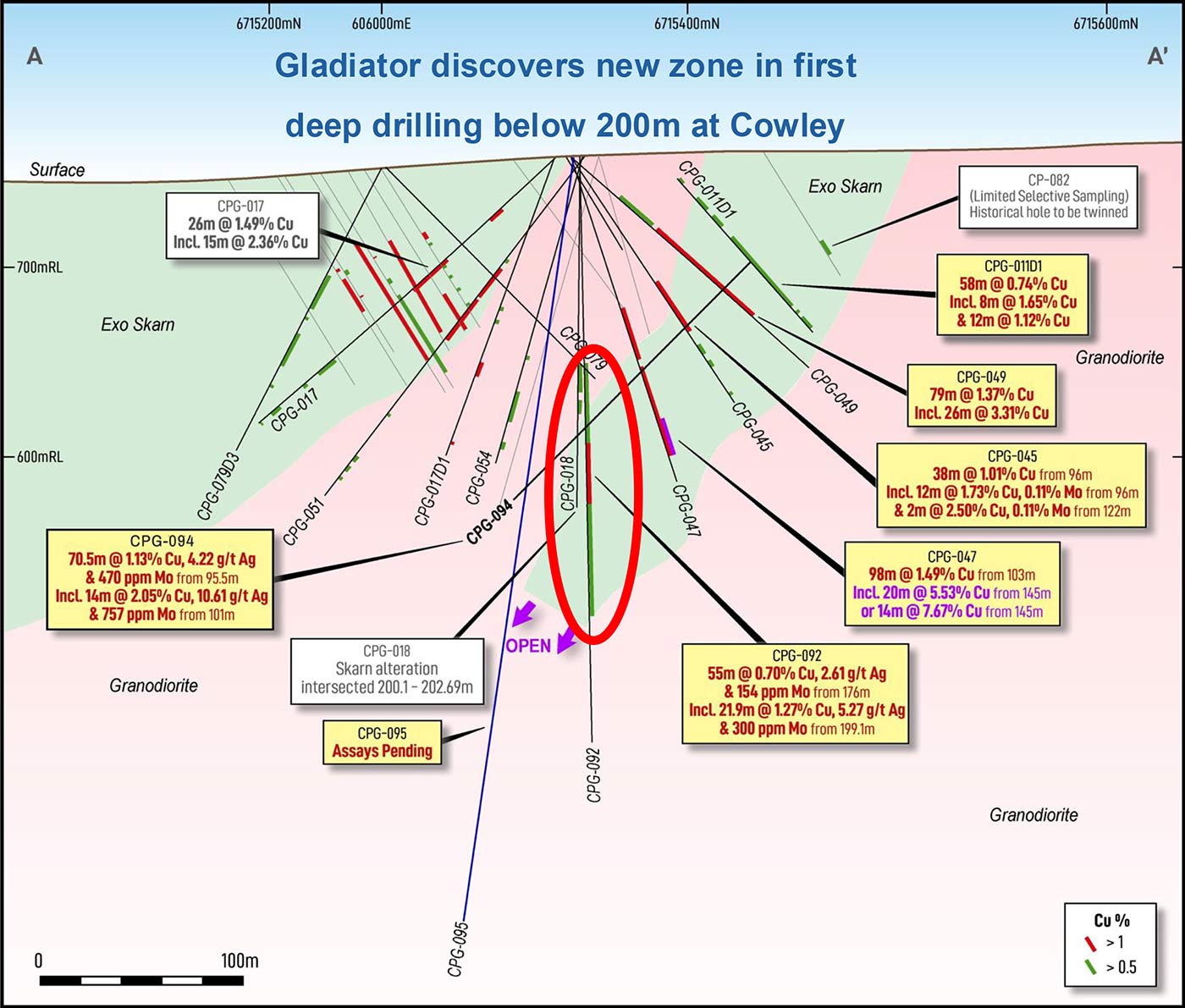
While Gladiator remains focused on defining near-surface skarn resources first, the presence of copper mineralization in intrusive rocks opens the door to a much larger long-term exploration story.
Finding What Historic Miners Couldn’t: Blind Targets Revealed by Modern Geophysics
Historic miners followed what they could see at surface.
Gladiator is using modern tools to find what lies beneath.
The company has deployed:
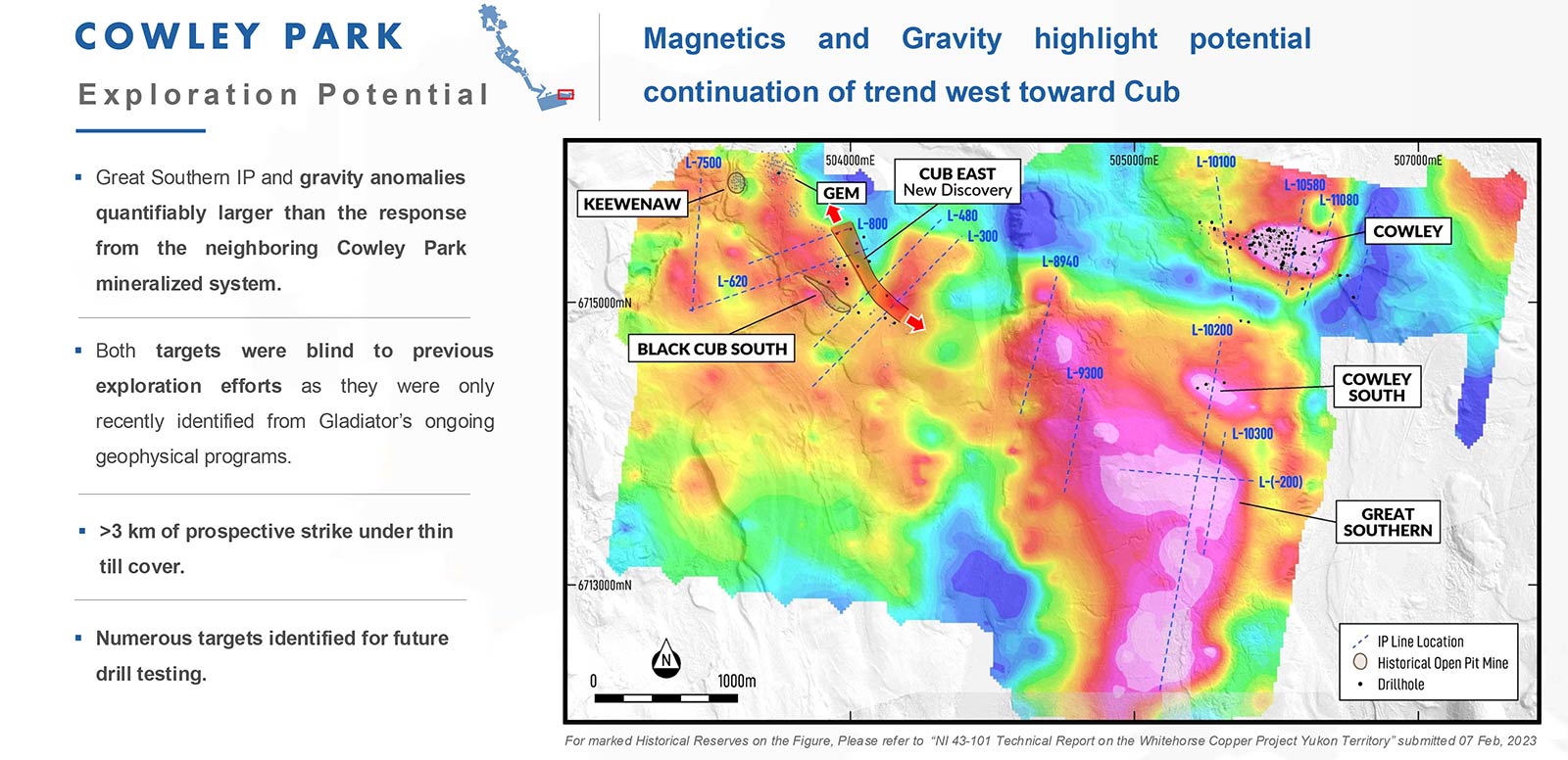
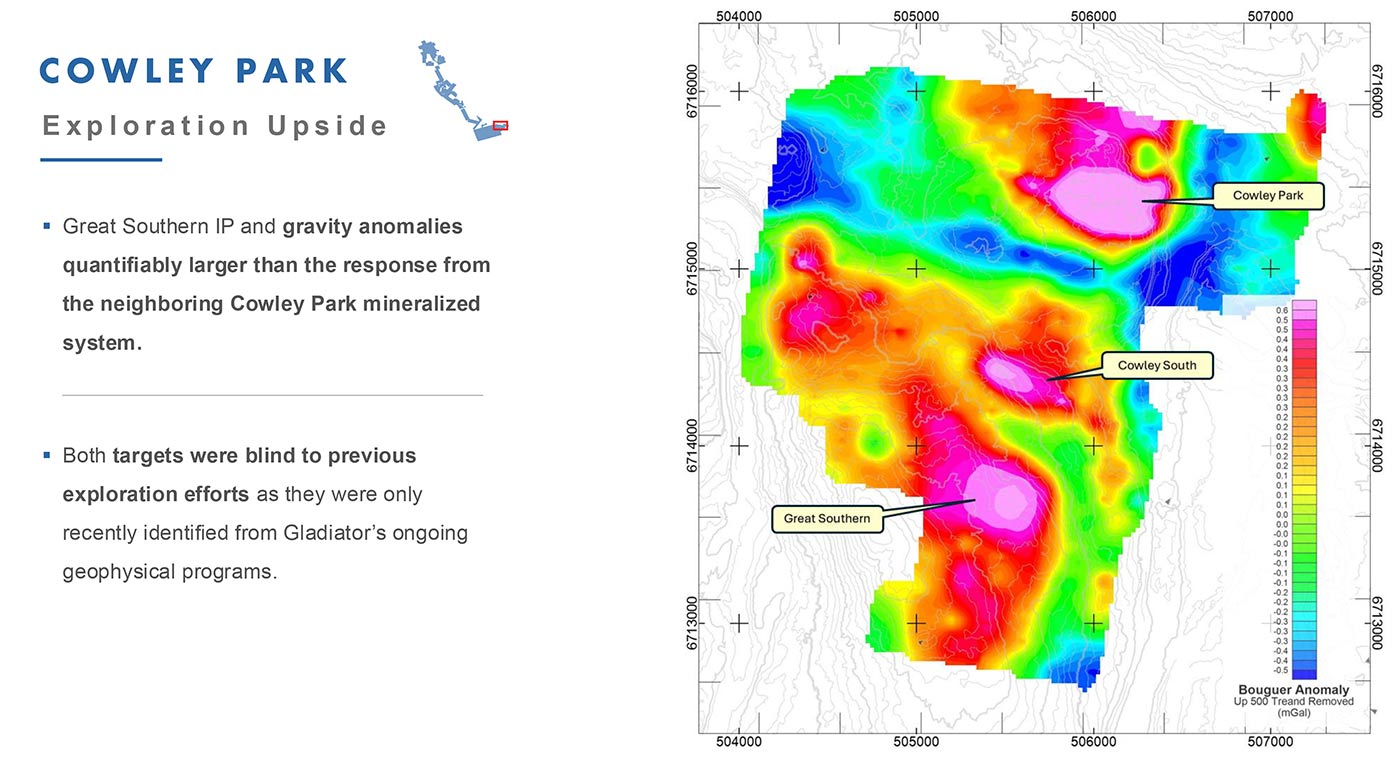
- Gravity surveys (to detect dense skarn bodies)
- Induced polarization (IP) surveys (to detect sulfide mineralization)
- Downhole electromagnetics
The results have been striking.
And importantly, the approach is no longer theoretical.
At Cub East, coincident gravity and IP anomalies led Gladiator directly to a new high-grade copper-gold discovery beneath shallow cover — providing the company with a proven targeting approach it can now apply across the broader Whitehorse Copper Belt.
That same work continues to generate additional targets across the district, including:
- Great Southern
- Cowley South
With Gladiator now permitted and funded to accelerate drilling across the belt, these modern geophysical tools provide a roadmap for identifying the next potential discoveries.
This is how districts are built: find one deposit, then find the next, and the next.
Chiefs Trend: High-Grade Copper
Where Mines Once Operated
Moving north along the belt, Gladiator controls the historic Little Chief and Middle Chief mines, which together produced:
- 8.5 million tonnes @ ~1.5% copper
- Plus gold credits of nearly 1 gram per tonne
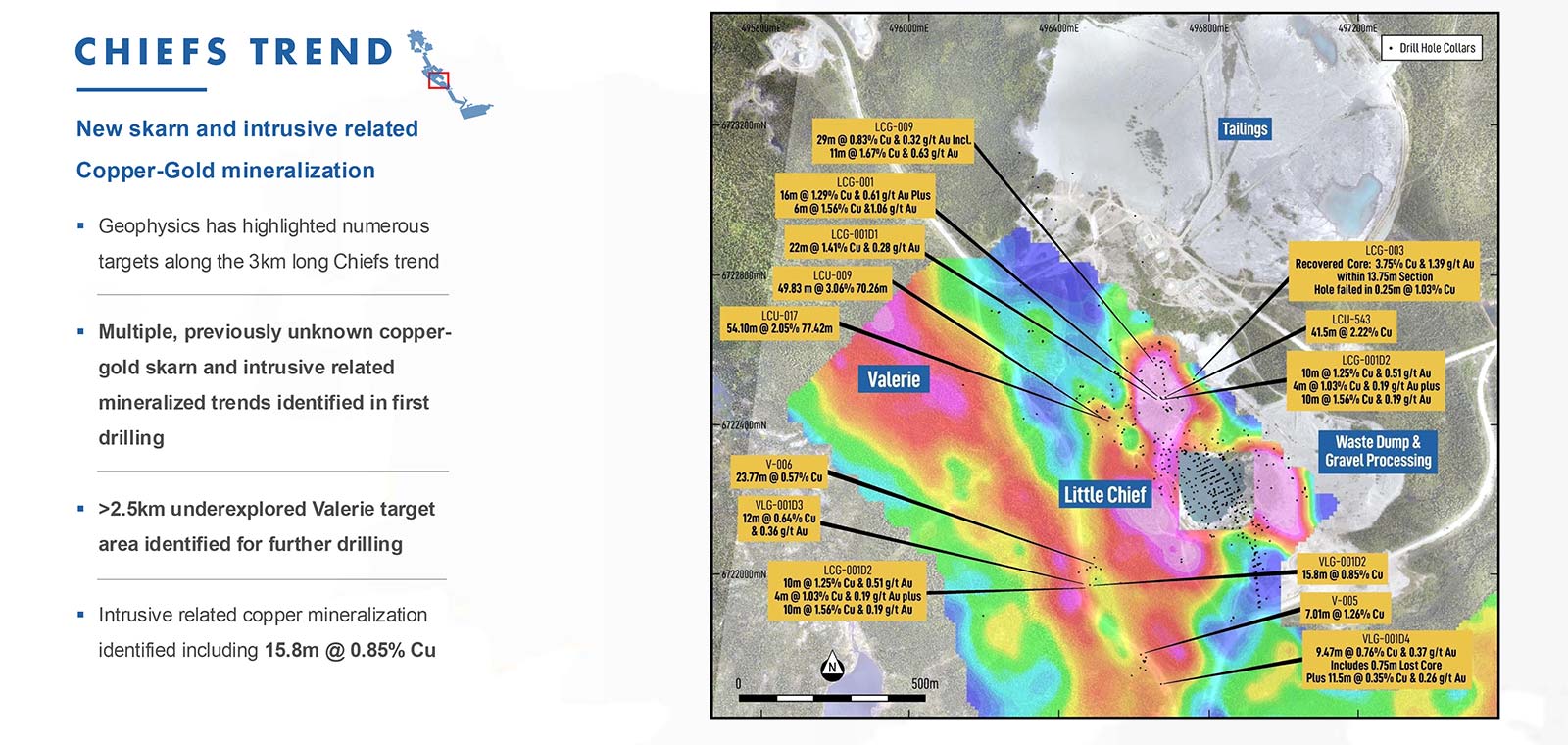
Historic mining focused mainly on underground extraction, leaving up-dip mineralization largely untested and significant strike extensions unexplored.
Modern drilling has now confirmed high-grade copper skarn, intrusive-related copper mineralization, and multiple unmined zones between Middle Chief and Little Chief.
Recent intercepts include:
- 49.8 meters @ 3.06% copper
- 54.1 meters @ 2.05% copper
- 41.1 meters @ 2.22% copper
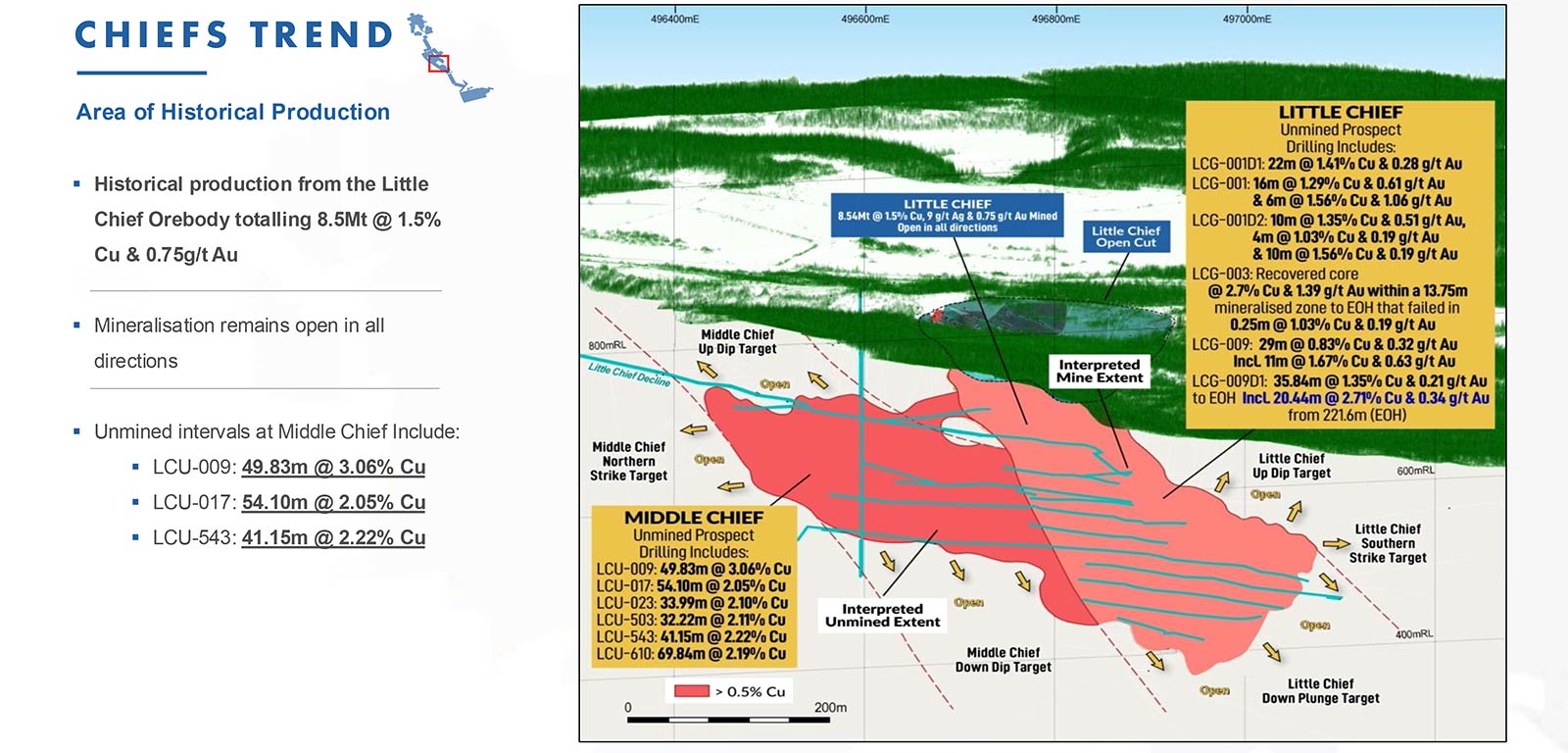
These are exceptional grades for bulk copper systems — and they remain open.
Geophysics has highlighted numerous targets along the 3 km Chiefs Trend with multiple previously unknown copper-gold skarn and intrusive-related mineralized trends identified in initial drilling.
Chief remains one of Gladiator’s advanced prospect areas along the belt, providing another opportunity for future drilling to add high-grade copper resources.
What makes the Chiefs Trend especially important is that it demonstrates clear continuity between historic production and modern discovery.
Historic mining only exploited a fraction of the system, largely focusing on underground extraction and leaving extensive up-dip and along-strike mineralization untested.
Modern drilling and geophysics now suggest the Chiefs Trend could ultimately support multiple resource domains, reinforcing the idea that the Whitehorse Copper Belt hosts repeatable, scalable copper systems rather than isolated deposits.
Arctic Chief and Best Chance:
More High-Grade Zones Emerging
Farther north still, the Arctic Chief Trend extends over roughly 2.5 kilometers and includes the historic Best Chance and Grafter prospects.
Here, historic drilling and recent work show broad copper-gold mineralization, multiple zones exceeding 1% copper, and gold-rich intercepts near surface.
Recent results include:
- 77 meters @ 0.70% copper from near surface
- Including 18 meters @ 1.10% copper
- Additional high-grade gold-bearing intervals
Drone magnetics and surface sampling have expanded the number of targets along this trend, suggesting that Arctic Chief may ultimately host multiple resource-scale zones.
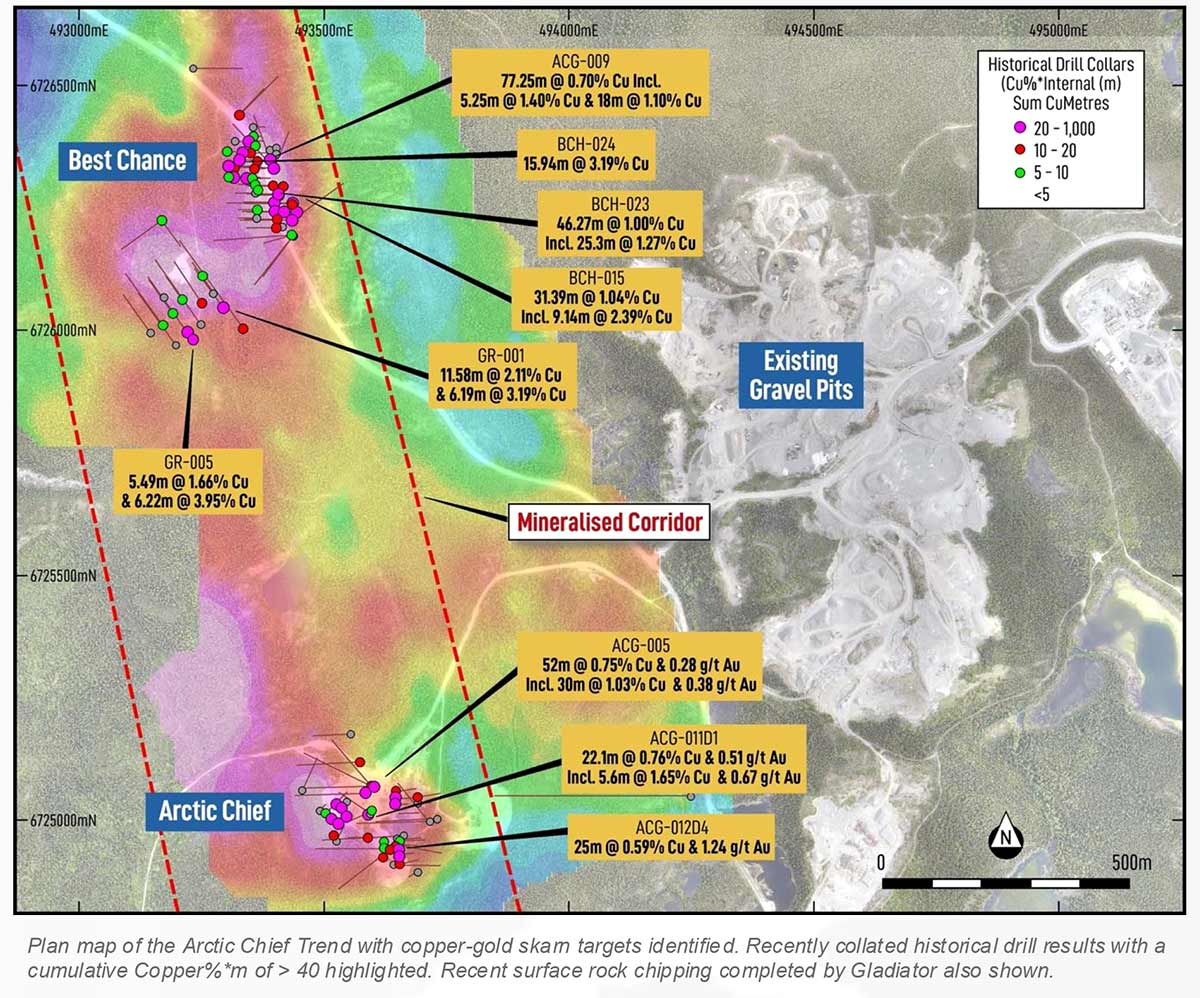
Strategically, Arctic Chief serves as further proof that high-grade copper mineralization persists well beyond the most heavily drilled areas of the belt.
Best Chance, in particular, has emerged as an important near-term target. Bontempo says it “looks like it could have the size, tonnes, and grade of Cowley,” with drilling at Best Chance now scheduled for Q4 as Gladiator expands to five rigs across the Whitehorse Copper Project.
With limited historic drilling and multiple zones already showing scale and grade from surface, Arctic Chief and Best Chance represent another opportunity for Gladiator to add meaningful tonnes outside of Cowley.
The Cub Trend: A Brand-New
High-Grade Discovery Emerges
Just as important as expanding known systems is proving that an entire belt can continue to deliver new discoveries.
That is exactly what Gladiator accomplished at the Cub Trend in January 2026 with the announcement of a previously unknown zone of high-grade copper-gold skarn mineralization discovered through maiden drilling.
The Cub Trend lies along the same 35-kilometer Whitehorse Copper Belt and includes several historic workings, most notably the Black Cub South open pit, which was partially mined in the past but never fully delineated using modern techniques.
What Gladiator has now demonstrated is that significant mineralization remained hidden beneath shallow cover, untouched by historic exploration.
The new discovery, now referred to as Cub East, was identified by targeting overlapping gravity and induced polarization (IP) anomalies beneath shallow till cover — mineralization that was completely blind to earlier miners.
A five-hole maiden drill program totaling 1,411 meters intersected high-grade copper-gold-magnetite skarn in all five holes, immediately confirming the presence of a new mineralized body adjacent to the historic Black Cub South pit.
And subsequent drilling has continued to build on that initial discovery.
Recent highlights include:
- 40 meters @ 2.01% copper and 0.72 g/t gold, including 24 meters @ 3.03% copper and 1.08 g/t gold
- 35.9 meters @ 2.68% copper and 1.35 g/t gold, including 22 meters @ 4.24% copper and 2.16 g/t gold
- 21.2 meters @ 3.07% copper, 1.19 g/t gold and 24.65 g/t silver
- 47.0 meters @ 1.01% copper, 0.44 g/t gold and 7.07 g/t silver, including 32.31 meters @ 1.40% copper, 0.63 g/t gold and 9.70 g/t silver
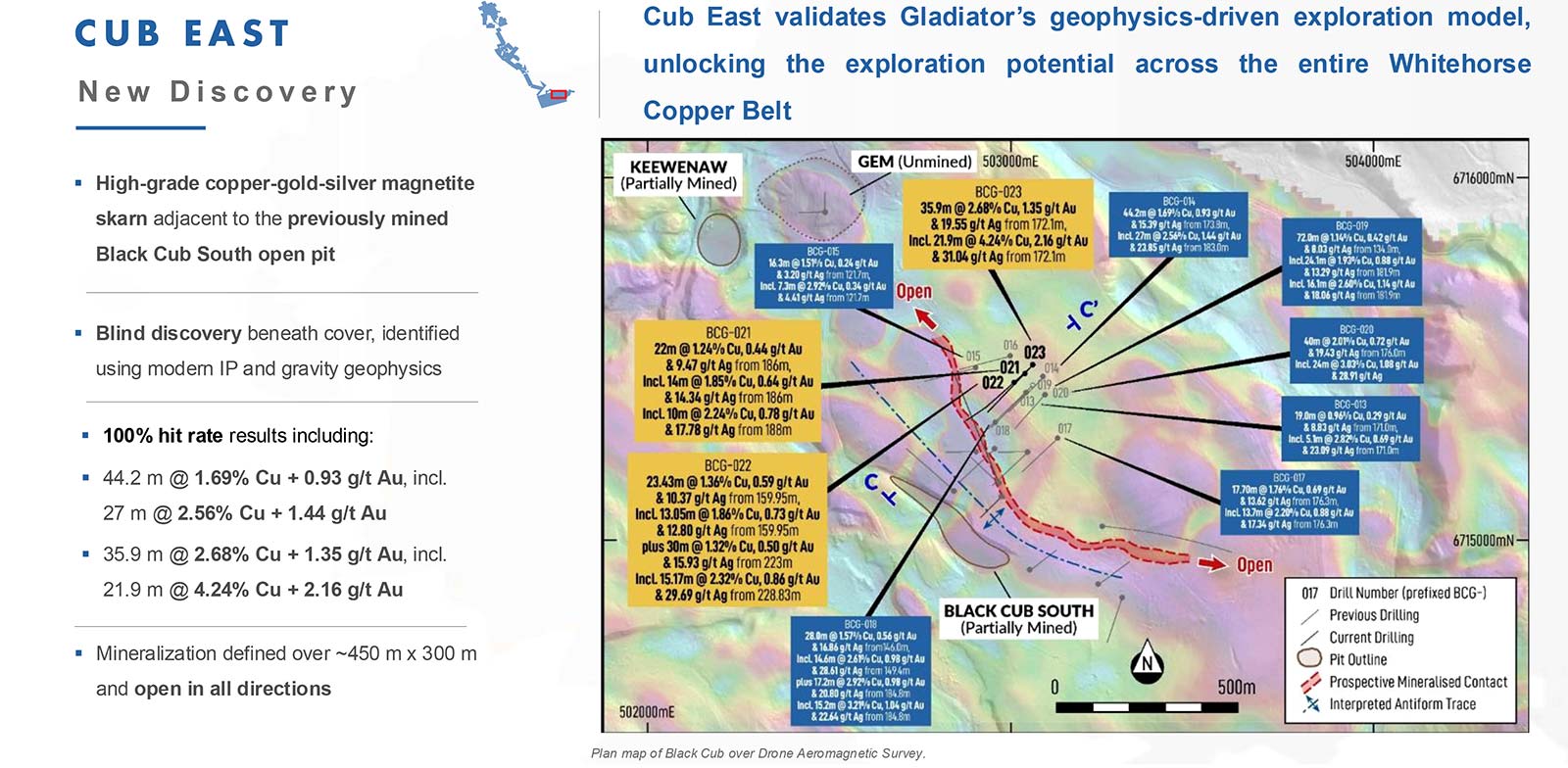
These thick, high-grade intercepts, which notably occur outside the primary historic zone, are consistent with some of the best results seen elsewhere in the Whitehorse Copper Belt and are helping Gladiator demonstrate meaningful scale and continuity at Cub East.
That high-grade core has now been confirmed over approximately 350 meters of strike while first-pass drilling more than 600 meters southeast has encountered additional skarn mineralization along the broader 1.5-km-long prospective Black Cub Trend.
Assays from those step-out holes are pending.
CEO Jason Bontempo says Cub East is delivering the type of high-grade copper-gold results that can “materially change the scale and market profile of the Whitehorse Copper Project.”
Two drill rigs are now testing up-dip and strike extensions at Cub East as Gladiator works to determine just how large the system may become.
Keep in mind also that Cub East was generated using coincident gravity and IP geophysics — a proven targeting technique Gladiator can now apply across the broader Whitehorse Copper Belt.
In short, Cub East appears to be another repeatable skarn system… not an isolated occurrence.
Validating Gladiator’s Exploration Strategy
The Cub discovery underscores a central thesis of this report: The Whitehorse Copper Belt is not a one-deposit story.
With Cowley emerging as a cornerstone resource, Chiefs and Arctic Chief demonstrating high-grade continuity, and now Cub delivering an expanding high-grade discovery, Gladiator is systematically proving that this is a multi-deposit copper district — the kind that has historically attracted major mining companies and commanded premium valuations.
The Cub discovery is important for more than just its grades.
It fully validates Gladiator’s exploration approach, which combines:
- Detailed gravity surveys to identify dense skarn bodies
- Induced polarization surveys to map sulfide-rich zones
- Step-out drilling guided by coincident geophysical responses
Management has noted that mineralization was intersected within approximately 10 meters of the modeled geophysical targets, underscoring the effectiveness of this low-cost, high-precision targeting method.
And Gladiator is now taking that proven approach across the broader belt.
With a fully funded exploration budget of more than C$40 million and 120,000 meters of drilling planned across 2026 and 2027, the company is expanding its geophysical work while aggressively drilling Cowley and Cub and advancing additional targets across the Whitehorse Copper Project.
That includes Best Chance, Great Southern, and the Chief and Arctic Chief trends — providing multiple opportunities for Gladiator to demonstrate that Whitehorse can ultimately host multiple high-grade copper-dominant deposits.
As Gladiator continues to demonstrate the district-scale potential of the Whitehorse Copper Project, it also benefits from something many exploration-stage copper projects lack: established infrastructure.
Infrastructure: A Rare Advantage in Copper Exploration
Many exploration projects have to overcome their location.
Gladiator benefits from it.
The Whitehorse Copper Project sits directly along the western margin of Whitehorse City with existing roads running throughout the belt, access to grid hydroelectric power, and a skilled local workforce supported by experienced contractors, vendors, and laboratories.
And roughly two hours away sits the deep-water port at Skagway, Alaska.
That means no fly-in camps. No massive logistical hurdle just to put drills on the ground. And potentially lower exploration, development, and operating costs as the project advances.
That matters because when it comes to building a large copper project, infrastructure can matter just as much as grade.
And Gladiator has both.
First Nations Partnerships and Community Support
The Whitehorse Copper Project lies within the traditional territory of the Kwanlin Dün First Nation and the Ta’an Kwäch’än Council.
Gladiator has been working closely with Kwanlin Dün since 2022 and signed a capacity funding agreement with the First Nation in October 2024.
The company has also completed public consultation for its upgraded Class 3 exploration permit and is working toward a formal Exploration Cooperation Agreement with Kwanlin Dün.
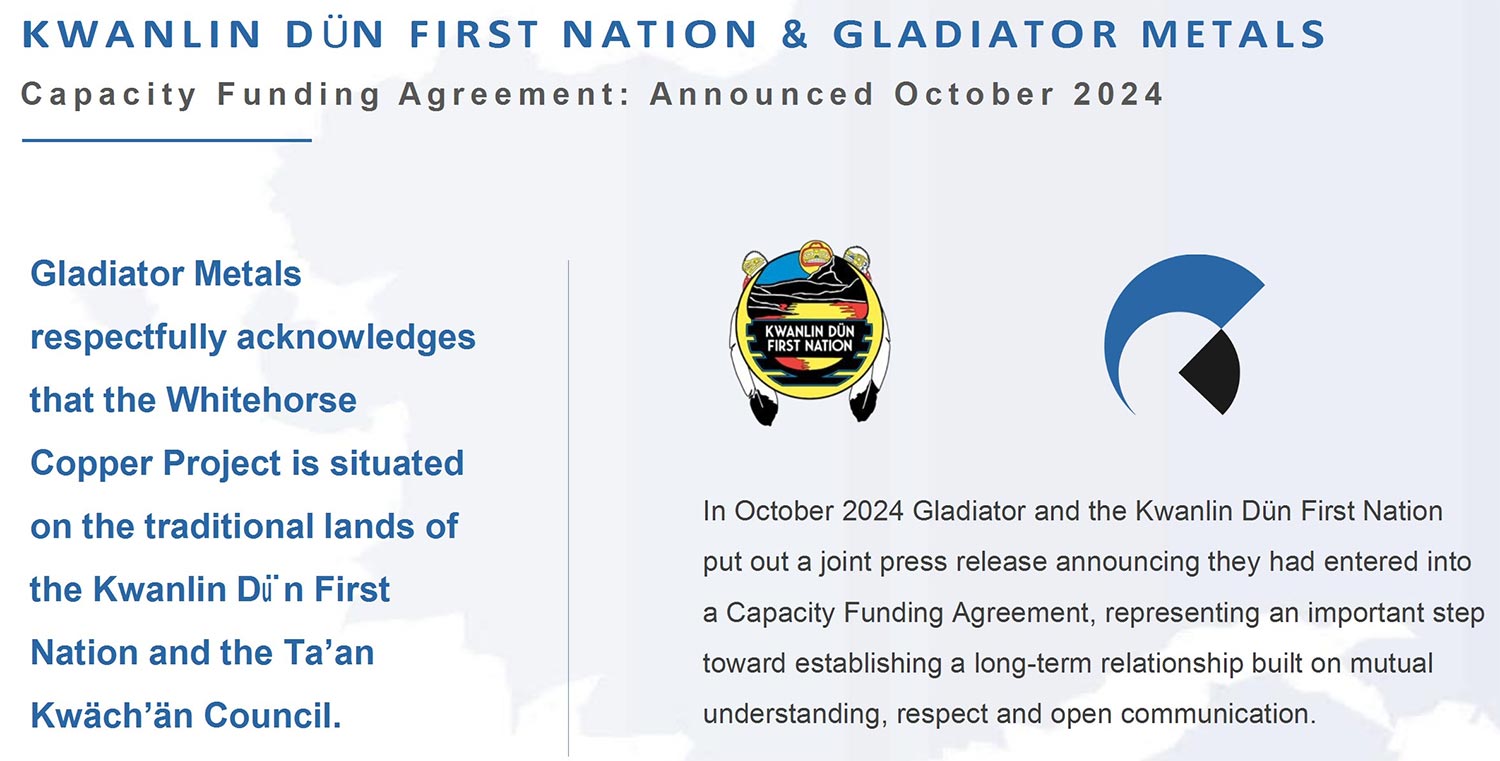
Importantly, the Whitehorse Copper Project is the only major mineral development opportunity within Kwanlin Dün traditional territory, making continued engagement and cooperation an important part of Gladiator’s strategy as the project advances.
Strong partnerships at this stage can help reduce future permitting and social risk.
Fully Funded and Accelerating Drilling
Gladiator enters the final stretch of 2026 from an exceptionally strong financial position.
In July, the company closed a C$35.04 million institutional private placement led by BlackRock, providing a major injection of capital and a significant vote of confidence from one of the world’s largest asset managers.
Gladiator now has approximately C$45 million in treasury and is fully funded to accelerate exploration through the end of 2027.
As CEO Jason Bontempo told us in our latest interview, “We currently have just under C$50 million in cash in the treasury to fund drilling right through to the end of next year.”
And the company intends to put that money to work.
With a planned exploration budget of more than C$40 million and 120,000 meters of drilling planned across 2026 and 2027, Gladiator is expanding to five drill rigs in Q4, including drilling at the high-priority Best Chance target.
That means aggressive drilling at Cowley and Cub, additional testing across the broader Whitehorse Copper Belt, and a steady stream of potential catalysts as Gladiator works to define resources and make additional discoveries.
Fully funded. More rigs. More drilling. And multiple opportunities for discovery across a 35-kilometer copper belt.
How Gladiator Compares to More
Advanced Copper Developers
Gladiator has already undergone a significant rerating as drilling continues to demonstrate the potential of the Whitehorse Copper Project.
But look at what has happened to more advanced copper companies.
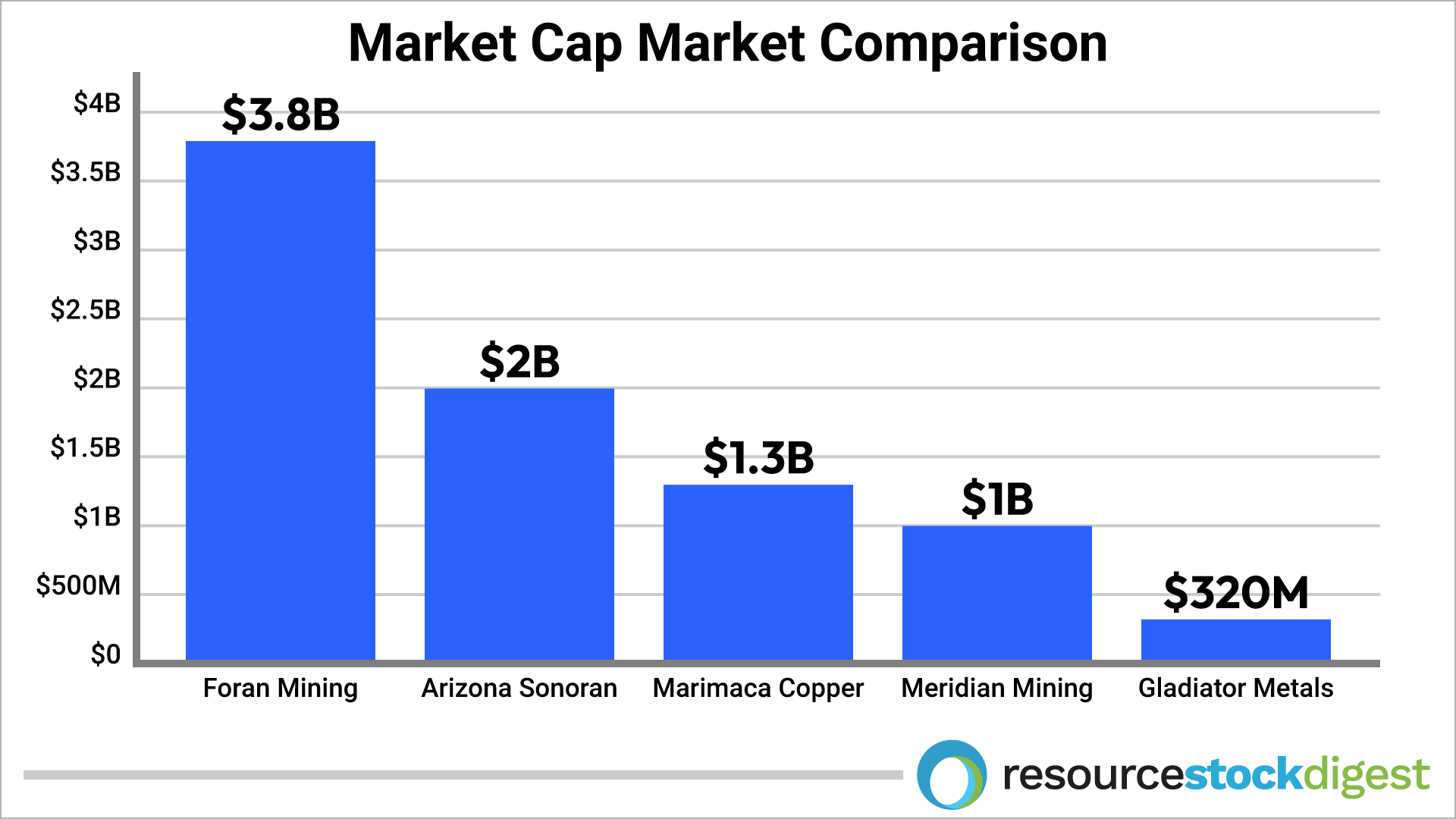
Foran Mining was acquired by Eldorado Gold for a valuation of approximately C$3.8 billion.
Arizona Sonoran was acquired by Hudbay Minerals at approximately C$2 billion.
Marimaca Copper and Meridian Mining currently command market capitalizations of approximately C$1.3 billion and C$1 billion, respectively.
Gladiator?
Approximately C$260 million — with Cowley still pre-resource and multiple advanced prospects across the Whitehorse Copper Belt.
Gladiator is earlier in the development curve — but that is exactly the point.
The market has already begun recognizing what Gladiator is building.
The question now is how much more value the drill bit can unlock.
So what comes next — and how does Gladiator plan to unlock that value?
Let’s go directly to CEO Jason Bontempo for the answers.
Exclusive Interview with Gladiator Metals
CEO Jason Bontempo
There are few copper companies in the junior space that can match the exploration, discovery, and capital markets experience Gladiator Metals has assembled.
CEO & Director Jason Bontempo brings more than 20 years of experience in public company management, corporate advisory, and investment banking.
President Marcus Harden brings more than 20 years of experience leading exploration projects worldwide and previously served as a principal geologist with First Quantum Minerals.
VP Exploration Kell Nielsen brings more than 30 years of geological experience and has been instrumental in the discovery and development of major resource projects globally, including work on the approximately 7-million-ounce Wallaby Gold Mine in Australia.
The board also brings considerable capital markets and resource-sector experience, including Director Shawn Khunkhun who has helped raise more than C$1 billion in equity for resource companies and Director Darren Devine who brings extensive corporate finance, M&A, and securities experience.
With Cowley advancing toward resource definition, Cub East emerging as a major new discovery, a strengthened treasury, and an aggressive drill program now accelerating across the Whitehorse Copper Belt, our own Gerardo Del Real of Resource Stock Digest sat down with Jason for the latest on what comes next.
Please enjoy the candid conversation.

Gerardo Del Real: This is Gerardo Del Real with Resource Stock Digest. Joining me today is the very busy CEO of Gladiator Metals — Mr. Jason Bontempo.
Jason, it is great to have you on. It’s been a bit. Congratulations on a heck of a run thus far in 2026. Let’s get into why I think it’s early. But congrats on a great year thus far. How are you today?

Jason Bontempo: Great, thank you, Gerardo. Great to be here again catching up with you.
Gerardo Del Real: Well, listen, once upon a time, a few years ago, we sat down in a hotel lobby, and it was yourself, some of the team, myself, Mr. Jeff Phillips, and Mr. Nick Hodge. And you all had this great idea for this project that you felt you understood very well. And you felt that it had the kind of scale that could be a game changer if you could prove it.
When you sit down with people in this industry, everybody believes they have a project where somebody maybe didn’t identify the scale or didn’t latch on to the more pertinent parts of it. And so we said, “Hey, great. Happy to watch the story and support the story.” And fast-forward a year and a half or two years later, you clearly have a tiger by the tail, and I want to get into that.
But before we get into that, can you start by providing a brief overview of the team and, frankly, the team that allowed you, at a very early point in the company’s history, to identify the potential for both grade and scale and multiple discoveries at the Whitehorse Copper Belt?
Jason Bontempo: Sure, Gerardo. The team comprises, obviously, myself, Marcus Harden, our president; and our partners, Kluane Drilling, which is owned by the Coyne family, a very successful local family in the city of Whitehorse in the Yukon.
The way it all came together is that I’d previously worked with the Coyne family. We were involved in a gold project in China, of all places, and I worked with Kluane Drilling, the drilling company owned by the Coyne family, for three years. We drilled out a very large gold deposit in northwest China that went on to be successfully developed into a producing gold mine.
Then, 15 years later, I was reacquainted with Jim and Rob Coyne via Marcus Harden, our president, and it all came together. I think it was just unique that the Whitehorse Copper Belt Project had been, in effect, hiding in the cupboard — hiding in the Kluane Drilling Coyne family cupboard.
No one really knew it was there other than them. Then, of course, Marcus Harden, who had moved from Australia to Canada and had briefly met them, brought us all together in 2021. I was very excited because I had looked at the project back when I first worked with the Coyne family in 2007.
I was amazed to think that a 35-kilometer-long copper belt with a formerly producing deposit — one of many deposits but one that had produced in the ’70s and ’80s — was available. And that’s how we got together.
Marcus went and spent six weeks there in March 2022 and digitized a lot of old data records. He spent a lot of time in Whitehorse, on the ground, having a look at the prospectivity. And the report came back and said, “Well, I think there’s potential here for over 100 million tonnes of high-grade copper resources from surface, and maybe more.” And that was how it all started, Gerardo.
We got together, came to an agreement with the Coyne family, and brought it into Gladiator Metals. We’ve been working at it now — well, it’s been about three and a half years since the first Gladiator Metals drill rig began turning at the project. And I think we’ve moved from a C$20 million to C$25 million market cap to now just shy of C$275 million.
Gerardo Del Real: Let’s talk about why it’s probably still early despite the run. We have copper making new all-time highs and looking like it’s going to continue making new all-time highs for the next several years with structural deficits really materializing in the space that I just don’t see an answer for anytime soon.
Give me your thoughts on why it’s likely still early because you talked about how, early on, you all felt as a team that you had the potential for 100 million tonnes of high-grade copper. And all you’ve done since then is prove that out to the point where you’re having companies and groups like BlackRock lead a C$35 million institutional private placement on very favorable terms.
That doesn’t happen every day in the resource space. Can you speak to that a bit?
Jason Bontempo: There are two key points as to why it’s still early, to answer your question, Gerardo. The first point is what we already know about the project, particularly what we know at the Cowley prospect. I’ll call it a prospect even though it’s very much looking like a deposit with the amount of drilling we’ve done. We just haven’t reported an official resource.
At the Cowley prospect and now the Cub prospect, I think what we see very much substantiates a large portion of our market cap and valuation just between those two future deposits. And that is really only on the basis that we’re still very early in the stage of development — or the stage of the project — which is pre-resource.
Now, if you look at peers in the industry that are more advanced than us — whether they’re post-resource, in feasibility, or even in construction — you’re looking at valuations ranging from over $1 billion to $2 billion to $4 billion.
For example, Foran was in construction and on its way to producing when it was taken out by Eldorado for close to $4 billion — $3.8 billion. And that was 40 million tonnes at 2% copper underground.
Arizona Sonoran, again, was at the permitting or feasibility stage when it was taken out for $2 billion by Hudbay. You look at Marimaca Copper or Meridian Mining. They’re both valued at over $1 billion and are more advanced with very similar potential tonnes and grade. Arguably, we will have a higher grade at the Whitehorse Copper Project.
And so that is why, when we’re pushing C$275 million, there’s still a long way to go. Just between those two deposits or prospects — Cowley and Cub — advancing them will unlock value.
The second point as to why we’re still very, very early is that we have two areas with what appear very likely to become high-grade copper resources within a 35-kilometer-long belt that still has numerous targets to test.
We have the Great Southern prospect, which we’re going to be drilling next year, where we’re identifying targets. Then we have the Arctic Chief trend and the Chief trend. These are advanced prospect areas where we just need to get drill rigs on them and show that they are the next prospects or deposits that will deliver resources.
And that is why it’s still very early — a combination of unlocking value from what we already know and the potential to deliver additional resources and discover more deposits or prospect areas.
Gerardo Del Real: The geophysics and the work the technical team has done clearly have enabled you to get this tiger by the tail. How important was receiving that Class 3 exploration permit for what comes next? And then I’d love for you to let the audience know what is next.
Jason Bontempo: To answer the first part of your question, yes, the geophysics work is very important. And what you’re referring to is the discovery of the Cub deposit, which came purely from geophysics — a combination of gravity and IP.
The gravity gives you the density, and the IP gives you the chargeability. You match up the density — where the higher the density, the more likely it is to be a copper skarn, which is what we’re looking for — with the IP. The higher the chargeability, the greater the chance that it’s sulfides carrying the copper mineralization.
That worked at Cub, and now we have an exploration tool and technique that we can apply to the rest of the belt. I think investors and the market recognize that we’ve potentially unlocked the tool for further discovery.
And then what’s next? Well, now that the summer is beginning to wind down in the Yukon, it won’t be winding down for Gladiator. We can drill year-round.
Over the final part of this year — particularly through September, October, and November — there’s going to be a significant amount of drilling. We’re going to be moving from three rigs to five rigs, and there’s going to be lots of news coming out of Cowley and Cub.
We’re also hoping to get a sixth rig onto Best Chance, which is a prospect we tested last year that looks very promising. It looks like it could have the size, tonnes, and grade of Cowley, and we’d like to show that it’s going to start stacking up as the next cab off the rank in terms of a deposit.
So there will be a significant amount of drilling and lots of news with plenty of substantiation of what we know at Cowley and Cub and, hopefully, further discovery at Best Chance.
Gerardo Del Real: All of those catalysts, together with what I believe is going to be a red-hot — pun intended — copper market, should make for a fun close to 2026 and a heck of a 2027.
Jason, thank you for your time. Anything else you’d like to add before I let you go?
Jason Bontempo: Just to add that we are fully funded, Gerardo. Back in June, we announced a significant C$35 million financing led by BlackRock. And so we currently have just under C$50 million in cash in the treasury to fund drilling right through to the end of next year.
Gerardo Del Real: Congrats on all the success. I suspect there’s a lot more to come. Jason, thank you so much.
Jason Bontempo: Thank you, Gerardo.
The Takeaway:
A Rare Combination in Today’s Copper Market
Gladiator Metals is advancing the Whitehorse Copper Project in Canada’s Yukon — a 35-kilometer, district-scale copper belt with a history of high-grade production, outstanding infrastructure, and multiple areas now demonstrating significant discovery and resource potential.

Backed by a strong treasury and an aggressive drill program, Gladiator has assembled a combination that is increasingly difficult to find in the copper exploration space: high grades, near-surface mineralization, district-scale potential, excellent infrastructure, and multiple opportunities for discovery in a premier mining jurisdiction.
And the timing is compelling.
Copper is trading at record highs as long-term supply constraints continue to come into focus, while Gladiator is entering its most aggressive period of exploration yet.
With 120,000 meters of drilling planned across 2026 and 2027, five rigs scheduled to be turning in Q4, resource definition underway, and additional discovery targets advancing across the belt, there should be no shortage of catalysts ahead.
Gladiator remains at an important stage in its evolution: still pre-resource but increasingly demonstrating the scale, grade, and repeatability that could ultimately define a much larger copper district.
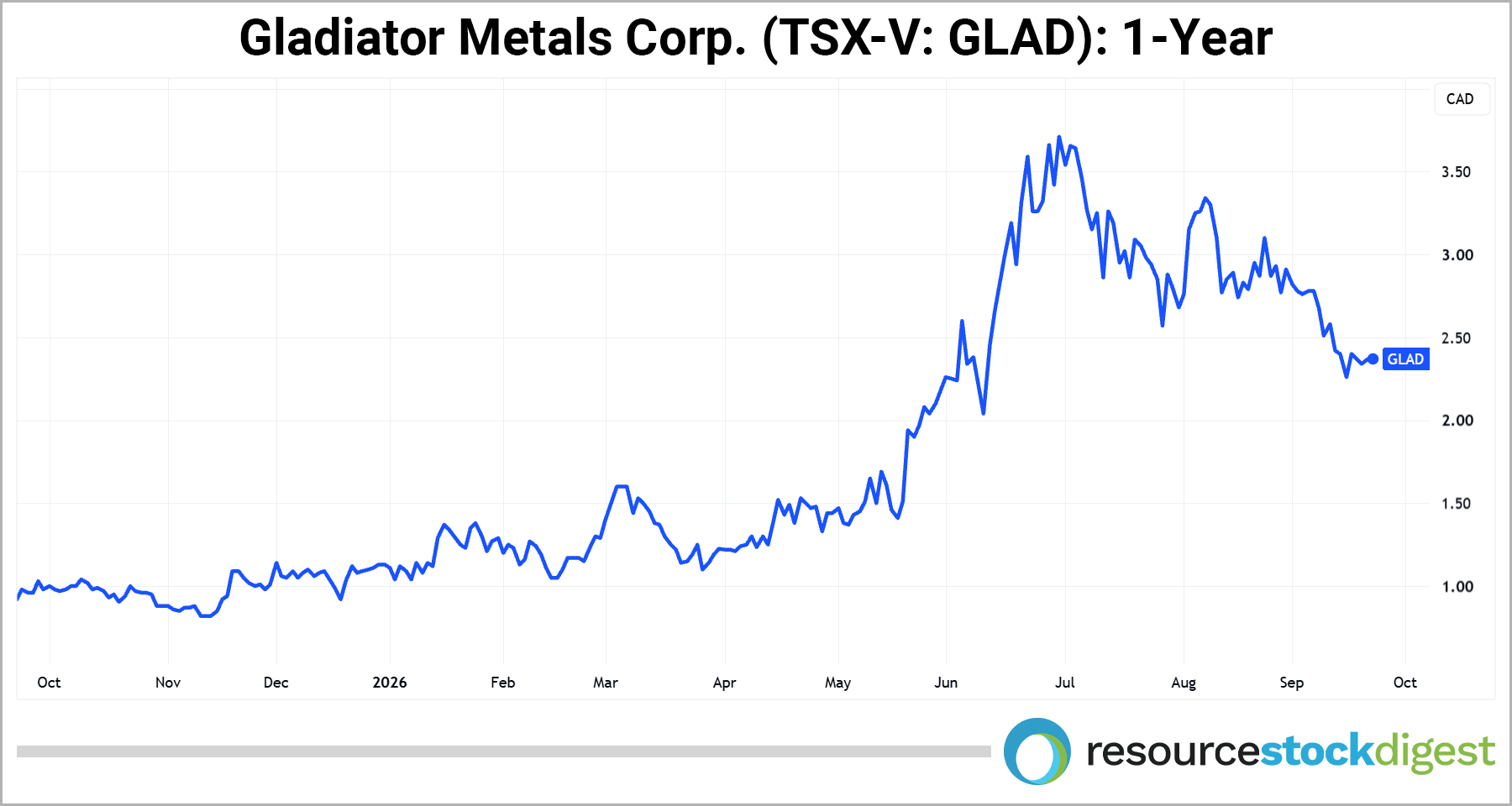
The company is also well-structured with approximately 116.5 million shares outstanding — a compelling setup given the scale of the opportunity now taking shape at Whitehorse.
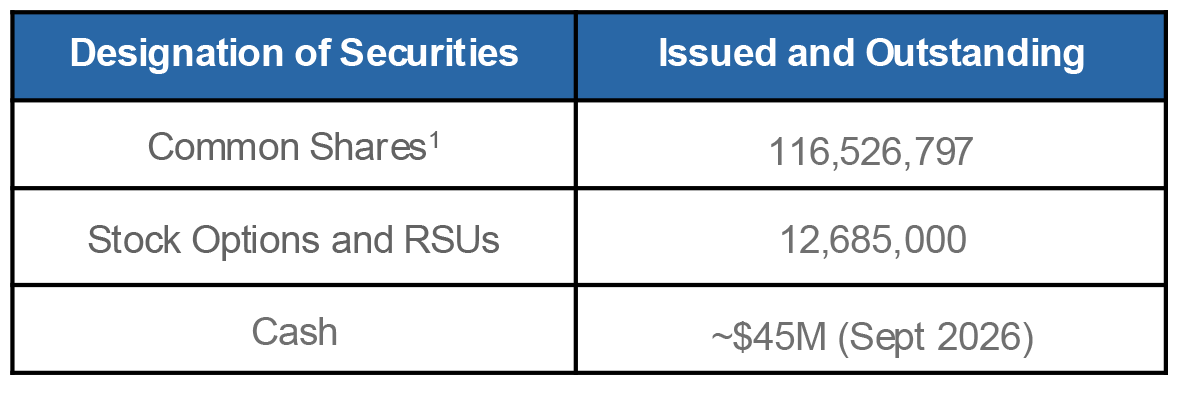
Now is an excellent time to begin conducting your own due diligence on Gladiator Metals Corporation — symbol GLAD on the Toronto Venture Exchange and symbol GDTRF on the US-OTCQX.
A great place to start is the Gladiator Metals corporate website.
There, you can sign up to receive updates directly from the company, view the most recent Corporate Presentation and much more.
Be sure to also follow our latest interviews and exclusive coverage on the company here.
— Resource Stock Digest Research
Click here to see more from Gladiator MetalsIMPORTANT DISCLAIMER & DISCLOSURES
Resource Stock Digest, as a publisher, is not a broker, investment advisor, or financial advisor in any jurisdiction.
Please do not rely on the information presented by Resource Stock Digest as personal investment advice.
If you need personal investment advice, kindly reach out to a qualified and registered broker, investment advisor, or financial advisor.
The communications from Resource Stock Digest should not form the basis of your investment decisions. Examples we provide regarding share price increases related to specific companies are based on randomly selected time periods and should not be taken as an indicator or predictor of future stock prices for those companies.
Gladiator Metals has sponsored this report.
The information in this newsletter does not constitute an offer to sell or a solicitation of an offer to buy any securities of a corporation or entity, including U.S. Traded Securities or U.S. Quoted Securities, in the United States or to U.S. Persons. Securities may not be offered or sold in the United States except in compliance with the registration requirements of the Securities Act and applicable U.S. state securities laws or pursuant to an exemption therefrom.
Any public offering of securities in the United States may only be made by means of a prospectus containing detailed information about the corporation or entity and its management as well as financial statements. No securities regulatory authority in the United States has either approved or disapproved of the contents of any newsletter. Neither Resource Stock Digest nor any employee of Resource Stock Digest is registered with the United States Securities and Exchange Commission (the “SEC”): as a “broker-dealer” under the Exchange Act, as an “investment adviser” under the Investment Advisers Act of 1940, or in any other capacity. Resource Stock Digest, its owners, directors, and employees are also not registered with any state securities commission or authority as a broker-dealer or investment advisor or in any other capacity.
HIGHLY BIASED:
In our role, we aim to highlight specific companies for your further investigation; however, these are not stock recommendations, nor do they constitute an offer or sale of the referenced securities. Resource Stock Digest has received cash compensation from Gladiator Metals and is thus extremely biased. It is crucial that you conduct your own research prior to investing. This includes reading the companies' SEDAR and SEC filings, press releases, and risk disclosures. The information contained in our profiles is based on data provided by the companies, extracted from SEDAR and SEC filings, company websites, and other publicly available sources.
Resource Stock Digest, and its owners, directors, employees, and members of their households may own shares of Gladiator Metals. Therefore, Resource Stock Digest is extremely biased. Measures are in place such that no shares will be sold during the active awareness campaign.
HIGH RISK:
The securities issued by the companies we feature should be seen as high risk; if you choose to invest, despite these warnings, you may lose your entire investment. You must be aware of the risks and be willing to accept them in order to invest in financial instruments, including stocks, options, and futures.
NOT PROFESSIONAL ADVICE:
By reading this, you agree to all of the following: You understand this to be an expression of opinions and NOT professional advice. You are solely responsible for the use of any content and hold Resource Stock Digest, and all partners, members, and affiliates harmless in any event or claim. While Resource Stock Digest strives to provide accurate and reliable information sourced from believed-to-be trustworthy sources, we cannot guarantee the accuracy or reliability of the information. The information provided reflects conditions as they are at the moment of writing and not at any future date. Resource Stock Digest is not obligated to update, correct, or revise the information post-publication.
FORWARD-LOOKING STATEMENTS:
Certain information presented may contain or be considered forward-looking statements. Such statements involve known and unknown risks, uncertainties, and other factors that may cause actual results or events to differ materially from those anticipated in these statements. There can be no assurance that any such statements will prove to be accurate, and readers should not place undue reliance on such information. Resource Stock Digest does not undertake any obligations to update the information presented or to ensure that such information remains current and accurate.