Click here to read important disclaimer & disclosures Click here to see more about Empress Royalty
Gold & Silver Royalty
TSX-V: EMPR | OTCQX: EMPYF
Top-Emerging Small-Cap
Gold-Silver Royalty Firm
Expanding Portfolio of Producing Precious Metals Assets
— Shares Currently Below $1 —
$62 MILLION TONGON GOLD STREAM
TAKES EMPRESS TO NEW SCALE
BIGGER DEALS + NEW ACQUISITIONS AHEAD
— The Opportunity BEFORE the Market Catches Up —
Click Here to Read Sponsor Disclosure
The Empress Royalty Approach
Empress Royalty Corp. (TSX-V: EMPR)(OTCQX: EMPYF) offers resource speculators a very different proposition than the typical exploration company.
Rather than taking on the cost and risk of exploring for deposits, building mines and operating them, Empress provides capital to carefully selected mining firms in exchange for gold and silver royalties and streams — giving the company exposure to production, rising metals prices and potential future discoveries across a growing portfolio of assets.
And importantly, this isn’t a business model waiting to prove itself.
Today, Empress Royalty (“EMPR”) has built a geographically diversified portfolio focused on gold and silver, combining cash-flowing producing assets with a growing pipeline of earlier-stage royalties.
Empress has already grown annual revenue from approximately $1.8 million in 2022 to a record $17.2 million in 2025 while achieving positive operating cash flow. That momentum has carried into 2026 with first-quarter revenue more than tripling year-over-year from the company’s four producing cornerstone investments.

Now, management is taking the next major step in scaling the business.
Empress is acquiring a $62 million gold stream on the producing Tongon Gold Mine in Côte d’Ivoire, West Africa — by far the largest transaction in the company’s history and one that adds a fifth producing asset to the portfolio.
And there’s a much bigger story behind how Empress got here.
From the beginning, management has focused on establishing a foundation of producing and near-producing assets capable of generating revenue and providing the financial flexibility to pursue additional opportunities over time.
That foundation is now firmly in place.
EMPR has since expanded into select development and exploration-stage royalties, adding another layer of longer-term optionality while developing new ways to identify and screen new opportunities.


And then there is Endeavour Financial.

Through its longstanding strategic relationship with the mining-focused investment banking firm, Empress has access to a vast network of deal flow, technical expertise and mining-finance experience that its size alone might never suggest.
Empress President & CEO Alexandra Woodyer Sherron — who joins us for an exclusive interview later in this report — spent years at Endeavour Financial before launching Empress alongside David Rhodes, who serves as both a Managing Director of Endeavour and Executive Chairman of Empress.

The recently announced Tongon transaction came directly through that relationship and Endeavour’s longstanding work with Appian Capital.
In other words, Tongon didn’t simply appear out of nowhere.
It represents the latest and largest step in a strategy that has already taken EMPR from four initial producing cornerstone investments to record revenue, a broader portfolio spanning the mining lifecycle and, now, a proposed $62 million stream on an established producing gold mine.
All of this is happening against a powerful precious metals backdrop where higher gold and silver prices can flow directly through royalty and streaming economics without requiring Empress to fund the operating and capital costs faced by mine operators.

That combination — a proven revenue-producing foundation, an expanding portfolio, and access to new opportunities amid a strong precious metals environment — is what makes the timing of the Empress story particularly compelling.
Unlike the typical junior resource story where shareholders often spend years waiting for drilling, permitting, financing, and construction to translate into value, Empress is already generating revenue and building from a strong production foundation.
The question now is how far management can take it.
That answer starts with the royalty and streaming model Empress is building around — the same model behind some of the most successful companies in the precious metals sector.
A Different Way to Participate in Mining
The appeal of the royalty and streaming model starts with a simple reality: mining requires enormous amounts of capital and carries substantial risk at nearly every stage.
A traditional mining company can spend hundreds of millions of dollars finding a deposit, defining it, permitting it, building the mine, and then operating it.
And the spending doesn’t stop once the first ounce is poured.
Royalty and streaming companies approach that equation from a very different direction.

Rather than operating the mine, they provide capital to mining companies in exchange for an economic interest in the production those companies generate.
For example, a royalty entitles Empress to an agreed upon percentage of the revenue generated from a mine.
As Sherron explains… royalties effectively sit at the “top line” — allowing Empress to participate in revenue without directly absorbing the mine operator’s ongoing operating and capital costs.

A stream works somewhat differently. Empress provides capital in exchange for the right to receive an agreed percentage of the gold or silver produced, purchasing those ounces at a predetermined discount to prevailing metals prices.
Having both tools gives EMPR considerable flexibility when structuring an investment. And when those investments are made successfully, the economics can become quite attractive.
The mine operator remains responsible for operating the mine and typically funds the exploration and development required to expand resources, discover additional mineralization or extend the mine life.
EMPR can benefit from that additional production and mine-life growth through its royalty or stream without directly funding the exploration and development behind it.
And that is where the model becomes even more powerful.
Put capital to work once… generate cash flow from the investment… and then reinvest that cash flow into the next royalty or stream.

As renowned mining financier and strategic EMPR investor Rick Rule — who also joins Sherron in our exclusive interview just ahead — explains it, repeat that process successfully over time and the power of compounding begins to take over.
- One producing asset can become several.
- Development-stage assets can advance toward production.
- Exploration success can extend existing mines or create entirely new sources of future revenue.

Of course, none of that eliminates mining risk. Empress still depends on the quality of the underlying assets, operators, and jurisdictions — which makes selecting and structuring each investment critically important.
And that brings us directly back to Empress.
Management didn’t begin by assembling a large collection of speculative royalties and hoping that something eventually worked.
It started by building a foundation of producing and near-producing assets designed to generate cash flow.
Next, see how Empress is turning that strategy into producing assets, rapidly growing revenue, and an expanding runway for future growth.
Building the Foundation: Four Producing Assets
Plenty of people have money.
The harder part is knowing where to put it.
That distinction matters because Empress’s job isn’t to operate mines — it’s to allocate capital intelligently by finding the right assets, backing capable operators and structuring investments that can deliver attractive economics over time.
As Sherron explains it, Empress initially concentrated on producing and near-producing assets for a simple reason: Cash flow would give the company the ability to grow.
That strategy has since produced a cornerstone portfolio of four cash-flowing precious metals investments across Mexico, Peru, South Africa and Mozambique — three streams and one royalty.
The Tahuehueto stream offers a particularly strong example of that strategy at work: Empress invested $5 million in the Tahuehueto Mine in Durango, Mexico, securing a silver stream that currently entitles it to purchase 100% of payable silver production at 20% of the applicable offtake price until 1.25 million ounces have been delivered.

Think about those economics for a moment.
Empress put $5 million to work. Operator Luca Mining Corp. is responsible for building and operating the mine. And as Tahuehueto advanced into commercial production, Empress’s stream began generating increasingly meaningful revenue.
In the first quarter of 2026 alone, Tahuehueto generated approximately $6.4 million in stream revenue for Empress — more than four times the approximately $1.5 million generated during the same quarter a year earlier.
That’s the streaming model doing exactly what it is designed to do.
And Empress didn’t stop at one mine. Today, its four producing cornerstone investments include:
- Tahuehueto, Mexico: $5 million silver stream.
- Sierra Antapite, Peru: $10 million gold stream.
- Galaxy, South Africa: $5 million gold stream.
- Manica, Mozambique: $3 million gold royalty.
By the first quarter of 2026, all four were contributing revenue, strengthening Empress’s financial flexibility and giving management greater capacity to reinvest and pursue new opportunities.

Sherron describes Empress as having evolved into a “full stage, full lifecycle royalty company” — an evolution built on establishing the cash-flowing foundation first.
And now comes the biggest step yet.
Let’s dive into EMPR’s $62 million gold stream on the producing Tongon Gold Mine — by far the largest transaction in the company’s history.
Tongon: The $62 Million Inflection Point
EMPR’s biggest step yet is Tongon.
In September 2026, Empress agreed to acquire a gold stream on the producing Tongon Gold Mine in Côte d’Ivoire for an upfront payment of $62 million — by far the largest transaction in the company’s history.
Sherron calls Tongon a “transformational transaction for Empress,” pointing to its strong operating history and opportunities for further reserve replacement and exploration success.
In other words… Tongon is not a mine waiting to be built.
Originally developed by Randgold Resources and later operated by Barrick Gold, Tongon entered commercial production in 2010 and has since produced more than 3 million ounces of gold.

Atlantic Group acquired Barrick’s 90% interest in 2025, and Tongon produced approximately 125,600 ounces of gold that year.
In exchange for its $62 million upfront investment, Empress will receive a percentage of Tongon’s payable gold production while paying just 0.5% of the prevailing gold price for each ounce delivered.
What’s more, Atlantic continues to invest in exploration, reserve replacement, operational improvements and development of Tongon’s satellite deposits — work that could extend mine life and increase future production.
Once again, that’s the streaming model at work: Atlantic funds the exploration and operates the mine while Empress participates in any additional production covered by the stream.
Tongon also demonstrates the value of EMPR’s relationship with Endeavour Financial with the opportunity coming through Endeavour’s longstanding work with Appian Capital, which is providing a $75 million senior secured credit facility to help finance the transaction and future acquisitions.
As Sherron puts it, the structure allows Empress to complete the Tongon investment while “preserving our liquidity and limiting shareholder dilution.”
That’s what scaling looks like.
And Tongon isn’t the only source of future growth.
Beyond its producing assets, Empress is also building exposure to discoveries and development it won’t have to fund.
Key to the Empress Throne: Cash Flow
The cash flow generated by EMPR’s producing assets doesn’t simply end up on the balance sheet.
It gives management the ability to pursue the next opportunity.
In August 2026, Empress acquired 14 pre-production royalties from Almadex Minerals for $2.5 million, adding exposure to projects across Canada, the United States, and Mexico being advanced by companies including Alamos Gold, McEwen, Kodiak Copper, and Westhaven Gold.
The attraction is straightforward: Empress gains exposure to future discoveries and development while the underlying operators spend their own capital advancing the projects.
Consider Westhaven.
Empress now holds 2% NSR royalties on Westhaven’s Prospect Valley and Skoonka Creek projects in British Columbia.

Earlier this year, Dundee Corporation agreed to fund up to C$85 million in staged expenditures across Westhaven’s four-project district, including a firm C$30 million initial commitment.
Empress doesn’t write those exploration checks… yet successful exploration and development can effectively increase the value of its royalties.
Sherron says the acquisition expands Empress’s “pipeline of future royalty opportunities” while maintaining a disciplined approach to capital allocation.
And management is widening the search for those opportunities.

In July 2026, Empress engaged Geomorphic AI — a mining-focused artificial intelligence platform — to help source, rank and conduct technical, resource and mine-life due diligence on prospective royalty and streaming opportunities.
Technology can help find the opportunities… but it still takes people to decide where the money goes.
And increasingly, Empress has more capital to put behind those decisions. With the revenue spigot now flowing, Empress’s financial capacity is strengthening, opening the door to additional opportunities and larger transactions.
Repeat that process successfully over time and the growth begins to compound.
For more on the team and strategy making it all come together… let’s go directly to the people behind Empress.
Exclusive Interview with Empress Royalty
CEO Alexandra Woodyer Sherron and
Strategic Investor Rick Rule
As alluded to earlier… the Empress growth story is deeply rooted in Endeavour Financial.
President & CEO Alexandra Woodyer Sherron spent a decade at Endeavour, ultimately serving as Director of Structured Finance and originating, structuring, and executing more than $2 billion in cross-border financings, restructurings, and acquisitions.

Empress Executive Chairman David Rhodes has spent roughly two decades as a Managing Director of Endeavour and more than 30 years in mining finance.
And importantly, the idea behind Empress emerged from what they were seeing firsthand. Rhodes has explained that Endeavour repeatedly encountered smaller mining companies requiring royalty and streaming capital that the larger providers simply weren’t supplying.
Empress was built specifically to pursue that opportunity.
Today, Endeavour serves as Empress’s investment manager, providing direct access to a global team of investment bankers, geologists, mining engineers, cash-flow analysts, and financial specialists. Its track record includes approximately $1.2 billion in royalty and stream finance and $8.6 billion in debt finance.
That gives Empress access to a vast pool of expertise extending well beyond its own four walls.
The company has also added specialists around that core.
Technical Advisor David Laing, North American business-development advisor Mark Ashcroft, African business-development advisor Brad Breetzke, and QP Rick Mazur provide additional expertise spanning mine operations, technical due diligence, geology, and project finance.
That matters because royalty and streaming is ultimately a capital-allocation business.
Strategic investor Rick Rule, former President & CEO of Sprott U.S. Holdings and current head of Rule Investment Media, brings extensive experience evaluating exactly the kinds of capital-allocation decisions at the heart of the Empress model.
And rather than have us explain how management intends to put all of those pieces to work, we’ll let Sherron and Rule take it from here in their exclusive interview with Resource Stock Digest’s Nick Hodge.


Nick Hodge: This is Nick Hodge with Resource Stock Digest. I’m here today with Rick Rule of Rule Investment Media and Alexandra Woodyer Sherron, President & CEO of Empress Royalty. Thank both of you for being here today.

Alexandra Woodyer Sherron: Thank you for having us.

Rick Rule: Pleasure, sir.
Nick Hodge: The goal today is to explain why the royalty and streaming companies can be such an attractive business for precious metals investors, why Rick has backed this model for decades, and then we’re going to use Empress as a case study, along with a new acquisition that the company has made, as a real-world example.
So we’re going to start with Rick. Why does Rick Rule like the royalty model so much? I’ve heard you say that royalties and streaming companies occupy what you consider to be one of the best parts of the mining capital stack.
Before we get to Empress, why do you like this business model so much, Rick?
Rick Rule: Well, there’s a whole bunch of reasons. The first is that mining — well, extractive industries generally — are capital intensive, volatile, and risky. The royalty and streaming business, with the exception of management mistakes, which is to say making a lousy investment, obviates most of those risks.
In the royalty business, in effect, your gross is your net. You don’t have upfront capital expenditures. You don’t have sustaining capital expenditures. You don’t have operating costs. Basically, that money which is specified by contract comes to you with no deduction for you to do with as you like.
It is also easier for a mining company not to mine. If all you do is cash a check, it is less incumbent on you to have phalanxes of managers and geologists and engineers. Never mind the fact that your gross is your net. Your G&A has the potential to be much lower.
A stream is a different instrument but it’s still an instrument where, properly constructed, you own all or some of the upside and you share in none of the downside.
I have participated as a lender in capital stacks alongside lots of royalty and streaming companies, but in particular Franco-Nevada and Wheaton Precious Metals, and I noticed often, as the secured lender, I was in first except for that I was pari passu with the royalty company or the streaming company.
Every other creditor in the place was subordinated to me, with the exception of Randy Smallwood or Pierre Lassonde, both of whom enjoyed that role of pari passu security.
A second point, or maybe it’s a third, is the fact that given that the business model is superior to other business models in extractive industries, the executives that find themselves attracted to this business model are usually more sophisticated, which is to say the people whose strategy is “got a hunch, bet a bunch” are more attracted to grassroots exploration.
And the people who are interested in probabilistic compounding over time, which is a much better investment strategy, are more often drawn to royalty and streaming. It’s a much more sophisticated investment that attracts much more sophisticated investors.
Nick Hodge: A follow-up here. You mentioned you don’t participate in the downside. One other thing I’ve heard you say about this business model is that if you take away most of your downside, you can also take away some of your upside.
Is that the right way for investors to think about owning the royalty and streaming companies versus the miners themselves?
Rick Rule: Anybody who doesn’t think that way across the length and breadth of their investment portfolio needs to have their head examined.
If you chase unbridled upside, unless you happen to be very tough, very rich, and work very hard, which is to say unless you’re Eric Sprott, the idea that you don’t juxtapose your downside against your upside is just lousy math. There’s just no particular point in not measuring both metrics.
When people say, “If this goes right, this goes right, this goes right, and this goes right, you could make 10 times on your investment,” you need to assess the probability that all four things go right, which is normally nil.
Nick Hodge: Alex, over to you. We typically use royalty and stream interchangeably but they are different things, of course. Rick started to explain the difference there a little bit, saying that streaming was a bit of a different model, but can you explain further in simple terms the difference between a royalty and a stream?
Alexandra Woodyer Sherron: Yes, absolutely. Royalties started hundreds of years ago with individuals wanting to mine land that the king owned, and he would receive a royal payment or percentage of that production. And that’s where royalties originated from.
It was later more commercialized by Franco-Nevada and other groups, and that is essentially where a company is receiving a percentage for their investment into it. They’re receiving a percentage of revenue from the production of the mine. So, for example, simplifying this very much, a 2% royalty is $2 for every $100 produced.
A stream was something that was created back in 2004 by what was then called Silver Wheaton, now called Wheaton Precious Metals. And the concept there was to be able to get non-dilutive capital or additional access to capital from mining companies, taking advantage of their production.
That’s where a streaming company invests in a company, provides capital, and in return gets a percentage of the metal. In Empress’s case, we’re getting a percentage of the gold or silver, which we’re buying at a deeply discounted price, typically paying 20% of spot. A royalty is more cash. The stream is more metals that you’re receiving.
But in both cases, as Rick mentioned, you don’t have the operating costs or the operational risks of being a mining company, and you’re able to participate in the upside and the further development work that’s done at a mine for no additional cost to us. We hold that percentage coming in.
Nick Hodge: And does Empress focus more on royalties or more on streams?
Alexandra Woodyer Sherron: We focus on both. With our mining finance background and structured finance background, we’re typically more interested in the stream creation side, but we do look at both opportunities.
It really depends on the opportunity in front of us, what countries we’re investing in, how we structure. There are typically more bells and whistles that you can play with in a streaming agreement to adapt to the environment that you’re structuring into, but we do both.
Nick Hodge: And, Rick, from your chair as an investor, any difference or preference on streams versus royalties?
Rick Rule: I think increasingly, we do what serves the customer, which is to say you look at the needs of the issuer. In the old days, we would often buy royalties from prospectors or people involved in the value creation chain.
The industry matured so that companies would sell royalties to raise what they consider to be at least non-equity-diluting interests in the capital stack. Streams were much more directly related to the capital stack, in particular because precious metals revenues are worth more in the market than those revenues would be if they reported as nickel or zinc or copper.
The base metals companies, in particular, have an incentive to sell the byproduct gold and silver revenues to somebody like Alexandra because she can surface the value more efficiently than they can, and she can provide them financing by doing this that has a much less dilutive impact on the equity shareholders.
The idea, Nick, is that you construct a financing package that is in the best interest that you can structure of the person that’s selling you the royalty or the stream.
Nick Hodge: Let’s talk about this issuer, Empress, of which you are a shareholder. This is not an academic exercise, and I know you’ve been a shareholder for at least a few years. Can you lay out what first attracted you to Empress and what made you write the initial check?
Rick Rule: Sure. I haven’t been involved in academic exercises for a very long time, Nick. I joke. I’m party to numerous conflicts of interest and I’m actively soliciting more. I met Alexandra, although I’ve known her parent firm, Endeavour, for a long time, and I’ve known her father for probably a longer time.
I met Alexandra, if my memory serves me correctly, in Zurich at Manny Bally’s wonderful conference. I was wandering around listening to stories, and she told me that she had a nascent royalty and streaming company that had access to the deal flow of Endeavour.
That was of interest to me because I know the Endeavour people. And she told me that she was selling at half NAV, and my interest progressed from interest to fascination. She’s also a very tough negotiator. She got me to do one of the few above-market financings that I’ve done during my time on earth. In return, I think I probably extracted a warrant or part of a warrant from her.
In other words, I gave her part of the upside but I got to take part of the upside if she was inordinately successful. And she made a very plausible case that she was selling at a discount to what it was worth.
I like investments that can compound. I like the idea that people can take the cash flow that they generate from the investment and reinvest that same money at high rates of return. And I like durable competitive advantages.

If you look across the royalty and streaming space, there’s a whole bunch of me-too royalty and streaming companies. They raise money because they’re royalty and streaming companies. In the case of Alexandra, she explained to me that in addition to the fact that she was selling at a discount to realizable net asset value, that she had access to the deal flow that came out of Endeavour.
When you’re looking particularly at the third-tier royalty and streaming companies, the little ones, what you need to find is durable, sustainable competitive advantage. In other words, you need to be able to obviate the auction process where all you’re doing is overpaying more aggressively than your peers, and you need to focus on companies that can sidestep the auction process.
And the fact that Endeavour, which Alexandra was part of for a substantial period of time, had completed, to my knowledge, billions of dollars of transactions in the same space seemed to be precisely that durable competitive advantage that would allow me to take advantage of compounding.
Nick Hodge: I had a feeling Endeavour was going to come up, and I want Alex to follow up on that. Can you talk about Endeavour, what it is, what is that competitive advantage that it gives you, or define it, as it were, the definable competitive advantage that allows Empress to punch above its weight, whether that’s sourcing deals or helping finance deals or technical due diligence, whatever it may be?
Alexandra Woodyer Sherron: Sure. Endeavour Financial is a leading investment banking firm focused on the mining industry. It’s been around for over 30 years, $8 billion in debt financings.
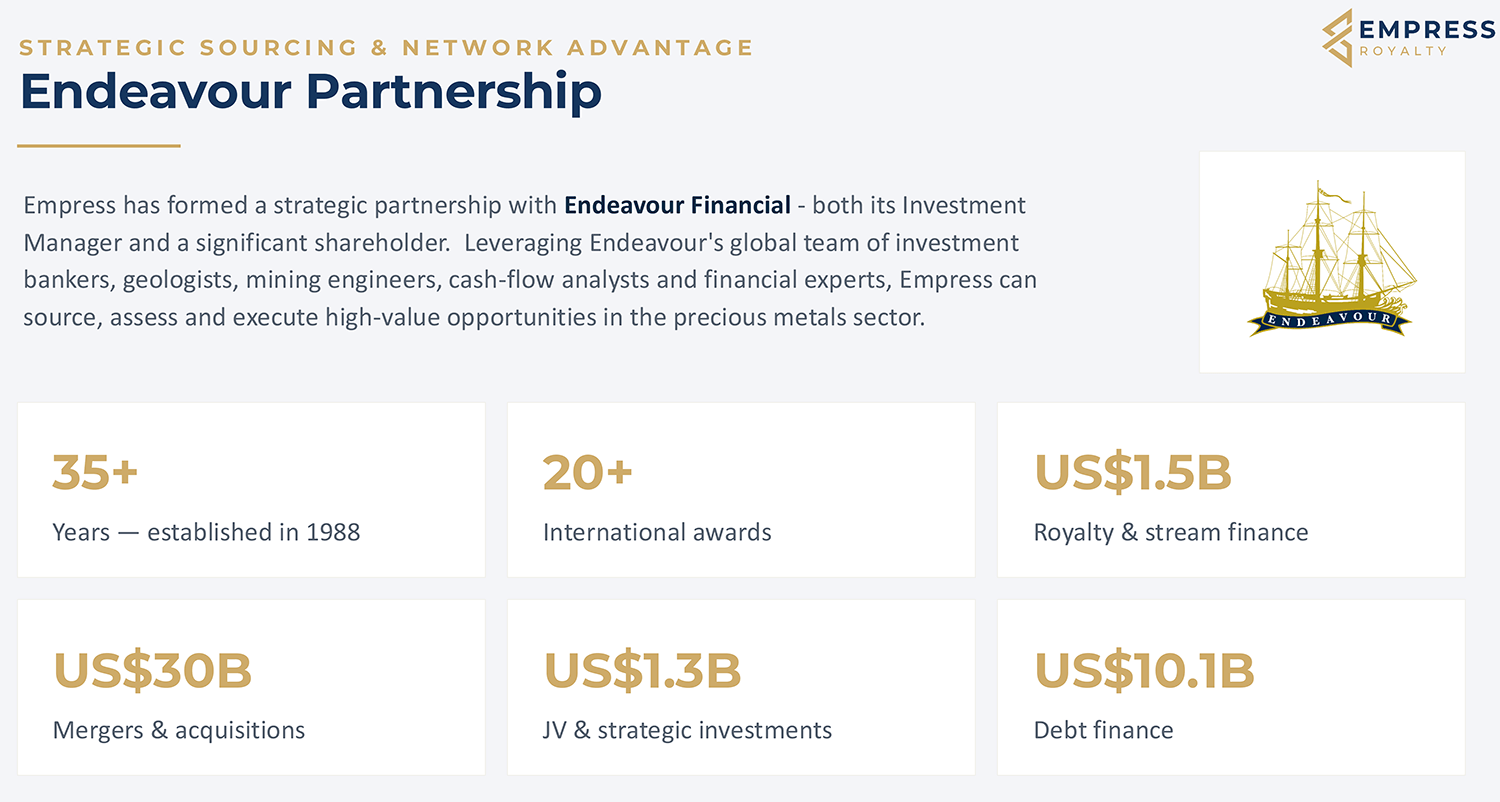
This is a very core team based in London and Vancouver. And with this team, I was there. I started out as an analyst, became director of structured finance over a period in London, did $1.5 billion worth of deals myself.
David Rhodes, who’s the managing director of Endeavour Financial, and I teamed up to launch Empress, and he’s the chairman of the company. And this really gives me access to geologists, mining engineers, investment bankers, financial analysts to, as you mentioned, punch above our weight in terms of the team size, keeping our G&A lower.
But it also gives us access to a whole network, so we’ve got access to multiple opportunities. We’re constantly looking at things, and the recent transaction we just announced was a direct part of that relationship with Endeavour Financial.
They had worked with Appian for many years, since Appian’s inception, as an advisor to it. Also advising their clients and bringing Appian into different deals. Recently, they did a silver stream with Appian being part of that.
They were really able to understand how the Appian team works, how they structure the streams, how they’re put together. And so that really did give us a leading advantage to build the relationship with Appian, as well as understand the Tongon stream.
Nick Hodge: And before we get to the Tongon stream, which is the transformational acquisition for which we’re doing this interview or educational little podcast here, can you tell me what Empress built before that transaction? You had four producing cornerstone assets.
Can you just quickly tell us about that platform? I couldn’t help but notice that, in the first six months of 2026, revenue more than doubled from those four streams. Tell us the current Empress platform, if you will.
Alexandra Woodyer Sherron: Yes, when we set Empress up, it was seeing that there was a niche in the market. No one was providing the streaming finance solution to the junior side of the market, and so thus we set up Empress.
And we came in with a very clear direction to invest into producing assets or near-term producing assets so we could generate that revenue, as Rick mentioned, and be able to reinvest it. And we’ve hit that critical point now.
We have the four producing assets. We have the Tahuehueto silver stream in Mexico, we have the Sierra Antapite gold stream in Peru, the Manica one in Mozambique, and then we also have a gold stream in South Africa with Galaxy.

Those produced record revenue for our first half of this year, and we’re able to, now at that point, find additional investments that will bring more revenue in.
Through this financial flexibility that’s happened with Empress over the last couple years, especially in the last six months, we’ve been able to do some critical things. We’ve been able to start bringing in some exploration assets.
We did that by picking up the Almadex package, which has Westhaven and Kodiak and a few other great ones in there that we think have real potential with those particular management teams if they find the discoveries to turn into a mine.

We’ve also started working with groups like Geomorphic AI to bring in faster ability to process information and to be able to really speed up our origination process and the due diligence that goes with it.
We’ve gone from being focused on producing assets to bring revenue in, to now expanding that and further expanding the revenue with Tongon and with the debt facility we’ve put into place, too. We have that capacity to keep doing it. We haven’t raised equity since our last equity was with Rick several years ago, and so we’ve been able to really deploy or get ready to deploy that capital we have now.
Nick Hodge: Well, let’s talk about that. You built a very solid foundation. You mentioned the four producing assets there, the exploration assets, and then bolting on Geomorphic AI and having the backing of Endeavour Financial.
And all of that has culminated in this new acquisition, which is why we are here, so let’s talk about it. You’ve agreed to acquire a gold stream on the Tongon Gold Mine in Côte d’Ivoire for $62 million. Let’s start with why this is transformational for your company, Alex.
Alexandra Woodyer Sherron: This investment brings immediate revenue, so it will increase the revenue that we have in the portfolio. We’ll go from four producing assets to five producing assets.
This is an established mine. It started producing in 2010. It’s produced more than three million gold ounces to date. It was originally developed by Randgold. It was operated by Barrick before Atlantic bought it in 2025. In 2025 alone, it produced 125,000 ounces, so we’ve got the stream on this mine.
When I visited the site a couple months ago and was doing the due diligence with our engineers on this, it was one of the cleanest operations I’ve ever seen. This is a typical major-built, large operation — a Rolls-Royce. And this was an opportunity where Atlantic saw the opportunity to buy this mine. It’s perfect for a mid-size producer who can really put money to work to expand the mine life and production.
When Barrick has anything under half a million ounces, it isn’t going to move the needle for them, so it was a perfect opportunity for Atlantic to pick it up.
Nick Hodge: And can you walk us through exactly what you picked up? What has Empress bought here?
Alexandra Woodyer Sherron: We’ve bought a gold stream, as you said, for the upfront initial payment of $62 million. We’re initially going to receive 3.58% of payable production. That does step down to 2.93%, and ultimately just under 1% at 0.81%, which goes then for 29 years.
For us, we’re paying for this transaction. We’re paying 0.5% of the prevailing gold price. As I mentioned earlier when we’re talking about streams, typically you’re paying a 20% spot price.
We’re paying a 0.5% spot price on that, so the cost of the actual gold is very low to us. And it’s been exciting to see what this group wants to do with the project and where they want to take it and seeing some of the work being done on it.
Nick Hodge: Rick, this is quite new, and I’m not sure if you’ve had a chance to dig into Tongon. What sticks out to you initially about this deal — the fact that the mine is already producing, the exploration upside, the term of the stream or the price Empress is paying? How do you evaluate these types of new stream acquisitions?
Rick Rule: I guess yes, yes, yes, and yes. Alex had the courage that many of her competitors don’t to go into a country that many of them can’t pronounce. That’s why the transaction took place. In my own life, having that kind of courage has benefited me. I’ve known the asset for a very long time.
And I think it’s true to say that a Barrick or even a mid-tier company will put an asset into production, not when they have totally drilled it off, but rather when they have enough proven reserves to amortize the front-end capital expense.
And in my own experience, deposits in excess of a million ounces almost always get bigger. One great example of that would be Franco-Nevada, where they’ve operated the Northern Nevada royalty since 1982, and they have more ounces on the books today than they either started with or have been produced to date.
Which is to say, big deposits always yield surprises and they’re always pleasant surprises, so I’m attracted to that. I think it’s very likely that Alex got more than she paid for. I think the other side understood that too. If this asset were in Ontario or if this asset was in Nevada, Alex wouldn’t have had access to it. It wouldn’t have happened.
The second thing is the financial terms. If you look at the delta between the cost of capital and the return on capital employed, that’s where the compounding comes from.
She has managed to use financial leverage in a very, very accretive fashion. Her return on equity, assuming nothing goes wrong, her ability to redeploy the capital that she receives in 2027, 2028, 2029 in new assets, separate and apart from what I see as the almost certain increase in reserves and resources at Tongon, is precisely the type of compounding that we spoke about at the beginning of this interview.
Nick Hodge: You took the next two questions right out of my mouth, so the segues are doing well but I’ve got to adapt here a little bit. I’m going to fast-forward to Rick Rule, the credit analyst, and then ask you how you decide whether the leverage that’s taken on in deals like this is appropriate for the cash flow that’s being acquired.
Rick Rule: Here’s one thing, Nick, that I’ve learned. If you have to study it too hard, pass. There’s got to be a lot of room. Everything that can go wrong will go wrong. If you have a 9% cost of capital and you’re putting the money out reasonably at a 16% or 17% internal rate of return, in other words, if, with reasonable assumptions, you’re making 700 or 800 basis points, you do that.
If you need to study the thing extensively to work up the courage to make a deal, you pass. You don’t do these deals to do deals. You do these deals when there is a disproportionate return relative to, A, your risk, and B, your cost of capital.
I remember when I had a much more active career as a lender. If I had to work too hard to make something work, I usually had to work even harder to work it out, and I have no interest in this. I did a back-of-the-envelope calculation on this. Now, listen, if you give me a $2,500, $3,000 gold price, I’m going to feel a lot less good about this transaction.
But the harm that a $2,500 or $3,000 gold price did to my portfolio would not be confined to Empress. I hope I was very clear with that. I like good margins and I like to understand why I got the good margin. Sometimes things seem too good to be true. They almost always are.
This is a country that many of Alex’s competitors couldn’t spell, and she got the transaction because Endeavour had a long relationship with the vendor/financier. In other words, I understood why the margin that was built in existed.
Nick Hodge: Yes, let’s talk about the transaction, which is a much larger one than Empress has ever done before. And Alex, you’re funding most of the $62 million purchase price with a $55 million initial draw from a $75 million Appian Capital facility.
Can you talk about the structure of that deal a little bit and how you thought about structuring that deal and taking on the debt while protecting existing shareholders?
Alexandra Woodyer Sherron: Yes, so we paid off our existing facility with Nebari, and now we’ve taken on this new facility. Obviously, Appian’s the one we’re buying the stream from on the Tongon mine and providing the debt for us.
We wanted to have enough of a facility that allowed us to purchase the asset, so we’re using $55 million of the $62 million to purchase it. The rest we’re using our existing cash that we have from the revenue we’ve been producing. And then that gives us another $20 million to spend on new opportunities as we look forward.
We still have that flexibility to grow the portfolio out but we’ve really been able to use the debt to fund this without having to go back and dilute our shareholders and being able to deliver on the revenue-producing assets right away. We’ve got that good partnership now with Appian. We’re very aligned, as well as we’re aligned with Tongon.
Nick Hodge: And I don’t want to get too far ahead of ourselves but it does, like you said, leave $20 million. And even before this deal was negotiated and announced, you were already publicly disclosing that you were evaluating some $50 million worth of deals. Anything you want to tease or anything further you want to say about that?
Alexandra Woodyer Sherron: I would love to but I can’t. We’re hard at work. We’ve got a business development team in North America. We’ve got a business development team as well in Johannesburg with Brad and with Mark in Toronto. And we are looking at more opportunities than ever, especially with Geomorphic AI being able to really speed up a lot.
What would take a couple of weeks to produce a report can be produced in days, if not less. And we’re really able to use the humans in our business to understand the network and the relationship because everything for us is relationship-driven.
But we’re able to cut through a lot of the technical reviews and the light due diligence side using Geomorphic AI. And then our team can be doing what they do best, which is the people side and the networking.
Nick Hodge: If we talk again 365 days from now and Tongon performs as you expect, what is Empress going to look like? What’s going to be different with the company?
Alexandra Woodyer Sherron: We will have significantly more revenue coming in. We’ll be holding more metals or hopefully putting them into new assets. We have the financial flexibility to grow this now.
I think we’re demonstrating the type of transactions we want to do and the kind of revenue we want to bring in. And we should be also looking at some more exploration development assets. We’ll be diversifying the portfolio and delivering what we promised: creating real value.
Nick Hodge: Excellent. Rick, last question to you. For the retail investor who’s watching this and likes the royalty model but sees dozens of these companies that call themselves royalty companies or streaming companies, can you just give us a couple of criteria that you look for or that they should look for before they invest in one of these companies with their own capital?
Rick Rule: I guess for the smaller royalty companies, it comes down to two things. Solvency. If you’re a capital provider and you have no capital, what role do you play in the feeding chain? And there are a few of those out there. There are a few capital providers that don’t have any capital, so that’s easy. You throw those away.
But the second thing that you look for is durable competitive advantage. I own, as you know, Nations Royalty. I own it because I think they have a durable competitive advantage structuring transactions within indigenous groups in Canada.
I own Empress because Alex has proven — this isn’t an assertion, there’s proof — that she has access to transactions, she has access to people who help her structure the transactions, and she has access to due diligence off-balance-sheet that her competitors don’t have.
And I’m really all about durable competitive advantage. Compounding is all about putting out money at 18% return on capital employed where your cost of capital is substantially less than that and you have the ability to redeploy the delta. That’s really the game.
One more thing that I think Alex deserves credit for is the fact that she understood that her shareholders believe in precious metals.

And what you’ll see is that in terms of the capital that may not be surplus, but the capital that isn’t allocated at present, rather than holding Canadian dollars or U.S. dollars, she has a substantial component of physical precious metals on the balance sheet.
She will be able, if she needs, to sell those, or more probably, she’ll be able to use those as collateral to secure the financings that she needs to do for further transactions. The beauty of this is that further transactions as she builds up will allow her to access equity, I would suspect, on ever more favorable terms.
Nick Hodge: I thought of another question for Alex while you were answering. What’s more scarce in this business model? Is it the capital, or is it the quality royalties and streams available?
Alexandra Woodyer Sherron: I would say the quality of the royalties and streams, because we’re investing in those companies and making sure that the people are right, they can do it, and the assets are right, too. I mean, we kill so much in due diligence, so many that don’t stack up. Rick?
Rick Rule: Well, I would agree with that. The me-too royalty and streaming companies, the guys that just show up at auction and compete by outbidding each other, not that some of those guys aren’t smart. They are.
They’re really, really, really smart… but that isn’t a durable competitive advantage. I happen to be an outlier in the context of the future of the streaming business.
A lot of people say that the huge transactions that built the business are behind us. I believe they’re ahead of us, and I believe the scope of these opportunities is so large that Wheaton and Franco will not be able to take them on balance sheet.
They’re going to have to syndicate them, and they’re going to syndicate them to people who they know and love and trust. And I think there will be ample opportunities, even for the smaller royalty and streaming companies of the Empress size, to participate in these syndicated deals if their reputation on the street and if their ability to access capital make them good syndicate partners.
Nick Hodge: Well, Empress has certainly proven that thus far, so I think we can wrap up there and say congratulations to Alex on the Tongon deal and getting it done. And thank you to Rick for providing your insight and knowledge about the royalty and streaming model here today. Thank you both.
Rick Rule: A pleasure.
Alexandra Woodyer Sherron: Thank you both so much. It’s always a pleasure speaking with you.
The Empress Royalty Opportunity
Empress Royalty has reached an important point in its evolution with four producing cornerstone investments establishing the company’s cash-flowing foundation.
Now, the proposed $62 million Tongon gold stream represents a major step up in transaction size — adding a fifth producing asset while demonstrating the scale of opportunity Empress is increasingly positioned to pursue.
And the company has the financial flexibility to keep moving forward.
Empress has approximately $21 million in cash, gold and silver, alongside an additional $20 million available through its Appian facility for future acquisitions.
You just heard directly from Alexandra Woodyer Sherron and Rick Rule… and the takeaway is pretty straightforward: Empress has reached the point where each successful investment can help fund the next.

And mind you… all of it sits inside a relatively compact company.
At 137 million shares outstanding, Empress sits at a current market capitalization of ~C$138 million.
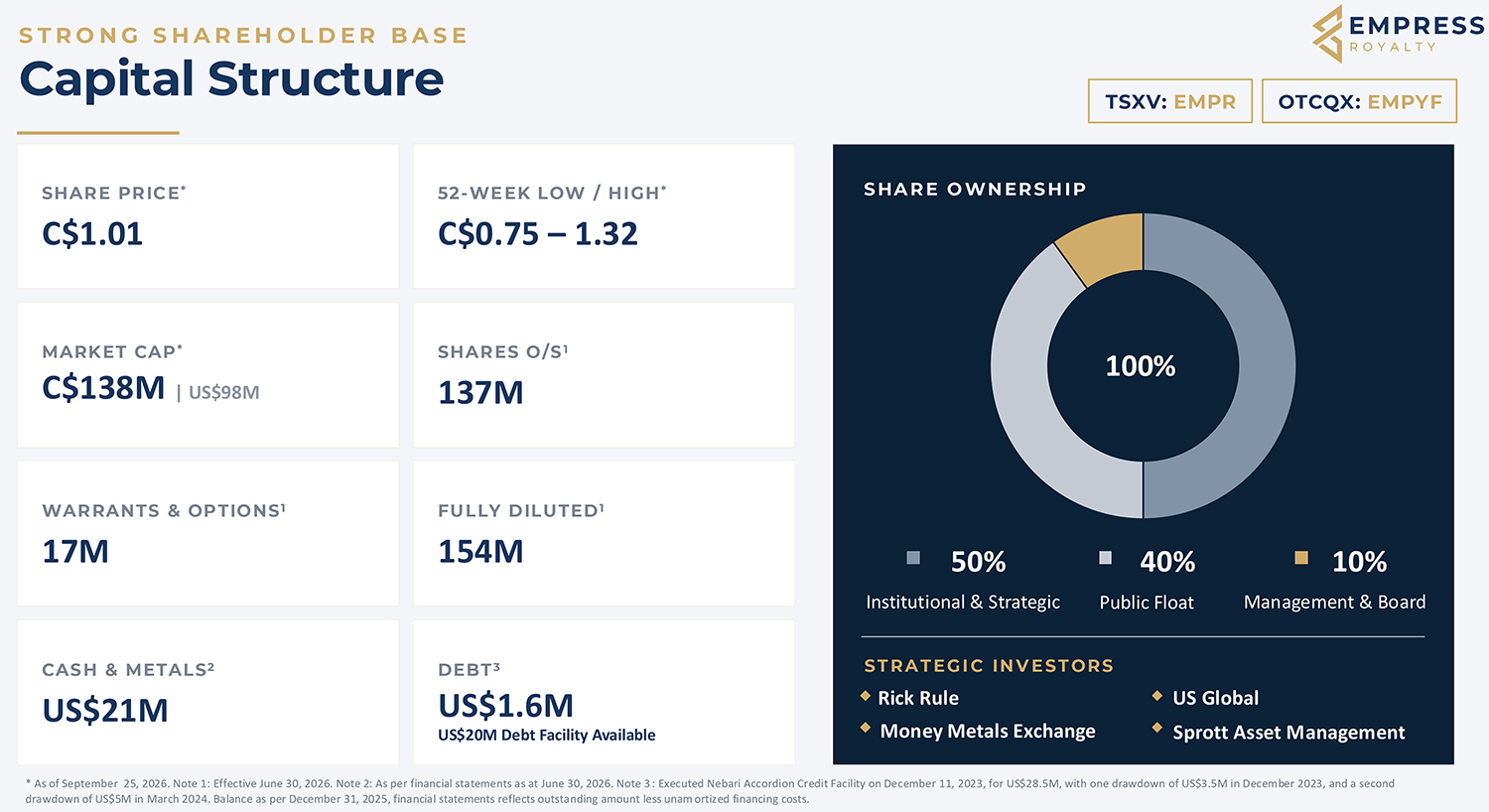
Institutional and strategic investors account for roughly 50% of the shareholder base with management and the board holding another 10%. Strategic investors include Rick Rule, US Global, Money Metals Exchange, and Sprott Asset Management.
Producing assets are generating cash flow while earlier-stage royalties provide additional upside… not to mention higher gold and silver prices strengthening economics across the EMPR portfolio.
Meanwhile, Tongon puts that evolution into perspective with Empress putting $62 million to work in a single gold stream.
The question now is no longer whether Empress can build a cash-flowing royalty and streaming business.
It’s how BIG that business can become.

As that story unfolds, a great place to further your due diligence is the company’s corporate website where you can view the portfolio, meet the team, and sign up for direct updates from the company.
View the most recent Corporate Presentation here.
Empress Royalty Corp. trades on the TSX-V under the symbol EMPR and on the US OTCQX under the symbol EMPYF.
— Resource Stock Digest Research
Click here to see more from Empress RoyaltyIMPORTANT DISCLAIMER & DISCLOSURES
Resource Stock Digest, as a publisher, is not a broker, investment advisor, or financial advisor in any jurisdiction.
Please do not rely on the information presented by Resource Stock Digest as personal investment advice.
If you need personal investment advice, kindly reach out to a qualified and registered broker, investment advisor, or financial advisor.
The communications from Resource Stock Digest should not form the basis of your investment decisions. Examples we provide regarding share price increases related to specific companies are based on randomly selected time periods and should not be taken as an indicator or predictor of future stock prices for those companies.
Empress Royalty has sponsored this report.
The information in this newsletter does not constitute an offer to sell or a solicitation of an offer to buy any securities of a corporation or entity, including U.S. Traded Securities or U.S. Quoted Securities, in the United States or to U.S. Persons. Securities may not be offered or sold in the United States except in compliance with the registration requirements of the Securities Act and applicable U.S. state securities laws or pursuant to an exemption therefrom.
Any public offering of securities in the United States may only be made by means of a prospectus containing detailed information about the corporation or entity and its management as well as financial statements. No securities regulatory authority in the United States has either approved or disapproved of the contents of any newsletter. Neither Resource Stock Digest nor any employee of Resource Stock Digest is registered with the United States Securities and Exchange Commission (the “SEC”): as a “broker-dealer” under the Exchange Act, as an “investment adviser” under the Investment Advisers Act of 1940, or in any other capacity. Resource Stock Digest, its owners, directors, and employees are also not registered with any state securities commission or authority as a broker-dealer or investment advisor or in any other capacity.
HIGHLY BIASED:
In our role, we aim to highlight specific companies for your further investigation; however, these are not stock recommendations, nor do they constitute an offer or sale of the referenced securities. Resource Stock Digest has received cash compensation from Empress Royalty and is thus extremely biased. It is crucial that you conduct your own research prior to investing. This includes reading the companies' SEDAR and SEC filings, press releases, and risk disclosures. The information contained in our profiles is based on data provided by the companies, extracted from SEDAR and SEC filings, company websites, and other publicly available sources.
Resource Stock Digest, and its owners, directors, employees, and members of their households may own shares of Empress Royalty. Therefore, Resource Stock Digest is extremely biased. Measures are in place such that no shares will be sold during the active awareness campaign.
HIGH RISK:
The securities issued by the companies we feature should be seen as high risk; if you choose to invest, despite these warnings, you may lose your entire investment. You must be aware of the risks and be willing to accept them in order to invest in financial instruments, including stocks, options, and futures.
NOT PROFESSIONAL ADVICE:
By reading this, you agree to all of the following: You understand this to be an expression of opinions and NOT professional advice. You are solely responsible for the use of any content and hold Resource Stock Digest, and all partners, members, and affiliates harmless in any event or claim. While Resource Stock Digest strives to provide accurate and reliable information sourced from believed-to-be trustworthy sources, we cannot guarantee the accuracy or reliability of the information. The information provided reflects conditions as they are at the moment of writing and not at any future date. Resource Stock Digest is not obligated to update, correct, or revise the information post-publication.
FORWARD-LOOKING STATEMENTS:
Certain information presented may contain or be considered forward-looking statements. Such statements involve known and unknown risks, uncertainties, and other factors that may cause actual results or events to differ materially from those anticipated in these statements. There can be no assurance that any such statements will prove to be accurate, and readers should not place undue reliance on such information. Resource Stock Digest does not undertake any obligations to update the information presented or to ensure that such information remains current and accurate.